


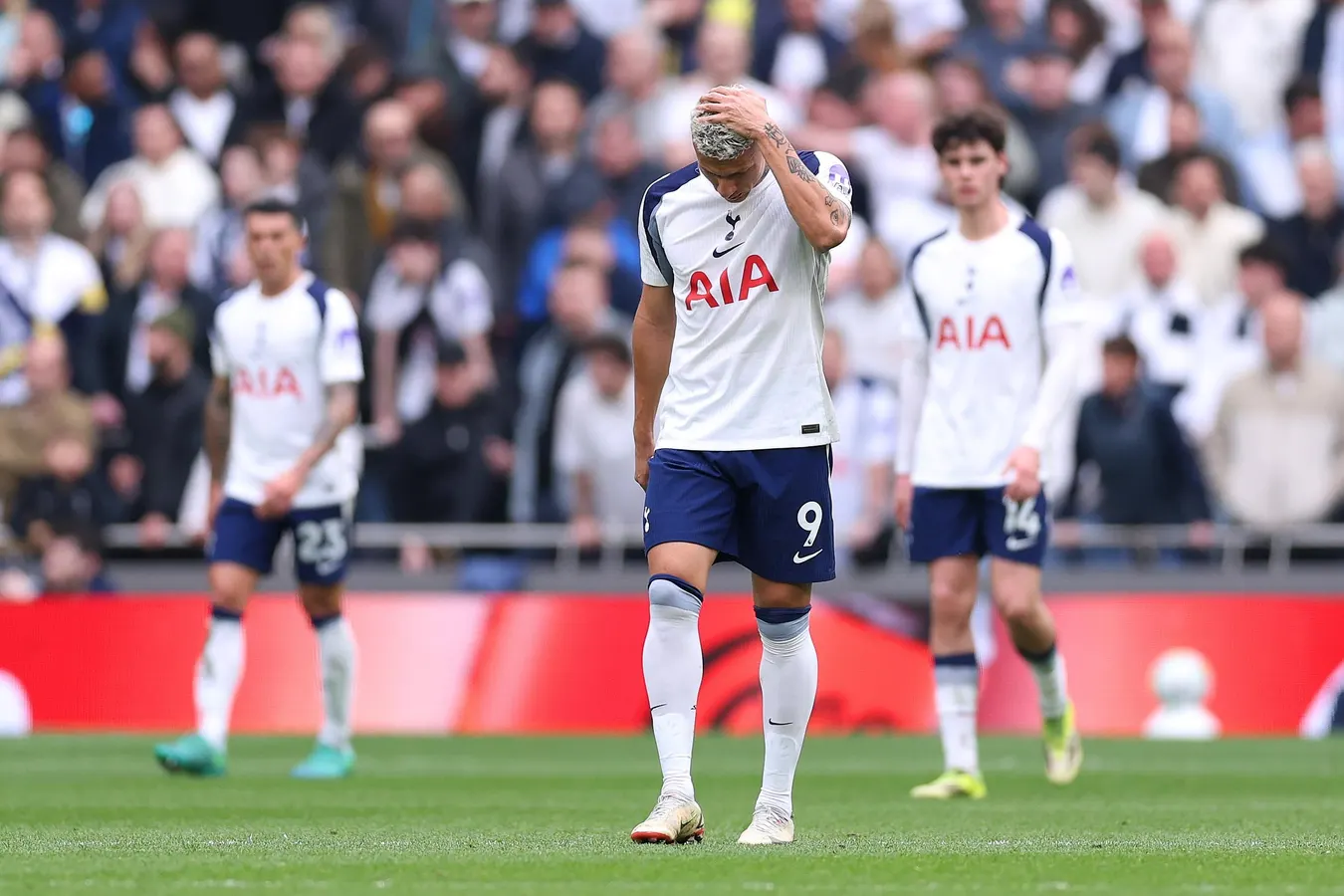

LONDON, ENGLAND – MARCH 22: Richarlison of Tottenham Hotspur looks dejected after conceding a second goal scored by Morgan Gibbs-White of Nottingham Forest (not pictured) during the Premier League match between Tottenham Hotspur and Nottingham Forest at Tottenham Hotspur Stadium on March 22, 2026 in London, England. (Photo by Ryan Pierse/Getty Images)
Getty Images
Manchester City and Tottenham each spent more than $400 million rebuilding their squads this summer. Five games into the season, one club sits atop the Premier League table with a perfect record. The other sits at the bottom with two draws and without a win.
If the transfer market alone determined outcomes, this gap shouldn’t exist. That it does — and that Manchester United’s parallel struggles complicate any easy explanation — says less about the price of players and more about what clubs are actually buying when they spend that kind of money.
Man City’s start to the post-Pep Guardiola era is the more surprising story, if only because succession moments like this one have historically been where dominant club cycles come undone. Replacing a manager of Guardiola’s pedigree typically invites a period of adjustment, if not outright decline, as a new voice tries to stamp its identity on a squad built around someone else’s philosophy.
Instead, City has opened with five straight victories, revealing that whatever structural advantages built the club’s recent dominance — recruitment infrastructure, tactical continuity among the coaching staff, a squad culture accustomed to winning — have proven more durable than the man who built them. This is made even more remarkable given how well Man City spent during the summer.
Tottenham’s situation is the inverse and far more damning. This isn’t a club spending big for the first time and encountering the normal turbulence of assembling a new group. Spurs are coming off back-to-back 17th-place finishes, hired a new manager in Roberto De Zerbi back in March specifically to stop this decline, made their largest-ever summer investment in the squad and have no European competition this season to divide attention or drain squad depth.
Every variable that typically excuses a slow start has been removed and the result has been worse, not better. When every structural excuse is stripped away and the outcome still fails to produce wins, the explanation almost has to sit somewhere deeper than results. It points toward the kind of entrenched organizational dysfunction that new signings can’t simply solve.
That’s the uncomfortable pattern this season is exposing: Transfer spending is not a reliable proxy for soccer intelligence. Clubs that treat it as one are learning that lesson in real time. Recruitment only pays off when it’s layered onto a functioning foundation. City has this strong foundation, but Tottenham’s results shows it does not.
Meanwhile, Manchester United’s parallel decline adds a third data point that undercuts any simple story about elite-versus-strapped spending. Manchester United remain one of the game’s wealthiest and most historically decorated clubs, yet they’ve managed just one win from their five matches.
Manchester United have spent extravagantly across multiple recent transfer windows under a rotating cast of managers. The persistent underperformance despite those investments have become almost its own type of Premier League storyline. What links Manchester United and Tottenham’s struggles isn’t a lack of resources or even a lack of talented players; it’s the absence of the connective tissue and a clear tactical identity.
Five games is a small sample size, but the coming international window will be a time for teams to reflect and reboot. Tottenham and Manchester United both have ample time to turn their seasons around. At the same time, these early results aren’t good. A top four finish is still in the cards for Spurs and United, but the gap with Manchester City remains very wide.















Leave a comment