


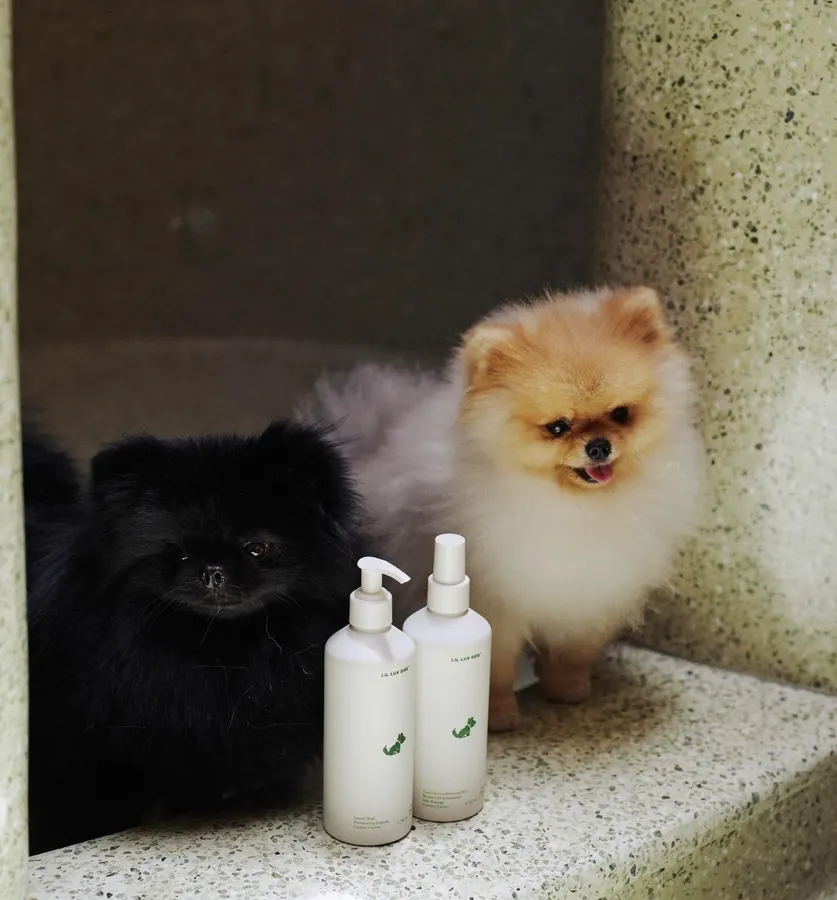

Lil Luv Dog, the US grooming brand founded by Cara Santana Leto and Stephanie Suganami, has chosen Selfridges for its first international retail expansion, bringing its fuller wash routine to the UK alongside products including dry shampoo and grooming wipes.
Lil Luv Dog
The latest beauty discovery at Selfridges is certainly not for you, but it could very well be for your best friend.
Lil Luv Dog, the US grooming brand founded by Cara Santana Leto and Stephanie Suganami, has chosen Selfridges for its first international retail expansion, bringing its fuller wash routine to the UK alongside products including dry shampoo and grooming wipes.
And its arrival on the beauty floor rather than in the traditional pet aisle tells us something interesting about where pet care, and the continued rise in pet spending, is heading.
Lil Luv Dog has deliberately built its retail presence outside traditional pet care, with existing stockists including Goop, Revolve and FWRD. The founders describe it as a beauty and lifestyle brand that happens to be for dogs.
The Pet Parent Premium
Our relationship with our pets had been evolving for some time, but COVID accelerated it considerably. Pet ownership surged, time together increased and the place our animals occupied within family life became even more pronounced. By 2022, I was writing about the growing commercial power of the pet parent and the opportunities emerging around it.
Four years later, the relationship is moving into a much wider range of categories.
Dogs Trust’s 2025 National Dog Survey found 94% of owners considered their dogs part of the family and 80% described their dog as their best friend.
Earlier this summer, I explored another expression of this through luxury hospitality. The global pet-friendly accommodation market is now worth more than $17.8 billion, with hotels extending everything from bespoke dining to personalised beds and dog butlers to four-legged guests.
What we are seeing in beauty is part of the same shift. The standards consumers apply to their own lives are increasingly being applied to their dogs. I spoke exclusively to Lil Luv Dog’s female founders, founders Cara Santana Leto and Stephanie Suganami.
Lil Luv Dog’s female founders, founders Cara Santana Leto and Stephanie Suganami speak to me exclusively as the product launches in Selfridges UK.
Lil Luv Dogs
“Our customer doesn’t become a different consumer when she shops for her dog,” Suganami tells me. “Her standards come with her.”
Ingredients, efficacy, fragrance, packaging and design therefore enter the purchase decision much as they do elsewhere in beauty.
And importantly, that customer may never visit a specialist pet retailer.
“Our customer might not walk into a pet store looking for a new shampoo,” says Suganami, “but she’s already at Selfridges discovering a new fragrance, serum or designer.”
From Pet Product To Beauty Routine
If there is one thing the beauty category knows, its how to package and sell routines.
Pet grooming has traditionally been more fragmented, and Lil Luv Dog is borrowing directly from beauty’s playbook.
The brand began with dry shampoo, addressing the period between baths, followed by grooming wipes and now liquid shampoo and leave-in conditioning mist. At Selfridges, those products become a fuller grooming routine rather than a collection of occasional purchases.
“The routine has always been the bigger idea,” says Suganami. “Routine changes the relationship from an occasional purchase to an ongoing behaviour.”
The company’s early numbers support the strategy. Lil Luv Dog reports 78% sell-through, a 30% repeat-purchase rate and a $75 average order value, with Cactus Dry Shampoo and the Discovery Pack currently its best-selling SKUs.
Santana Leto calls the model “companion shopping”: instead of asking customers to make a separate pet-care shopping trip, the brand meets them where they are already spending.
It is a useful principle for retailers more broadly. Stores may be organised around categories; consumers increasingly shop around their lives.
Why Selfridges And Why Britain?
Selfridges offers Lil Luv Dog something beyond access to an affluent customer: discovery.
“We always have maintained that our brand is a clean beauty brand for dogs and our consumer is someone who values premium and prestige beauty and wellness,” says Santana Leto. “I cannot think of a more synergetic retail partner than Selfridges.”
The founders also see strong similarities between British and American pet parents.
“What has shifted in the US is not an American phenomenon, it’s actually a generational one,” says Santana Leto.
Younger consumers delaying traditional life milestones, changing definitions of family and placing greater emphasis on wellness have helped reshape spending around pets on both sides of the Atlantic.
A New Growth Category For Beauty?
Beauty retail is hardly short of brands. Finding genuinely incremental categories is more interesting, and perhaps prestige pet care could be one.
Beauty businesses have already begun testing the boundary. Ouai (with Fur Bebe) and Aesop (with Animal) are among brands that have created products for pets. Lil Luv Dog takes the idea further by building the entire proposition around pet grooming while using beauty’s language of formulation, routines, efficacy and design.
“I don’t think being expensive for the sake of being expensive is interesting,” Suganami says. “Making something demonstrably better: safer ingredients, better performance, better experience is interesting. Premium only works if the product earns it.”
Santana Leto goes further, arguing that pet spending is becoming increasingly protected even as consumers scrutinise other discretionary purchases.
“We don’t see our dogs as tangential to our life,” she says. “They are, in fact, so much of our life.”
The commercial opportunity sits somewhere between those two points: deep emotional commitment from the customer, but a product that still has to perform.
Follow The Customer, Not The Category
With hotels redesigning luxury experiences around dogs, the rise of pet jets and fashion and lifestyle brands continuing to embrace our faithful friends, premium pet products and experiences have a growing place in retail, certainly not tucked away in a traditional pet category, but alongside the brands, products and experiences their owners already value and covet.














Leave a comment