


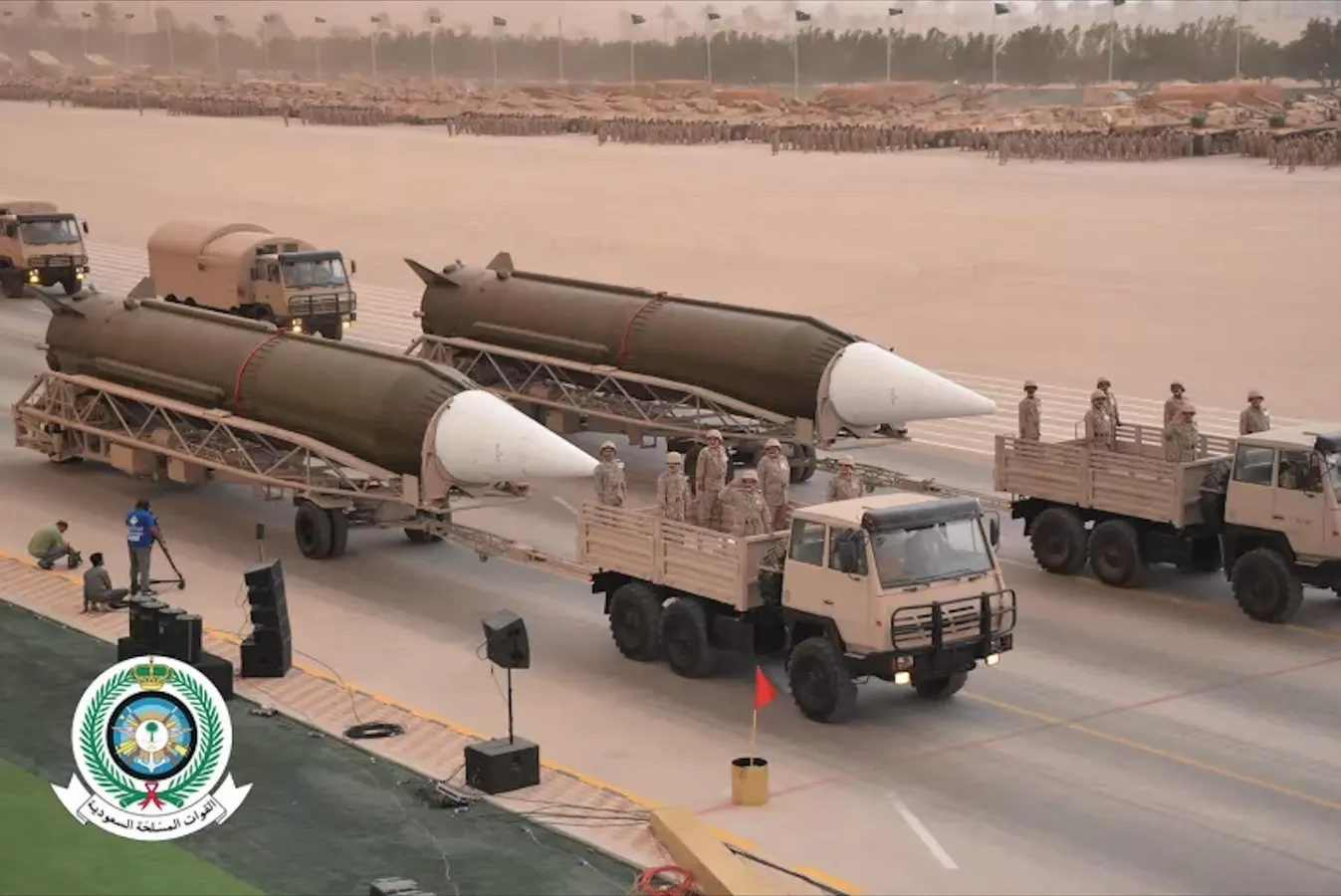

Saudi Arabia’s Chinese-made DF-3A ballistic missiles on display at a military parade on April 29, 2014.
Armed Forces of Saudi Arabia
Footage from social media and statements from both Yemeni government and Houthi officials indicate that Saudi Arabia has fired a Chinese-made ballistic missile into Yemen, The Wall Street Journal reported Wednesday. If conclusively confirmed, the move would mark the first-ever time the kingdom fired one of its ballistic missiles in combat. While clashes with the Houthis have escalated in recent weeks, it’s plausible that Riyadh fired the missile to send a message to the group’s main backer, Iran.
Cellphone videos from Yemenis shared on social media show the fuselage and parts of a Chinese-made Dongfeng-15, including its intact “DF-15A” designation. The DF-15A warhead is designed to separate in flight, so it’s unclear where it ultimately landed or what, presumably fixed, target it was aimed at.
Saudi Arabia wasn’t hitherto known to have acquired DF-15 short-range ballistic missiles. However, it wouldn’t be surprising. While its Western partners refused to sell it ballistic missiles, the kingdom has turned to China for these weapons since the 1980s, when it acquired liquid-fueled DF-3A intermediate-range ballistic missiles. The order came in the latter stages of the bloody Iran-Iraq War, when both sides were building up ballistic missile arsenals to hit each other’s cities. Riyadh first paraded these missiles in public in 2014. Unlike Iran, which has long prioritized its ballistic missile arsenal over other capabilities, Saudi Arabia and most Middle Eastern states are much more discreet about their respective ballistic missile arsenals.
The DF-3A has an approximate range of 1,860 miles but isn’t all that accurate, which makes sense given that it was designed to carry nuclear warheads. In 2007, Saudi Arabia reportedly purchased the more accurate but shorter-range DF-21, which can still hit targets about 1,000 miles away. The DF-15A SRBM Riyadh may have used against Yemen has a more modest range of approximately 370 miles.
Why Saudi Arabia chose now to use ballistic missiles in Yemen isn’t clear, although there are conceivable reasons. The kingdom boasts an advanced Western-equipped air force replete with sophisticated F-15SA and Eurofighter Typhoon combat aircraft. These Saudi jets are also armed with standoff missiles capable of hitting distant targets, including the Storm Shadow and AGM-84H SLAM-ER cruise missiles, with ranges of 150 to 170 miles. The Saudi Air Force is believed to have used the latter against the runway of Yemen’s Houthi-controlled Sanaa International Airport in July to block an attempt by the group to establish an air bridge with its patron in Tehran. Such weapons let fighter jets strike distant targets while staying safely out of range of enemy air defenses.
It’s therefore questionable why Riyadh chose to use one of its ground-based surface-to-surface missiles in Yemen. The recent escalation in that country and the region may well have compelled Riyadh to signal its willingness to respond more forcefully. Since the July airport standoff, the Houthis have ramped up missile and drone attacks against the kingdom, blockaded Saudi shipping in the Red Sea, and advanced down Yemen’s western coast against the Saudi-backed internationally recognized Yemeni government. Furthermore, in another dangerous sign that Saudi Arabia finds itself in a pincer, its East-West oil pipeline came under attack by drones launched from Iraq to its north on September 11.
Most recently, Saudi Arabia said it shot down a Houthi drone south of Mecca on Tuesday evening, marking the second time the group targeted that Islamic holy city since 2017. The Houthis deny doing so, claiming on Wednesday that they shot down a Saudi F-15 over Yemen’s Marib Governorate and forced Saudi F-15s and Eurofighters searching for the debris to retreat.
While it would make sense for Riyadh to use SRBMs after losing a fighter, or in retaliation over an escalation like an attack targeting Mecca, it’s crucial to note that the footage of the DF-15A surfaced before these incidents. Still, broader escalations like the Houthi takeover of Yemen’s western coast and the East-West pipeline attack, among other things, could have convinced Riyadh it needed to signal its unwillingness to tolerate such developments and provocations. After all, Iran’s powerful Islamic Revolutionary Guard Corps directed the Houthis’ coastal advance and oversaw Houthi attacks against Saudi Arabia, according to Reuters.
Using ballistic missiles would have conveyed Riyadh’s displeasure directly to Tehran more so than the Houthis.
Earlier in the Iran war, Saudi Arabia’s air force covertly retaliated against repeated Iranian attacks on its territories, as did the air forces of the United Arab Emirates and, later, Kuwait and Bahrain. Unlike these smaller Gulf states, Iran has considerable strategic depth. So, while Gulf air forces can only hope to hit Iran’s coast if they want to evade its air defenses, Iranian SRBMs and cheap Shahed drones can hit any part of their territories with comparable ease. Kuwait has found itself particularly vulnerable to such attacks in recent months.
Decades ago during the Iran-Iraq War, Iran’s much greater landmass worked to its advantage when it came to missile exchanges with its western neighbor, which possessed a much larger arsenal of Soviet-made Scud missiles at the time. When Tehran acquired Scuds of its own to hit back, they only needed to travel about 90 miles from the Iranian border to reach Baghdad. Conversely, Tehran was out of range of conventional Iraqi Scuds, which needed to fly 290 miles to reach the Iranian capital. Baghdad devised the modified Al-Husayn variant of the Scud to finally enable it to target Tehran, which it did in the war’s final months. While the Al-Husyans had a smaller payload than regular Scuds, they still served as an effective terror weapon, causing many Tehranis to flee their homes.
Today, firing DF-15As into Yemen could be Riyadh’s way of telegraphing that it is prepared to strike deeper inside Iran than ever if Tehran continues to imperil its security and economy via militia strikes from its south and north. While DF-15As could only reach Iran’s coastal regions, the DF-3As and DF-21s have the potential to strike much deeper inside the country. Doing so could mark another dangerous escalation and possibly even give Iran a propaganda coup if one of these missiles causes civilian casualties, an inevitability if Riyadh fires them at a population center. In such an event, Tehran could escalate further via militias or even directly to cause greater and longer-lasting damage to critical Saudi infrastructure, cities, and energy facilities.
The regional stakes may never have been higher.















Leave a comment