


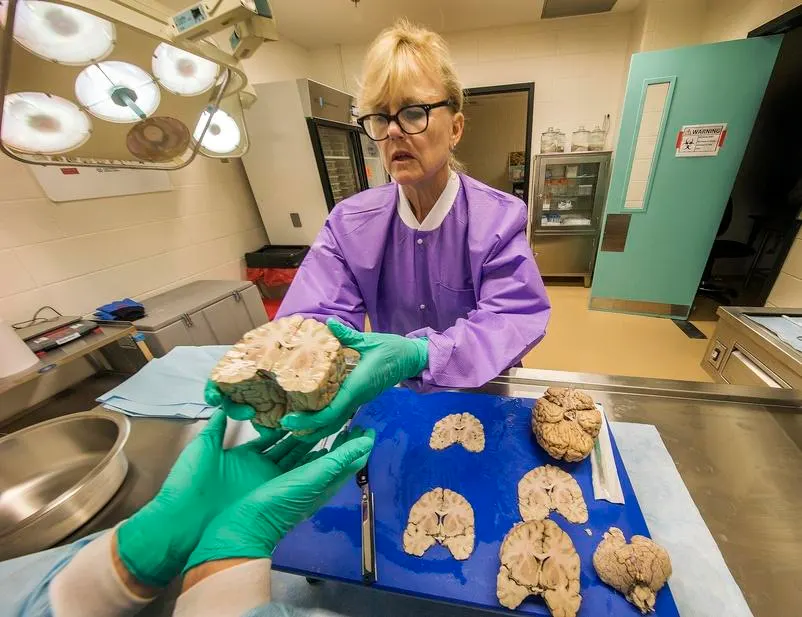

BOSTON, MA – JULY 12: Dr. Ann C. McKee, Director of Boston University’s CTE Center and Chief of Neuropathology at the VA Boston Healthcare System, does an autopsy on the brain of an NFL player who died in his 40s and donated his brain to to the VA-BU-CLF Brain Bank in the Jamaica Plain neighborhood of Boston, July 12, 2017. (Photo by Stan Grossfeld/The Boston Globe via Getty Images)
Boston Globe via Getty Images
For the past two decades, the CTE literature has had a “denominator problem”. Researchers have been able to count brains with tau protein deposits in the depths of regions of the brain in cortical sulci around small vessels. However, they have been unable to count the players those brains came from. The landmark 2017 JAMA series–chronic traumatic encephalopathy in 110 of 111 donated NFL brains —was a numerator in search of a population.
It told us the disease was real and, in donated brains, nearly universal. It never told us how common CTE is among NFL players, and it was repeatedly misreported as if it did.
The retrospective population-based cohort published today in The BMJ by Daneshvar and colleagues at Mass General Brigham, Boston University, and the Concussion & CTE Foundation is the first serious attempt to build the denominator. That, more than the headline number, is why it matters.
What The Study Found
The investigators assembled a roster of every man who appeared in at least one NFL game since 1949, then used CDC death-certificate data to identify 1,712 who died between 2008 and 2021. They narrowed the analytic window to 2016–2021, when the proportion of decedents whose brains reached the UNITE Brain Bank was highest.
Among the more than 330 NFL brains donated across the full period, 93% showed CTE. Placed over the population denominator, that yields a minimum prevalence at death of roughly 25% for the 2016–2021 cohort. The theoretical ceiling — assuming every non-donor had the disease except the 20 brains definitively cleared — is about 97%. The truth sits somewhere in between.
A secondary analysis could prove more clinically consequential than the prevalence figure. More than 90% of stage IV CTE cases carried a clinician-assigned dementia diagnosis. But roughly 40% of donors whose brains were free of CTE also had dementia, and the correlation at lower pathologic stages was weak. The point is this: pathology and phenotype are not interchangeable.
How Accurate Is This New Data and What Does It Add?
The reality is that this new dataset is better than anything preceding it, but with important limitations. The strengths are structural: a near-complete population roster, a national vital-statistics source for the denominator, an explicit bounding analysis rather than a single defining percentage, and unusual real world and honest implications about selection bias. This study should be viewed as the empirical successor to the modeling exercise Binney and Bachynski published in 2019, which placed the denominator closer to 10%.
The limitations of the new BMJ study are equally structural. Brain donation is symptom-driven and non-random, which inflates any brain-bank numerator; the resulting 25%–97% interval is honest and not clinically accurate for counseling any individual player. The denominator is itself conservative–an additional 215 non-donors had a neurodegenerative disease listed on the death certificate, and certificates systematically undercapture these diagnoses. Mean age at death among donors was roughly 66 years, meaning most careers ended before 2005, before helmet grading, kickoff redesign, targeting enforcement, or contact-practice limits. Nothing here characterizes a player drafted in 2020, and prevalence at death is not lifetime risk.
“In reading this study and interpreting its findings I think there are two points regarding which the results should be interpreted with some caution,” explained Uzma Samadani, MD, PhD, a neurosurgeon who has served as a consultant to the NFL from 2015-2019, and founder of Oculogica, a company that has developed a FDA-cleared neurodiagnostic known as SNAP for concussion. ”The first of these is that association does not imply causation. History urges caution. For many years the amyloid hypothesis prevailed as the predominant underlying cause for symptoms of Alzheimer’s disease. We don’t want to make a similar mistake in thinking that hyper phosphorated mislocalized tau necessarily causes symptoms of encephalopathy when that is not yet proven.”
“The second reason for caution in interpretation of these results is that many athletes or other people who have a single or few concussions may look at the media storm around this result and misunderstand the incidental association between brain injury and chronic neurodegenerative pathology. The vast majority of people in the U.S. who developed dementia have far more common risk factors such as hypertension, obesity, diabetes, social isolation, hearing loss, or genetic risk. Brain injury is still a less likely cause of dementia than all of these,”added Samadani.
“Nevertheless, people who sustain a single or few concussions may perceive themselves as having an irreversible neurodegenerative condition, when in fact they have a treatable pathophysiology. This misunderstanding can lead to despondency or failure to obtain treatment for other conditions,” she cautioned.
Youth American football player in full gear
getty
Screening Living Players: What Works And What Doesn’t
There is no validated diagnostic test for CTE for players that are currently competing or finished their careers. Clinicians should say so plainly, because a direct-to-consumer (DTC) market has grown up in the gap, namely blood biomarkers.
The DIAGNOSE CTE analysis of plasma p-tau217 published in July, 2026 is the definitive negative result: concentrations were higher in former players than controls but did not differ across traumatic encephalopathy syndrome (TES) certainty levels, and the authors concluded p-tau217 is unlikely to be useful for detecting CTE, while still retaining real value for ruling out amyloid pathology.
That is clinically actionable in the opposite direction from how it is usually pitched: in a symptomatic 60-year-old former lineman, a negative p-tau217 makes Alzheimer disease unlikely and redirects the workup. Neurofilament light chain (NfL) and GFAP remain nonspecific markers of axonal and astroglial injury–useful for research trajectories, but not for diagnosis at this time.
Tau PET Scans are another approach to making a diagnosis of a taupathy. Flortaucipir is FDA-approved for advanced Alzheimer neurofibrillary pathology, not for CTE. CTE tau patients differ, and imaging studies in former players show variable, low-to-intermediate uptake with group-level frontotemporal and medial temporal signal that overlaps the control range at the individual level; the same pattern holds for newer ligands such as MK-6240. Tau PET has no role in clinical decision-making, insurance determinations, or return-to-play, and ordering it may introduce overinterpretation.
What to do instead is to structure the player history around the TES research criteria, then aggressively pursue what is treatable. Obstructive sleep apnea, hypertension and cerebrovascular disease, hypogonadism, chronic pain, (opioid exposure), alcohol use, depression, and sleep deprivation are common in this population, tied to prior head injury, and produce exactly the cognitive and behavioral phenotype attributed to CTE.
Clinicians should then consider formal neuropsychological testing, MRI, and amyloid biomarkers when dementia is the question, with subsequent referral to a center with sports medicine and neurology expertise. The 40% dementia rate among CTE-negative donors in this study is the strongest available argument against therapeutic skepticism or even outright denial.
Blood Biomarkers In Acute TBI: What Actually Correlates
Two biomarker conversations get conflated, and separating them clarifies both. The chronic question–can a blood test detect an evolving tauopathy–remains unanswered. The acute question–can a blood test tell me whether this patient has an intracranial injury–has a usable answer, and it is the one that changes clinical practice during immediate evaluation of patients.
GFAP and UCH-L1 are now cleared across multiple platforms: the handheld i-STAT plasma cartridge in 2021, core-laboratory Alinity i and ARCHITECT assays in 2023, the bioMérieux VIDAS TBI test in 2024, and — most useful for emergency practice — a whole-blood i-STAT Alinity cartridge cleared in 2024 that runs at the bedside, extends the sampling window to 24 hours post-injury, and returns results in roughly 15 minutes. The 2024 ACS Trauma Quality Program best-practice guidance recognizes biomarker testing as a tool for reducing unnecessary head CT.
The performance profile is deliberately asymmetric, and misreading it is the main implementation failure. Reported sensitivity runs 96%–97% with negative predictive value near 99% for CT-detectable intracranial injury, but specificity to confirm or rule in pathology ranges between 34% and 41%; in the whole-blood clearance dataset, nearly 60% of CT-negative patients tested positive. As a result it has good sensitivity or functions as a “rule-out”assay.
In a patient who has mild neurological symptoms (Glasgow Coma Scale [GCS]13–15), a negative result safely spares imaging; a positive result means only that a brain CT cannot be avoided. It layers onto the Canadian CT Head Rule and New Orleans criteria–it does not replace them–and its highest value is where imaging access is limited or the decision rule is equivocal.
Serial measurement of biomarkers is more clinically relevant than any single value. GFAP and NfL trajectories track neurobiologic recovery after sport-related concussion; in one prospective cohort, a subset of athletes–disproportionately those with loss of consciousness (LOC)– showed elevations persisting at least four weeks alongside longer return-to-training times.
That is suggestive of a future role in return-to-play (RTP) decisions, not a rule today. CARE Consortium panels combining total tau, GFAP and NfL poorly discriminated RTP groups (AUC below 0.7), a group-level signal representative of individual-level “noise”. Symptom-based graduated protocols should remain the standard for now.
The correlation that does not yet exist is the one patients most want. No acute biomarker value has been linked to future tauopathy risk, and a full season of repetitive head impacts in football players produced no change in candidate CTE blood biomarkers according to a 2024 study.
We can measure the hit and, imperfectly, the recovery. We cannot measure accumulating risk. Until that link is established, a normal TBI panel is not reassurance about CTE, and an abnormal one is not a diagnosis of it.
BALTIMORE, MD – NOVEMBER 12: A close up side view of a Notre Dame golden / gold Schutt football helmet shining in the afternoon sunlight on Notre Dame cornerback Benjamin Morrison (20) during the Notre Dame Fighting Irish versus Navy Midshipmen game on November 12, 2022 at M&T Bank Stadium in Baltimore, MD. (Photo by Randy Litzinger/Icon Sportswire via Getty Images)
Icon Sportswire via Getty Images
Helmets: Useful, Oversold, And The Incomplete Variable
Modern helmets prevent skull fracture and severe TBI. They were never engineered against rotational acceleration, the variable most implicated in tauopathy.
The NFL/NFLPA laboratory grading program has produced measurable movement — top-performing models carry roughly 30% lower on-field concussion rates, though about 12% of players remain in “Not Recommended” shells for 2026.
Independent testing complicates the picture: University of Cincinnati published data in March, 2026 found the newest shells perform better overall but that position-specific models underperformed general models, with posterior impacts still the weak point. Facemask components were involved in 44% of in-game concussions last season.
FLOWERY BRANCH, GA – JULY 27: Kyle Pitts #8 of Atlanta Falcons runs through a drill while wearing a Guardian protective helmet cap during a training camp practice on July 27, 2022 in Flowery Branch, Georgia. (Photo by Todd Kirkland/Getty Images)
Getty Images
Guardian Caps sit in the same category. Laboratory work shows head-acceleration reductions of roughly 9% to 25% depending on model, impact site, and closing speed, roughly doubling when both colliding helmets are padded.
The league’s widely cited concussion reductions are bundled with rule and practice changes, and independent on-field studies have not consistently reproduced a benefit.
An inexpensive intervention with a plausible mechanism and a modest measured effect is worth mandating–it is not a solution. Equipment reduces the tail of the impact distribution; it does not reduce the number of repetitive head impacts. If cumulative acceleration is the driver, the highest-yield levers remain structural: fewer contact practices, fewer collisions per game, later first exposure with full contact waiting until the teen years.
Bottom line
“One in four” is evidence built on a real denominator, drawn from a cohort whose careers largely predate the modern era of rules and regulations. It should not be read as a roadmap or prediction for today’s players, and it should not be interpreted as reassurance.
For clinicians the key findings are the dose-response signal and the dementia data: reduce cumulative head impact exposure now, while evaluating treatable causes of symptoms as we wait for a reliable and reproducible biomarker that does not yet exist.















Leave a comment