


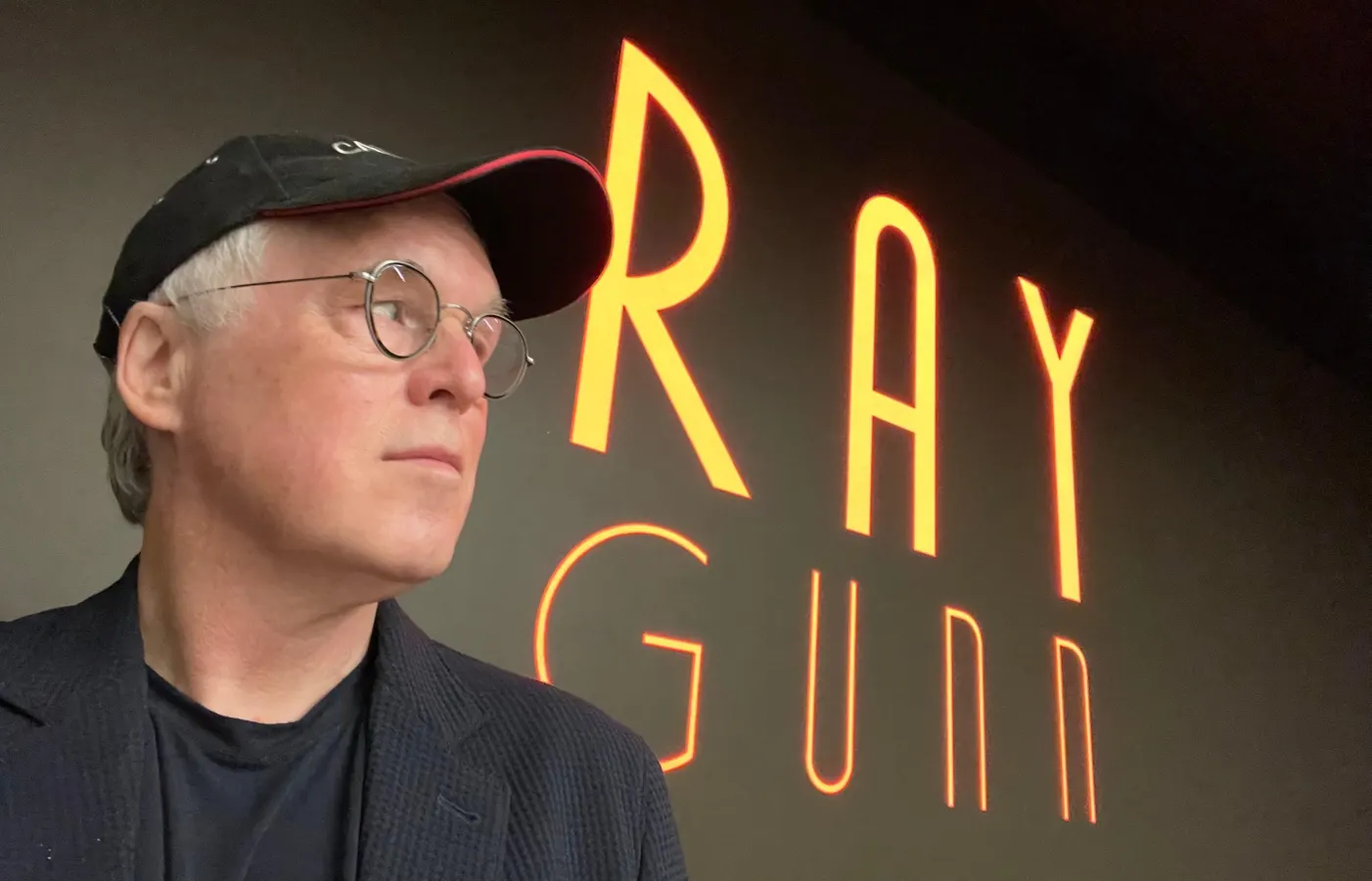

Since the success of Netflix’s Leo, The Sea Beast, Arcane, Love, Sex & Robots, and KPop Demon Hunters, Netflix has been dominating the animation game. In 2018, Netflix increased its spending on animation content to roughly $1.1 billion, including its own Studio space built in 2020. In 2023, Netflix announced its partnership with Skydance Animation, led by ex-Pixar’s John Lasseter. One of the projects attached to Skydance Animation was Brad Bird’s Ray Gunn, which was first signed in 2021.
Now, the animated neo-noir sci-fi mystery, co-written with Matthew Robbins, comes to Netflix on December 18.
In the upcoming Netflix animation, Ray Gunn is set in Metropia, a futuristic city with 1930s aesthetics, where aliens and humans live alongside each other. Ray Gunn (Sam Rockwell) is one of the last remaining human private-eye detectives and is struggling financially. With his alien colleague Eyera (Tom Waits), they work on whatever cases they can, but must fit Ray’s moral code. The duo find themselves on a case with the famous pop star, Venus Nova (Scarlett Johansson), and must solve the case before it’s too late.
Netflix invited select journalists to attend a behind-the-scenes look at Ray Gunn with Bird, composer Michael Giacchino, Art Director Wedell Luebbe, and VFX Supervisor Adel Abada at their Netflix campus in Burbank. Here are some fun tidbits from the event.
Ray Gunn
Skydance Animation
Brad Bird has been dreaming about Ray Gunn for over 30 years.
Bird, who wrote and directed Disney’s The Incredibles, Disney’s Ratatouille, and WB’s The Iron Giant, initially conceptualized the idea from the 1989 television film Peter Gunn and the sound from the B-52’s song, “Planet Claire.” He’s been a fan of film noir and knew he wanted to create a story that celebrated it – citing The Maltese Falcon, Chinatown, and The Big Sleep as influences. It was shelved later in the 90s as Bird began directing more and more movies.
After signing with Skydance Animation, Bird brought Ray Gunn back from the shelf and finally worked on it. He says during the event, “One of the hard things about having the idea for so long is that I haven’t talked outside of the group making the film for years, so I basically lose my train of thought.”
He admits he didn’t think it would get made because he’s tried over the years to have it made. He accepted the reality that the project was dead until an opportunity came up to make a new, original film – and he brought out Ray Gunn again. He describes finding the script again: “I took the thing out of the Raiders of the Lost Ark ending – where he goes to the warehouse and opens the crate to pull it out.”
Ray Gunn’s original dialogue has changed over the years, but the overall vision hasn’t.
Over the past 30 years, culture has changed so much, and so has dialogue. Like every project, Bird has had to change a few things, particularly dialogue and lines. It’s still the same movie. Bird explains, “Rewriting a line that somebody says or just barely getting it under the wire – there were those kinds of changes, but fundamentally – no. It was stuff that people are going to think is really current. It was a long time ago; it was just either ahead of its time or pessimistic about where we’re at.”
He shares, “I don’t know how much [the script] had changed because it had been sitting there for 20 years or so. The story is the story. The characters are the characters. It’s not like anytime you write a story, you find better ways to say things, or this information needs to be in the film is actually better here. You do that kind of stuff all the time.”
Though several film noir-based animations have come out in the past few years, it didn’t affect him if his movie had it too. He had these plans years ago. He knows people are going to think he’s reacting to or pulling from these other animated films when, in fact, it was written in the script that way long ago.
Ray Gunn concept art
Skydance Animation
Bird brought Award-winning composer Michael Giacchino on board for the project.
Bird and Giacchino have worked together six times (including Ray Gunn) since The Incredibles in 2004. Since then, they’ve worked together on Ratatouille, Mission: Impossible – Ghost Protocol, Tomorrowland, and Incredibles 2. Giacchino read the script in 2009 and wanted to work on this with Bird.
“It’s always the best,” Giacchino says of Bird. “It’s the highlight of my year when I look and see on my schedule that there’s going to be a Brad Bird film coming up!”
Bird says the most fun part of the process is creating the film, but the scariest is “ripping out this music that has sort of been band-aids on band-aids.” He knows Giacchino will do a great job on the music and keep it consistent.
“[Michael] makes [the process] into it beautiful and consistent,” Bird explains. “Just sitting there and watching the process happen is the highlight of every film that I’ve worked with him on. He dials right into the movie that we all want to make. As soon as I hear it with the film, I’m like, ‘That’s the way it had to be. It’s absolutely what I want.”
Giacchino drew musical inspiration from the radio show Yours Truly, Johnny Dollar, and composer Jerry Goldsmith.
Giacchino also listened to what inspired Bird to make the film, like the B-52s. But he also drew inspiration from what he grew up with, including old radio dramas like Yours Truly, Johnny Dollar and The Shadow.
“I listened to those incessantly,” says Giacchino. “A lot og my heroes worked on those things. Jerry Goldsmith worked on a lot of stuff like Chinatown.”
RAY GUNN – Barry Vogel (Alan Tudyk), Venus Nova (Scarlett Johansson), and Ray Gunn (Sam Rockwell). Cr: Skydance Animation ©2026
Skydance Animation
Within the last 30 years, there is also an infamous Ray Gun from Australia – the Australian breakdancing Olympian from the Paris Summer Games in 2024, who performed very odd dance moves that became viral. A small Easter Egg is surrounding her, so watch carefully when dancers are involved in a scene.
An animation supervisor introduced Kimbra’s music to Bird.
Bird credits a good friend of his who is also a “wonderful” creator and one of the animation supervisors on Ray Gunn for introducing Kimbra’s music to him. Bird did, and he really liked her voice. He thought she would be great to write the music for the main character, Venus Nova.
“When I realized that this was actually going to get funding, then I [said] we could have her write the Venus Nova songs,” Bird states. “Michael and I met her very early, and started talking about what kind of songs we needed for the movie. It was really interesting because I could be unbelievably specific. I could say, ‘I want you to write an earworm, but I want it to be slightly annoying. She came back and gave me this song that she would call – a banger.”
Venus Nova Concept Art
Skydance Animation
Ray Gunn and Venus Nova’s character design are based on no one person.
When asked if there were any inspirations for the main characters – particularly Ray Gunn, who looks a bit like the late Luke Perry, Bird says there isn’t a linear answer to that. He didn’t want to make them look exactly like a particular person because “the mistake that people have traditionally made in animation is when they have a lead human woman or man, they tend to idealize them to the point of blandness, and they’re not interesting to look at.”
“If you look at a lot of different faces, there are certain qualities of each different one,” Bird explains. “There are weird little things and imperfections. People have mentioned the most beautiful actress or the handsomest guy; the visual reasons for that are their imperfections. That’s what makes them.”
He mentions that when actress Ingrid Bergman first came to the U.S., Hollywood wanted to change her. American film producer David O. Selznick told everyone not to touch anything about Bergman and to let her stay exactly the way she is. He adds, “When we look at characters, we’re looking at several faces and liking different qualities on each one. It’s the things that are not perfect that make them interesting to look at – like Ray’s eyebrows are way big. [His eyebrows are like Montgomery Clift in his early films. Some other aspect of him is that he’s not the tallest guy. He’s not any taller than Venus Nova.”
He compares Ray Gunn and Venus Nova to the classic Hollywood power couple, Lauren Bacall and Humphrey Bogart. He states, “Lauren Bacall has all kinds of quirky things to her. Bogart has even more. He’s got a weird lisp. You know, he shouldn’t be a leading man, but yet – he totally is. That’s why movies are this mystery. There’s no science to it.”
Ray Gunn’s animation style has evolved with the times and technology.
Ray Gunn’s Art Director, Wedell Luebbe, says there were many permutations of the characters and story going back to the early-to-mid ‘90s, since Bird has had this idea for years. But the idea of Ray has remained consistent over time – a detective with a large overcoat and a very unique tie.
“[Ray’s look] evolved a bit and got a little more or less caricatured than Incredibles,” says Luebbe. “You can see it in the film – the characters still have a level of stylization.”
Ray Gunn has many different outfits.
Unlike the animations that have the characters wearing the same outfit in every episode, the team thought about everything that can change from a person on a day-to-day – even within the day. VFX Supervisor Adel Abada reveals that Ray had about 10 different outfits – Venus has even more!
“[Ray’s] hair had different groom variations and different skin variations,” Abada details. “Brad always talks about realism [and being] tangible. So if a character goes through a fight, he gets disheveled hair. If he gets wet walking in the rain, he should feel wet. So all of these had to be created separately, then combined as presets. So we had up to six or seven presets on this guy with that level of variation.”
Ray Gunn
Skydance Animation
Veronica Lake and Lauren Bacall heavily inspired Venus Nova.
Though Bird says their main characters draw on a variety of inspirations, Luebbe and Abada used classic actresses Veronica Lake and Lauren Bacall as the source for Venus Nova’s look. Luebbe says, “Venus went through all kinds of permutations that look very different from what she ended up looking like.”
Venus also had multiple variations of outfits (23) and 14 groom variations – makeup/no makeup/light makeup – adding complexity to the character.
Luebbe notes, “Her half-open eyes are very much inspired by Lauren Bacall.”
Venus Nova’s costumes were futuristic 1940s
Designed by Skydance Animation Costume Designer Neysa Bove, Venus Nova’s outfits were meant to look like they were from the 1940s but with a futuristic twist. Brad gravitated toward this look, adding motifs seen in “streamlined moderne product design.”
“The challenge with retro futuristic movies is always the same,” Luebbe says. “We’ll design something, and somebody will say, ‘That’s not period enough. So then we add something futuristic to it. Then we will add more period to it, and they say: ‘It’s not futuristic enough.’ You’re always balancing the futuristic and the period – yet you want to make it unique.”
Eyera concept art
Skydance Animation
Eyrea references the TV character Columbo.
With aliens in the picture, the animation team had the opportunity to go nuts with the caricature and design. Eyera started as half organic and half Terminator-metal. He gradually evolved towards an organic alien with spider legs – and a supersized coat.
“The reference was Columbo,” says Abada. “That’s what the costume designer made it look like. On the clothing side, he has a coat, jacket, shirt – three layers – and he’s a tripod that crawls everywhere, even on the sides of buildings.”
Brad loved the challenges of the three-legged design because, according to Luebbe, “it forces the animators to come up with a walk that becomes a unique sort of movement.”
Metropia Concept Art
Skydance Animation
The world is a mixture of Hugh Ferriss architecture meets horizontal streamlined modern architecture – with film noir lighting.
Hugh Ferriss was a 1920s architect, best known as the prophet of “Metropolis” for his skyscraper designs. Because of Ferriss, many cities had zoning laws limiting how tall a building could be, since tall buildings left the ground floor in darkness. That’s where they got the idea to create this world.
“[Ferriss’ designs] were very blocky,” Luebbe describes. “It’s very square, monumental, and tall. If you look at Streamline Moderne, it’s just the opposite. It’s horizontal. It is curved on the edges—a lot of circular ideas. With the Pan-Pacific, you can see the curves and the blades. So Brad melds those two together. We created these super tall buildings, but brought the streamlined modern design into the buildings as they reach the sky.”
Abada adds, “They’re all structured to build the city, so it’s a mile-high city that has its own challenges of how we were going to build this. The early designs gave us an example with some traffic system. We weren’t going to build the city as it exists physically and then move the camera around it. We approached it from the storyboard and built it specifically for each sequence because that was the most efficient and best way to allow Brad to work around it.”
Brad had envisioned the setting, Metropia, as utopian, which is typically shiny and bright – and mixed it in with the darkness of film noir to make Ray Gunn. Luebbe called it the 1939 World Fair’s View of the Future.
“So it was bright and positive, but underneath in the shadows is this film noir detective story,” Luebbe describes. “All of these things are happening underneath the surface. You’ll see that in a lot of the work. We show the combination between the utopian light and the seedy, darker underground.”
Metropia Concept Art
Skydance Animation
The Alien World was completely different.
Like in the real world, anything or anyone different is often discriminated against. In this case, it’s the aliens, but they still live amongst the humans. There are places in this world just for the aliens to live. The team got to have a bit more fun because it contrasted with the perfectionist world of Hugh Ferriss. Luebe says artist Dale Chihuly’s glassblowing art inspired them.
Abada says building the city was challenging because it had over 200 shots – “up to 300 shots.” They had to make it worth building, designing, and seeing the sequence multiple times. Abada says, “We’re building something massive for probably less than 20 shots, but it’s a Brad Bird movie. You gotta do it.”
The film Chinatown played a part in Ray Gunn’s lighting.
Chinatown played a huge influence on the film, which Bird referenced a lot. So the animation and VFX team created a lot of wide lenses. Bird was interested in lenses that went below 40 MIL. Abada says, “You look at any animated features; everybody wants to stay within the 50 MIL and above, which flattens the environment. So here we are on Ray Gunn and went all the way to 21-28 MIL. This was one of Brad’s favorite lenses.”
Brad Bird’s Ray Gunn premieres on December 18 on Netflix.





Leave a comment