


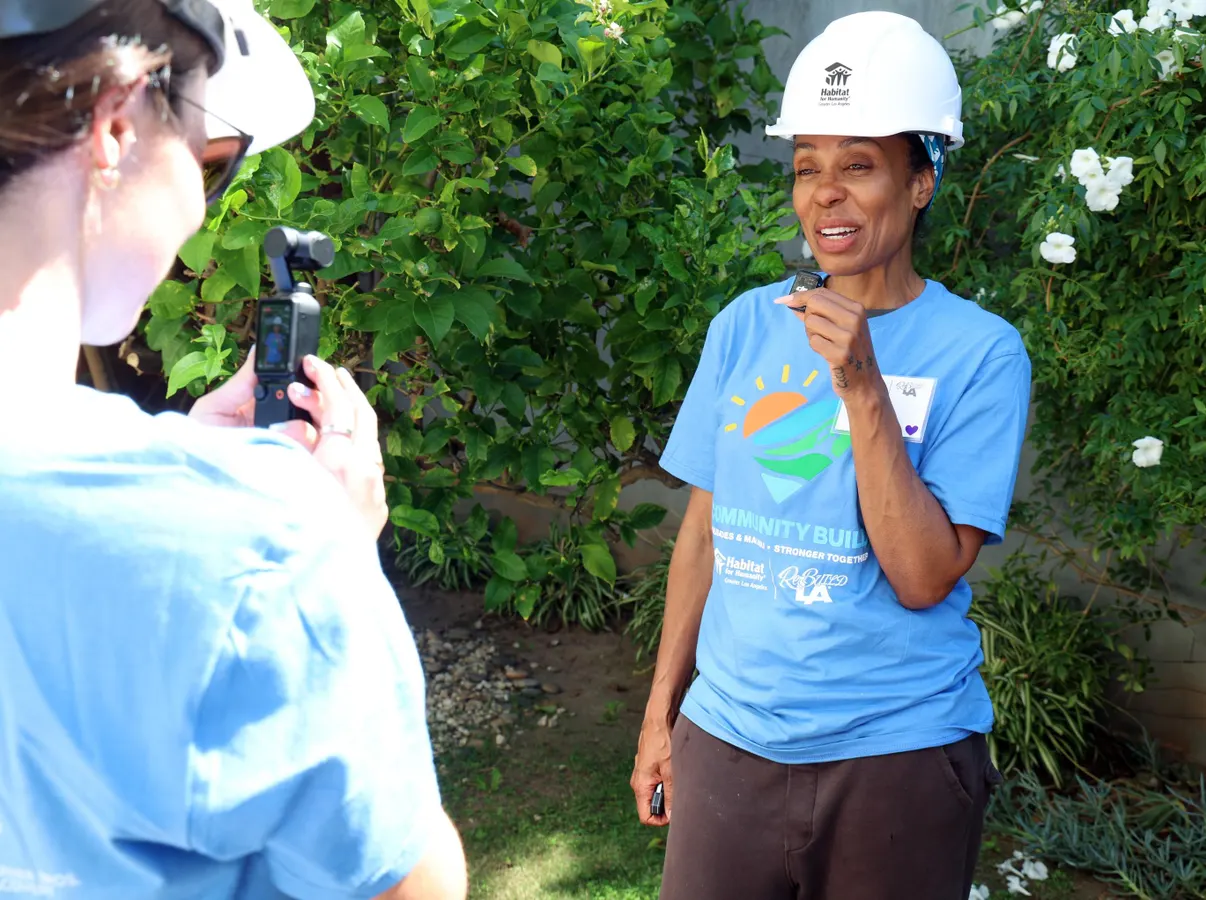

PACIFIC PALISADES, CALIFORNIA – SEPTEMBER 23: Karen Pittman participates in the Habitat for Humanity of Greater Los Angeles ReBUILD LA Community Build on September 23, 2026 in Pacific Palisades, California. (Photo by Phillip Faraone/Getty Images for Habitat for Humanity of Greater Los Angeles)
Getty Images for Habitat for Humanity of Greater Los Angeles
More than 18 months after devastating wildfires swept through Los Angeles, rebuilding continues, often away from the headlines, but with urgency for families still working to return home; thankfully, organizations like Habitat for Humanity of Greater Los Angeles are helping families start over securely.
Today, as part of its ReBUILD LA program, Habitat for Humanity of Greater Los Angeles launched a four-day community rebuilding effort in Pacific Palisades, bringing together more than 500 volunteers, residents, corporate and civic leaders, entertainment and media partners, construction professionals and community organizations to support wildfire survivors as they continue rebuilding more than a year after the Los Angeles wildfires. The initiative includes home repairs, landscaping, exterior improvements, wall framing and broader neighborhood revitalization.
Taking place from September 23 through September 26, the ReBUILD LA community initiative will mobilize volunteers and partners throughout Pacific Palisades in support of ongoing recovery efforts. During opening remarks at Wednesday’s build, Erin Rank, president and CEO of Habitat for Humanity of Greater Los Angeles, emphasized that disaster recovery does not end when public attention moves elsewhere.
PACIFIC PALISADES, CALIFORNIA – SEPTEMBER 23: Erin Rank, President & CEO, Habitat for Humanity of Greater Los Angeles (Habitat LA) speaks during the Habitat for Humanity of Greater Los Angeles ReBUILD LA Community Build on September 23, 2026 in Pacific Palisades, California. (Photo by Phillip Faraone/Getty Images for Habitat for Humanity of Greater Los Angeles)
Getty Images for Habitat for Humanity of Greater Los Angeles
“We’re here because recovery does not end, of course, when the headlines move on,” Rank said. “And here, more than 18 months after the fires, you see that Palisades and Malibu are starting to build back, and yet there are many survivors who are still trying to navigate the complicated recovery process.”
Rank said the organization is committed to helping survivors facing financial gaps that can make rebuilding difficult or impossible without additional assistance. “We’re focused on survivors who have a funding gap,” she said. “But without assistance from groups like Habitat and all of you volunteers, they wouldn’t be able to rebuild because their funding gaps, their insurance, and everything are just too large. But they’re longtime residents of this community.”
The initiative reflects a reality of disaster recovery that can be easy to overlook once the initial crisis has passed: rebuilding a community takes considerably longer than rebuilding public attention. “We knew from the very beginning that there was going to be a financial gap for families to be able to come back home,” Rank said. “We wanted to make sure that we were there for the long haul.”
According to Rank, Habitat for Humanity of Greater Los Angeles responded immediately following the fires and has since approved 160 households for assistance, with another 167 households in the pipeline that meet eligibility requirements for rebuilding support in Pacific Palisades and Malibu. However, she and her team realize the need extends beyond homes that were destroyed. Some standing homes sustained smoke damage that requires extensive interior work, including removing and replacing furnishings, flooring, and drywall, which the public doesn’t always see.
“There is a perception that everyone who lives in that area has the resources to be able to rebuild,” Rank said to me. “But Los Angeles is economically diverse, and there are a lot of people who don’t have the financial resources to rebuild their homes.”
For older adults, people with limited or no insurance, and longtime homeowners, losing a home can also mean losing a significant portion of their financial security. In some cases, losses extend to businesses and other income sources tied to the property.
Habitat LA’s approach focuses on helping homeowners rebuild on their own properties rather than relocate. Rank describes the home as more than a physical structure; it is a source of stability, safety, and financial security, while the surrounding neighborhood provides identity and connection.
PACIFIC PALISADES, CALIFORNIA – SEPTEMBER 23: Volunteers participate in the Habitat for Humanity of Greater Los Angeles ReBUILD LA Community Build on September 23, 2026 in Pacific Palisades, California. (Photo by Phillip Faraone/Getty Images for Habitat for Humanity of Greater Los Angeles)
Getty Images for Habitat for Humanity of Greater Los Angeles
Since the fires, the organization has helped thousands of survivors with immediate needs, short-term housing, financial assistance, and furnishings for temporary apartments. The organization has also helped survivors navigate the rebuilding process, from determining what can fit on a property and securing permits to construction and eventually returning home.
“People came to Habitat LA, trusting us as a builder, someone who knows how to build homes, yet doesn’t have a profit model and is willing to help them with everything from what’s going to fit on your site to getting your permits to building your house and moving back in, then getting furnishings,” Rank said.
The organization’s work is rooted in community participation. In recognition of Habitat’s 50th anniversary, Rank said the organization chose to mark the milestone not with a traditional celebration, but by doing what Habitat does best: bringing volunteers together to help their neighbors.
“So, in recognition of the 50th anniversary, instead of having a party, we decided to do what Habitat does best, and that is bring volunteers together from the community, from all different backgrounds, and to make a difference in their community and help their neighbors out,” Rank said.
PACIFIC PALISADES, CALIFORNIA – SEPTEMBER 23: Volunteers participate in the Habitat for Humanity of Greater Los Angeles ReBUILD LA Community Build on September 23, 2026 in Pacific Palisades, California. (Photo by Phillip Faraone/Getty Images for Habitat for Humanity of Greater Los Angeles)
Getty Images for Habitat for Humanity of Greater Los Angeles
That sense of connection has also shaped the grassroots response throughout the recovery. Block captains, neighborhood meetings, and phone trees have helped residents stay connected and share information. At the same time, organizations like Habitat for Humanity of Greater Los Angeles have worked alongside those existing networks to understand what residents need.
Among the volunteers on the first day was actress Karen Pittman (The Morning Show, Forever), who participated in the build alongside other volunteers. For Pittman, showing up offered a tangible way to respond to a disaster that has left many Angelenos feeling powerless.
“I’m grateful for the opportunity to volunteer. It makes me feel better in a time and climate where I feel so helpless,” Pittman told me. “Every minute I’m getting breaking news about something terrible happening, and coming and volunteering allows me to give back in a way that feels very meaningful to me. We have a responsibility to eachother.”
She continued, “I’m lucky to be in a family and community of people who do care. If I’m choosing a way to speak to my community and my friends and my family, though, and I’m personally doing that on my platforms. I’m taking time to make sure people know what I’m doing; I’m showing up. Also, I think it’s important for us to write a check to a charity organization if able. But it says a lot to show up and volunteer in person.”
The fires also hit close to home for Pittman. She says friends and crew members from The Morning Show were affected by the fires in Altadena, while others she knows throughout Los Angeles experienced losses. The experience, she says, reinforced her sense of connection to the city. “I don’t know anyone who doesn’t know someone who was affected by the fires. The devastation that happened, happened to all of us. But I know we can come together to rebuild.”
“I think that there’s something about a city that goes through a crisis together,” Pittman said, reflecting on the experience. She compared it to the sense of collective connection she witnessed in New York after 9/11, saying she believes Los Angeles can similarly come together and rebuild, even if the process takes time.
The four-day effort is structured around different volunteer groups and rebuilding needs. On the first day, corporate and civic partners are participating in critical repairs, landscaping, exterior improvements, and neighborhood revitalization. Entertainment talent participating included Pittman and Haley and Joel Osment.
The second day will bring together entertainment and media studio volunteers, executives, and talent to frame walls for two new rebuilds, work on landscaping, and hear directly from Pacific Palisades and Malibu survivors about their experiences.
On the third day, sports teams and corporate partners will participate in landscaping, wall framing, standing-home repairs, and community revitalization. Samsung will furnish one home with appliances, security, and technology as part of its partnership with the organization to distribute $1 million in appliances to wildfire-affected households.
The fourth day will bring additional volunteers to the site, along with a builder announcement and support for Pacific Palisades residents navigating the application process. Rank emphasizes that the four-day build is only one visible piece of a much longer recovery effort. “This is much bigger than the four-day event,” she said. “This is a long-term partnership.”
Corporate partners, she explained, are not simply serving as sponsors. They are part of the organization’s leadership cabinet and are involved in conversations about longer-term solutions, including financial tools that can help families navigate the rebuilding process.
That work also happens behind the scenes. Habitat for Humanity of Greater Los Angeles’ rebuild navigators answer calls from homeowners and survivors seeking guidance. Rank recalls one survivor who called approximately 60 times during the process and ultimately expressed appreciation for the patience and support she received.
For families navigating insurance, permits, financing, and the complexities of rebuilding after a disaster, having someone answer the phone can become an important part of recovery. Habitat also provides grants that, depending on eligibility and circumstances, may not require repayment, helping address some of the financial barriers survivors face. The organization’s work extends beyond Pacific Palisades, supporting survivors of the Eaton Fire in Altadena, where rebuilding needs are similarly complex and long-term.
For Rank, the central message is that recovery cannot be measured simply by how quickly homes go back up. “Recovery takes a long time,” she said. “These families are working so hard to get back home.”
The work of rebuilding is therefore about more than construction. It is about restoring a sense of belonging to neighborhoods transformed by loss. As volunteers arrive in Pacific Palisades, their work offers a visible reminder that recovery is still underway—and that rebuilding a city after disaster requires more than construction expertise. It requires sustained investment, community partnerships, and people willing to show up long after the cameras have moved on.
Rank’s invitation to Angelenos is ultimately simple: link arms with Habitat for Humanity of Greater Los Angeles and help families come home.












Leave a comment