


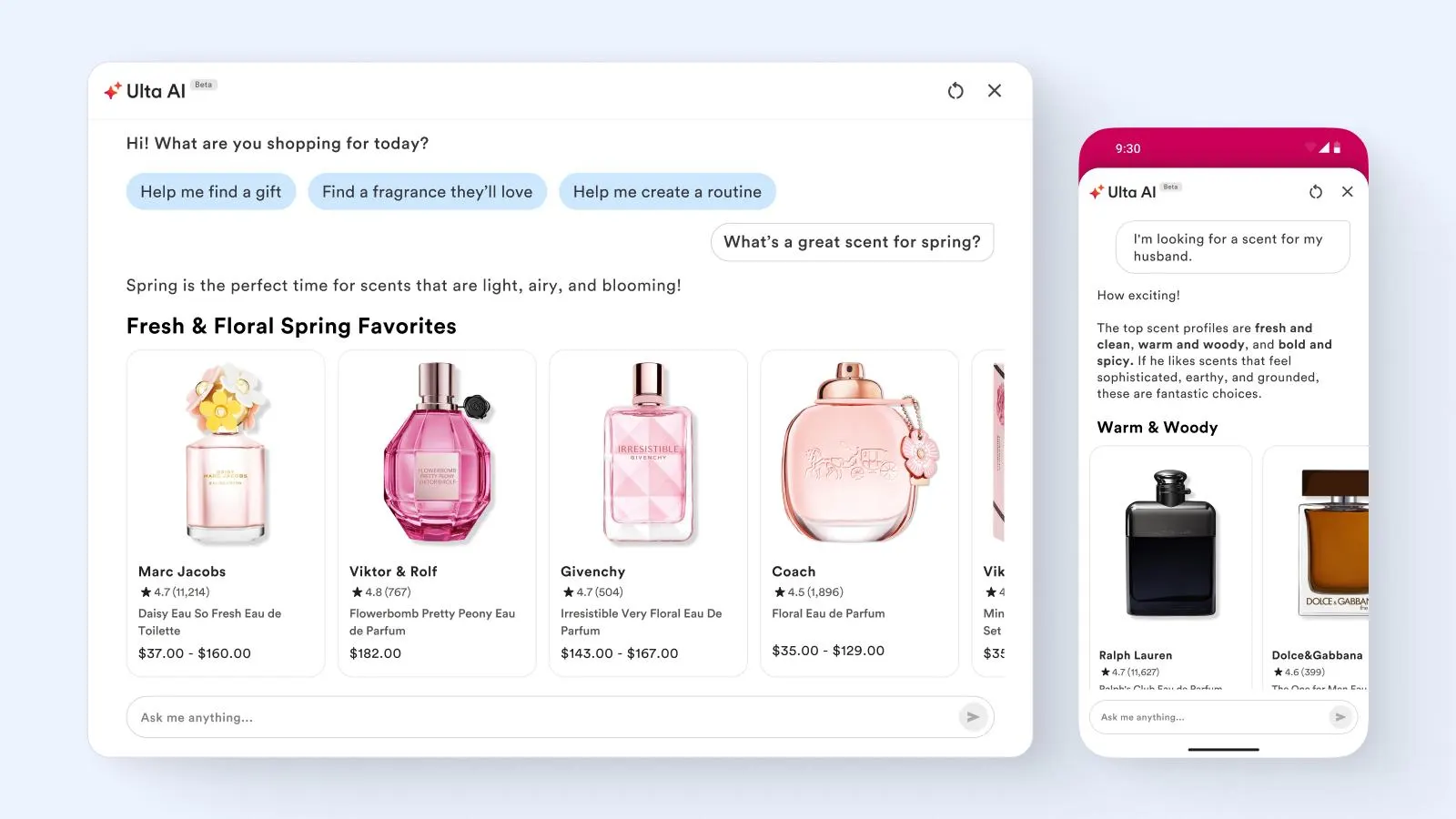

“The next era of commerce will be shaped by how well retailers turn AI into practical, scalable capabilities,” said Mike Maresca, Ulta’s chief technology and transformation officer.
Courtesy of Ulta Beauty
It’s poised not just to disrupt the customer relationship, but to disintermediate it entirely. McKinsey warns that agents increasingly mediate key consumer decisions, “reshaping how intent forms, how products are discovered, and where value pools can be found.”
The use of generative AI as a shopping assistant is reaching critical mass. Bain’s Consumer Lab finds that between 30% to 45% of American consumers now turn to agents, like ChatGPT, Perplexity and Gemini, for research, comparisons and product guidance.
Ulta Beauty isn’t sitting idly by waiting for external AI agents to make beauty decisions for customers. It is getting ahead of the curve in partnership with Google to embed Gemini directly into its Ulta.com website and Ulta Beauty app, as well as extend its product catalog across Google search, shopping and its Gemini AI-driven discovery platform.
Chief merchandising and digital officer Lauren Brindley added that the AI-powered shopping experiences will make “beauty discovery more seamless, personalized and shoppable wherever it happens.”
Battle For Dominance In Beauty
In the estimated $110 billion U.S. beauty and personal care market, where Ulta and Sephora compete for retail dominance, Ulta’s partnership with Google could give it a decisive edge. While Sephora has long leaned into AI to optimize the shopping experience, including personalized product recommendations, guided shopping, color matching and virtual makeup assistant, Ulta’s latest move is a big leap forward to where the shopping journey increasingly begins and bring it to its final conclusion at checkout.
Until now, the two have been running largely head-to-head in the beauty retail market. Sephora, part of LVMH’s Selective Retail Group, doesn’t break out results, but both chains operate at a similar scale in the U.S. Sephora has about 500 standalone stores, plus 1,100 Kohl’s shop-in-shops, while Ulta has over 1,500 stores.
Each hold about a 30% share in the prestige beauty market, which totaled $36 billion in 2025, according to Circana. But Ulta’s broader reach into the mass beauty and personal care market suggests it holds a larger share of the overall market.
Ulta generated $12.4 billion in sales during fiscal 2025, up 10% over previous year with a 12% surge in the fourth quarter. On the other hand, Sephora’s U.S. retail partner, Kohl’s, has struggled lately, with net sales dropping from $16.6 billion in 2023 to $14.8 billion last year. Sephora and Kohl’s announced their partnership in August 2022 after a year-long trial run.
Google’s Big Unlock
Ulta has garnered the loyalty of over 46 million customers who generate roughly 95% of its revenue. They will benefit from the greater ability to discover and compare products across Ulta’s current range of 30,000 products from approximately 600 brands—a scale that can overwhelm even the most determined beauty shopper. While 73% of U.S. loyalty members transact exclusively in stores, nearly 20% shop both in-store and online —and those omnichannel shoppers spend three-times more than store-only customers.
That makes the big unlock for Ulta from the Google partnership to be its ability to reach beyond its physical and virtual four walls. Ulta defines its target customer as the “beauty enthusiast,” someone with a “deep emotional connection with beauty.” Ulta estimates there are some 140 million Americans who fit that profile.
Google gives Ulta unprecedented access to that audience at the start of their shopping journey across search, shopping, YouTube, Lens and Gemini.
Ulta Beauty on Google Gemini
Courtesy of Ulta Beauty
And operating under the open-sourced Universal Commerce Protocol—a new standard that lets shoppers move from discovery to checkout— Ulta’s extensive catalog of products can be discovered, compared and purchased directly through Google’s AI-driven platform.
“Ultra Beauty engaged early with UCP because we see a clear shift in how guests are discovering and shopping for beauty, with AI playing a much bigger role in that journey,” Maresca said.
Google Cloud vice president Darshan Kantak added, “Our shopping agent connects the breadcrumbs of intent and inspiration to guide the customer journey. It skips traditional search filters and helps shoppers connect directly with products they love, providing a fast, tailored experience from discovery to checkout.”













Leave a comment