


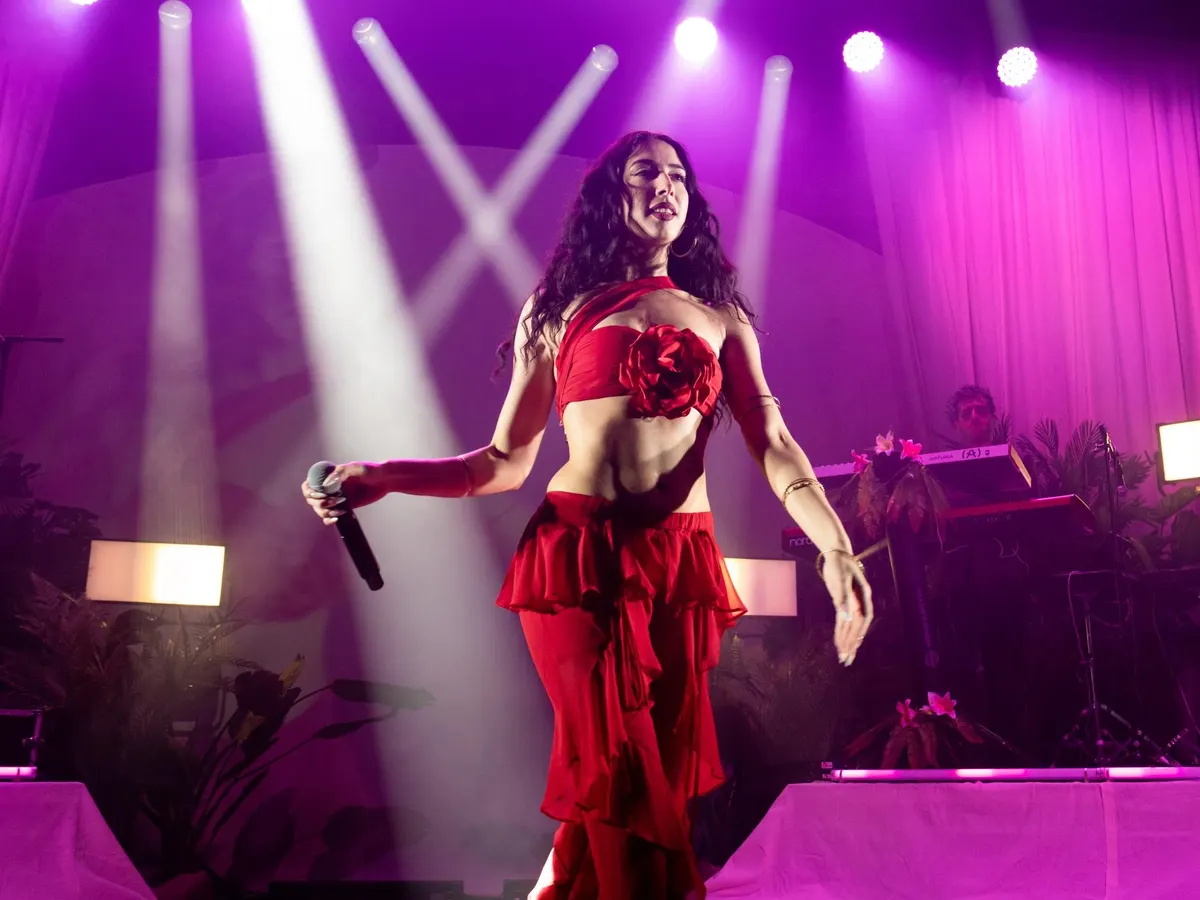

LONDON, ENGLAND – MARCH 2: Naïka performs during their COSPLAY tour at Outernet London on February 26, 2026 in London, England. (Photo by James Klug/Getty Images)
Getty Images
Naïka does not enter a room so much as she gathers it—pulling voices, textures, and histories into a shared orbit that feels at once intimate and expansive. It’s the same gravitational pull that defines Eclesia, her debut album, and now its global extension, the largely sold-out Eclesia Tour. There is a sense, listening to her speak and sing, that this moment is not a culmination but a beginning—one she has authored deliberately, meticulously, and, as she emphasizes, entirely on her own terms.
Naïka On Crafting A Living Expression Of Self
“Hello—how are you?” she laughs, mid-motion, toggling between languages, people, and energies with ease. Even in the in-between moments—greeting friends, introducing family, capturing fleeting memories on her phone—Naïka reveals the ethos behind Eclesia: connection as a living, breathing practice.
The album itself is not simply a collection of songs, but a foundation—“my debut album,” she says, pausing with intention, “I wanted it to be an introduction to who I am [for] the world.” That invitation resists neat categorization. It moves across continents and cultures, stitching together Haitian rhythms, French lyricism, and the elasticity of contemporary pop. “It was important for me to represent all the different things that make me who I am,” she explains.
“The album kind of makes you travel—you find Haiti in the Caribbean, and a song like ‘Soleil’ represents my French side. It’s just the blend of things that make up who I am.” While songs like ‘Barely Barely’ and ‘Ritual’ lean into lush Caribbean instrumentation and a slower, more sultry vocal cadence, where rhythm and desire intertwine with an ease that feels both instinctive and intentional.
Eclesia, Distance, And The Shape Of Belonging In Naïka’s World
That blend is not accidental—it is deeply lived. Born into multiplicity, Naïka doesn’t treat identity as a static label but as an evolving landscape. “Home is in other people,” she says, reflecting on the international network of collaborators who helped shape the album. “Not necessarily a place.” The production process—spanning time zones and continents—was not without friction. “It was tough… I’m not even gonna lie to you,” she admits. Yet that very tension became part of the album’s texture, reinforcing its central thesis: that belonging is less about resolution and more about movement.
Naïka stands on stage bathed in lights and drifting smoke, singing as she gazes into the audience, fully immersed in the moment of performance.
(Photo Courtesy of WOZNIAK)
If Eclesia is an offering, its reception is just as layered. Kiara, a multi-ethnic fan who shared her thoughts via DM, explained why Naïka’s music resonates so deeply with her:
“Being multi-ethnic shapes who we are—not only because of our background, but because of how the world perceives us and how we learn to navigate it. We aren’t monolithic, even when we share the same ethnicities; we express them in completely different variations. Watching artists like Naïka—alongside icons like Celia Cruz and Sade—shows us that identity doesn’t have to be flattened to be received.”
Naïka performs under glowing stage lights, singing into a microphone adorned with flowers as she fully immerses herself in the moment on stage.
(Photo Courtesy of JOEY JG)
The Balance Of Control And Surrender In Naïka’s Process
If Eclesia is a map, then Naïka is both its architect and its compass. Unlike many emerging artists who rely heavily on external creative direction, she insists on total immersion in her work. “I’m not just a performer,” she says plainly. “Everything… the visuals, the outfits, the sound—this is my baby. This is my art.” There is pride in that ownership, but also an awareness of its weight. “I need to learn how to let people take the reins sometimes,” she adds, smiling.
That sense of authorship extends beyond music into image, style, and storytelling. Fashion, for Naïka, is not ornamental—it is ancestral. “My biggest inspiration is my mom,” she says, her voice softening. “She always did her own thing… she was very unique.” Childhood memories surface: afternoons spent in her mother’s boutique, holidays in Haiti surrounded by bolts of fabric in her grandparents’ textile shop. “I would cut [material] up and make little outfits and put on fashion shows for my family,” she recalls. Today, those early rituals echo in her stage presence, where clothing becomes another language—fluid, expressive, and deeply personal.
Her father is never far from the orbit of it all, quietly stepping into her dressing room before showtime to ensure his daughter is grounded, prepared, and cared for. During the performance, he slips out more than once, watching from the wings with a soft smile—part awe, part instinct—as he takes in the artist she’s become.
Naïka performs in a matching black sequined costume under glowing green stage lights, singing as a live band plays behind her, enveloping the stage in an immersive concert atmosphere.
(Photo Courtesy of WOZNIAK)
The Emotional Language Behind Naïka’s Rise
Yet beneath the global scope and creative ambition, there is a quieter, more introspective current running through Naïka’s work. When asked how she navigates the pressures of rapid ascent, she turns inward. “I check in with my inner child,” she says. “When I get anxious or overwhelmed… I close my eyes and connect with her, see what she needs.” It’s a practice she has only recently embraced, but one that has become foundational. “We all have our inner child still inside of us… and that deserves to be checked in.”
That emotional literacy—rare and hard-won—grounds her in an industry often defined by acceleration. Even as she describes her career trajectory, there is a conscious effort to resist the pull of constant forward motion. “I think I need to take the time to realize it,” she admits. “Because I’m very much like, go, go, go.” Still, there is pride—earned, not performative. “I’m proud that I was able to get here on my own terms… even though it didn’t happen from one day to the next.”
Naïka And The Quiet Force Of Building Without A Blueprint
Her journey, which began with early releases like a reimagined Haitian cover in 2017, has been anything but linear. Without the backing of a major label, Naïka built her foundation independently, often without a roadmap. “No one extended a hand to me,” she says candidly. “I really figured this out on my own.” And yet, she is quick to reframe the narrative—not as isolation, but as collective belief. “I don’t want to exclude my team… they’re everything to me,” she emphasizes. “We don’t have the big budgets… but we have people who believe enough to roll their sleeves up.”
Naïka lies on the stage floor under warm orange and red lighting, eyes closed as she soaks in the moment during a live performance, surrounded by an intimate concert atmosphere.
(Photo Courtesy of Elizabeth B. Marsh)
Naïka And The Living Mission Of Eclesia
That ethos—resourcefulness over excess, intention over spectacle—now defines the Eclesia Tour, where each performance becomes an extension of the album’s core idea: gathering. “Guys, I love you,” she calls out to a passing group, half in conversation, half in performance. The line blurs easily for her.
And perhaps that is Naïka’s most compelling quality: her refusal to separate the artist from the person, the stage from the world, the self from the collective. Eclesia—a word that evokes assembly, congregation, coming together—feels less like a title and more like a mission statement.
“I knew it would get to this point,” she says, reflecting on her trajectory, eyes steady. “And, I know where I want to take it.” For Naïka, the journey is not about arrival. It is about expansion—of sound, of self, and of belonging itself.















Leave a comment