


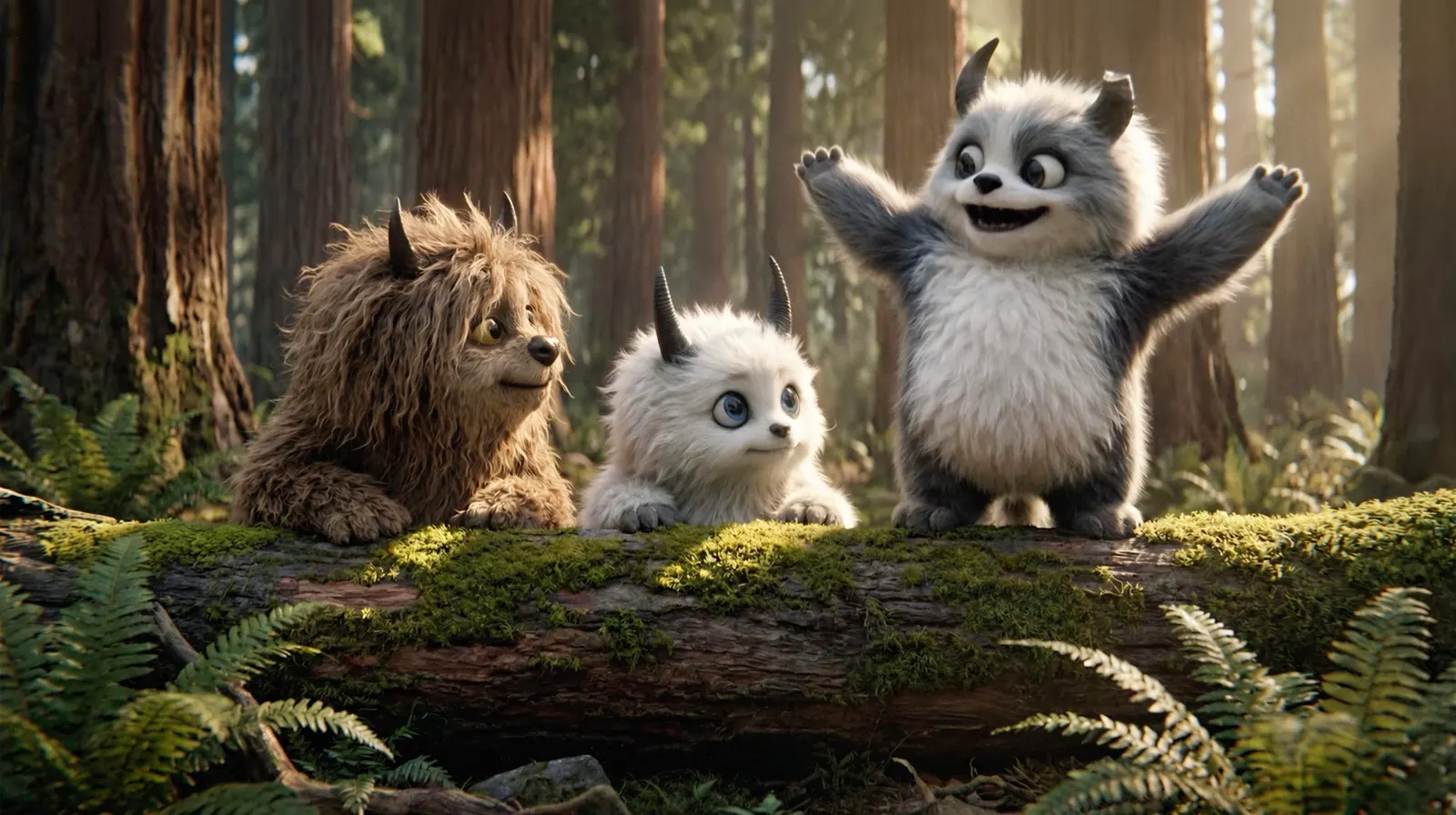

Critterz first-look footage presented to Studios, streamers and all major international distributors at the 2026 Cannes Film Festival. (Image: Courtesy of Critterz Film Ltd.)
Critterz Film Ltd
The most useful question about Critterz is not whether artificial intelligence can make a movie. It is whether a movie made with AI can survive the ordinary tests of filmmaking: character, story, taste, iteration, deadlines, buyers, audiences and the judgment of people who have seen technological promises come and go before.
That is where Critterz becomes interesting.
The animated family feature began as a 2023 viral short by Chad Nelson, a creative strategist at OpenAI, and has grown into a full-length film directed and co-produced by Nik Kleverov, with Nelson serving as creator and co-producer and a script by Paddington in Peru writers Jon Foster and James Lamont.
Critterz is also the first full production run of Woven, the AI-assisted production system developed during the making of the film and now being positioned for use beyond this one project.
Kleverov’s background sits at the intersection of design and emerging technology: his Emmy-nominated work on the Narcos title sequence for Netflix, and the Toys“R”Us spot widely credited as the first AI-generated commercial brand film, produced at Native Foreign, the Los Angeles studio he co-founded and where Nelson made the original Critterz short.
In other words, Critterz is not only a film. It is a production argument.
The Cannes Test
That argument was taken to Cannes this month, not to the festival’s main competition—which bars AI as a principal authoring tool—but to the market beside it. Buyers, distributors and producers were not being asked to reward a finished film. They were being asked to look at first footage, assess a method and decide whether this new production logic might travel.
In an interview, Kleverov told me the team set out to compress what would conventionally be a multi-year build (Pixar’s Toy Story took roughly four years) into something closer to a year, and that the broad timetable still holds.
The team has “a pretty substantial amount” of work already completed, Kleverov said, and Nelson confirmed by text that the production is aiming for a Q1 2027 release.
The claim is not that AI made the movie. It is that AI-assisted tools, organized inside a production system, allowed a smaller team to work at a scale usually reserved for much larger operations.
The Workflow Problem
That is also where the skepticism begins. A model can produce images, shots and options. A film production needs memory, continuity, taste, review, version control and accountability. It needs a way to know which version of a character is current, which shots are locked, which creative decisions have been rejected and who has authority to decide.
That is the gap Woven is meant to fill.
Kleverov describes Woven as a collaboration tool for professional filmmakers and larger teams. His shorthand is more concrete.
“Think about it as extra knobs and dials sitting on top of technology that we’ve developed,” Kleverov said.
Woven is not a replacement for the director, producer or artists, but an operating environment for collaboration, versioning, scene work and human judgment.
Speaking at a Brand Innovators event in Cannes, held in partnership with The Ankler, Nelson described what that human input actually looks like inside the workflow.
“We wanted to own everything about it—the characters, the script, the story, the world itself,” Nelson said. “Our artists feed the AI their own sketches, their own imaginative characters and visions of these worlds, and the AI uses that to bring them to life. It’s truly human authorship, augmented by AI. It would never exist without those sketches feeding the system.”
Not text prompts. Drawings. The artists’ own imagination, fed to the model as guidance rather than instruction.
A System Beyond One Model
That distinction became more important when OpenAI began winding down Sora, the video model around which Critterz had initially been built.
Sora’s web and app experiences were discontinued on April 26, 2026, with the API to follow on September 24. Kleverov described it as the moment Sora “exited the video model game,” and said it forced the team to prove Woven’s flexibility rather than merely claim it.
In a conventional production, a disruption of that scale could be fatal. Kleverov said the silver lining was that “every tech company in the world called us” as soon as the news broke, and the team kept moving.
Woven has since integrated other models, and the system is now being rolled out to a small group of alpha partners. The broader implication is that Woven’s industrial value may depend less on any single AI engine than on a usable production environment across a changing technical landscape.
That is also why Critterz is arriving at a particular moment. Native Foreign has been working with AI for nearly five years, Kleverov said, but 2026 still feels like year zero—the moment, as he put it, when “everyone has woken up” and “everybody is now moving full steam ahead with at least some sort of AI project.”
AI has moved faster in advertising, where shorter projects carry less risk. Long-form storytelling is a harder test. A commercial can work around the limits of a technology. A feature has to hold attention, sustain characters and make its world cohere across time.
Judged as a Movie, Not a Demo
Cannes gave the team its first real trial in front of the commercial side of the industry. AGC Studios showed first-look footage to studios, streamers and international distributors, while the producers also took part in the Cannes Next AI summit.
In an email exchange, Nelson described the market response directly. “We introduced Critterz first-look footage to studios, streamers and all of the major international distributors who near universally showed huge enthusiasm for distributing the project when it’s finished,” he said.
Kleverov’s account was more textured. There was surprise at the footage—“everyone watching was like, ‘Oh my God, I didn’t realize it was going to look this good and be this good,’” he said—but the revealing response was more practical.
It was a distributor noticing that one character might push the film from a G rating toward PG.
That small detail shows Critterz being judged not as a laboratory experiment but as a commercial family film, where a character choice can affect classification, positioning and distribution economics.
For Kleverov, the comment was a reminder that filmmaking is always surrounded by specialists who see different risks. “We’re so lost in our storytelling world and making the thing,” he said, “that there’s so many specialists and things to consider in the business.”
In an email, James Richardson of Vertigo Films, which co-produces the feature, said the conversation around AI at the festival had moved from argument to method, with the Cannes Next AI summit drawing strong engagement around Critterz.
Skepticism remains, and it should. Buyers will want to know about cost, copyright, labor, audience appetite, repeatability and whether Critterz can finish at the quality promised by its first footage.
But Kleverov said the industry’s posture has changed. After years of conversations, he now sees studios and partners beginning to move from talk to action. “They’re starting to put their money where their mouth is,” he said. Not all of it is an embrace of AI, he added, but there is now a clearer openness to it.
That is the real test for Critterz. Not only whether this team can finish this film, but also whether the method can be used by other teams that did not invent the system.
The Audience Test
Audiences will not care how many models, prompts, tools or review stages sat behind the finished image. They will judge Critterz by older criteria: whether it is funny, charming, moving, coherent and worth watching.
Kleverov’s ambition for that audience is plainly stated. “When people watch the movie, I just want them to watch a great film and not think about AI once,” he said.
Nelson, when asked the same question, reached for the historical parallel. “At the end of the day, what matters most is making a great film—crafted by exceptional artists and storytellers—so that the technology behind it becomes secondary, much as it did with the original Toy Story,” he said.
Toy Story arrived as a technological event before it settled into memory as a film. Its achievement was not that computer animation existed. It was that the film worked.
That is the standard Critterz is asking to be judged by. If it fails as a film, the method will be remembered as a stunt. If it works, its importance may be quieter and more durable.
It may not announce the arrival of “the AI movie.” It may show how AI becomes one more part of a production culture that has always absorbed new machinery, resisted it, fought over it and finally judged it by what appears on screen.
For now, the verdict belongs to a finished film that does not yet exist. But the more immediate question has already arrived: whether AI in filmmaking is moving from spectacle to method.















Leave a comment