




Malnutrition is set to explode due to a global fertilizer supply squeeze.
getty
Warfare in the Persian Gulf is hitting markets well beyond oil and gas. Disruptions near the southern Iranian coastal city of Bandar Abbas and the near-blockade of the Strait of Hormuz — through which roughly one-third of globally traded fertilizer moves — are forcing buyers to rethink sourcing strategies that had been established for decades. Fertilizer prices track the cost of natural gas, one of their principal production inputs, meaning energy shocks ripple directly into the agricultural markets.
Coupled with past dependence on Russian natural gas for European fertilizer production (Yara International, EuroChem, and Grupa Azoty), the result is a market where oil commands the headlines, but fertilizer supply is quietly becoming more urgent.
Why Fertilizer Flows Are Shifting Faster Than Oil Markets
Oil markets absorb shocks. Fertilizer markets do not.
Unlike crude, which trades on deep, liquid global exchanges, fertilizer moves through tighter, more regionally constrained supply chains. With logistics in the Persian Gulf snarled and endangered due to the conflict, rerouting is not seamless. The Strait of Hormuz is a choke point not only for energy, but for the agricultural inputs that underpin global food production.
The distinction matters. Oil disruptions trigger price volatility; fertilizer disruptions threaten planting cycles. For fertilizer-import-dependent economies such as India and Brazil, delays translate directly into higher food production costs and, ultimately, inflation that governments cannot easily absorb.
Global economic choke points at the entrances to the Red Sea and Persian Gulf threaten to upend routine global economic activity.
getty
The Houthi Threat to the Red Sea Corridor
The Strait of Hormuz is not the only choke point. Fertilizer moving through the Bab el-Mandeb Strait and the Suez Canal — the other main artery for Middle Eastern exports heading toward Asian and European markets — is now being rerouted around the Cape of Good Hope. This detour adds approximately 6,000 kilometers and up to ten days of transit time, a cost burden that falls hardest on the buyers least able to afford it.
Israel and Jordan occupy a peculiar position in this landscape. Both have some of the world’s richest deposits of potash and phosphate. Israel’s ICL, which operates the Dead Sea Works — the third-largest potassium chloride refinery on the planet — ships potash, phosphate rock, and specialty fertilizers such as potassium nitrate to markets across Asia and beyond. Jordan’s Arab Potash Company mirrors that model from its side of the Dead Sea, making it the Arab world’s sole potash producer. Both ship from Red Sea ports — Eilat and Aqaba, respectively — and sail north through Suez or south through Bab el-Mandeb. That geography gives them a structural advantage over Gulf producers, which have been throttled by the closure of the Strait of Hormuz. But with Houthi Ansarallah U.S. State Department terrorist-designated forces still active along the Yemeni coastline, this corridor is contested and insecure.
How Russian Producers Are Positioned to Benefit
Russia entered this crisis holding the structural cards. It accounts for roughly 20% of global fertilizer exports, with producers such as PhosAgro, Swiss-registered EuroChem, and Uralkali holding dominant positions across key nutrient categories. Industry groups with Kremlin connections are reportedly targeting a 25% share of the global market by 2030, with expansion concentrated in non-Western markets.
Russian companies sit at the center of the fertilizer trade. Some of the world’s largest fertilizer producers operate across jurisdictions increasingly divided by incompatible sanctions regimes. European regulators have tightened their scrutiny of Russian-linked inputs. Meanwhile, global demand continues to pull supply toward emerging markets, which are unconstrained by those rules.
The result is a fertilizer market duality. On the one hand, compliance with EU restrictions; on the other, expanding trade relationships in India, Brazil, and across Africa. The challenge is not merely legal — it is also logistical. Sanctions have forced companies to rebuild their financing, insurance, and shipping arrangements from the ground up. What began as sanction workarounds is hardening into permanent market architecture.
The demand side reinforces that trajectory. BRICS economies already account for approximately half of global fertilizer consumption. This is a built-in customer base that is structurally less sensitive to Western sanctions pressure. In this context, Gulf disruptions do not simply constrain supply. They redirect demand toward Russian producers capable of delivering via alternative corridors such as Baltic rail links, the Black Sea, and the Caspian. The global economic ties come apart. The world is polarizing.
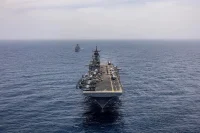
Iran’s small mobile navy of gunboats focusing on asymmetric strikes is perfect for global economic pressure while avoiding confrontations with the conventionally superior American Navy.
NurPhoto via Getty Images
Why Fertilizers Create More Durable Leverage Than Oil
Oil is fungible. Fertilizer is strategic.
While energy exports dominate national security briefings, agricultural inputs operate on a different and less forgiving timeline. A missed oil shipment can be replaced from spot markets within days. A missed fertilizer delivery can suppress yields months later, compounding quietly into food shortages and the political instability that follows.
Russia’s position in nitrogen markets illustrates this. The country produces roughly 25% of global ammonium nitrate and controls up to 40% of its trade, giving Moscow significant influence over a critical input for crop production worldwide. This leverage extends beyond pricing. Export restrictions, logistical prioritization, and bilateral agreements allow the Kremlin to shape supply availability in ways that oil markets, buffered by deep inventories and diversified producers, simply cannot replicate.
What This Means for Investors
The counterintuitive takeaway for investors is this: the most consequential commodity story to emerge from the Iran conflict may not be oil.
Fertilizer markets are smaller, less transparent, and more sensitive to disruption. That combination generates volatility, but also opportunity. Companies with diversified logistics networks and established footholds in non-Western markets are best placed to capture redirected demand. Russian-connected producers, sanctions notwithstanding, fit that profile. Their scale, resource base, and existing trade relationships allow them to move quickly when conventional supply routes break down.
Risks remain. Capacity constraints limit how much additional supply Russian and Arab producers can bring to market in the near term, even as demand rises. Arab producers are drawing their own conclusions, redirecting supply chains away from Gulf chokepoints and investing in rail corridors linking inland production facilities to ports far removed from the current theater of conflict.
A Quieter Crisis with Louder Consequences
The Iran conflict is reshaping global commodity flows in ways that extend well beyond energy. Russia built this advantage on scale, geography, and a decade of deliberate investment in markets Western capitals largely ignored. The current crisis is revealing how durable that position has become.
For policymakers and investors alike, the signal is clear: in an era of geopolitical disorder, fertilizer markets now carry weight comparable to energy markets — and deserve to be analyzed with the same urgency.















Leave a comment