


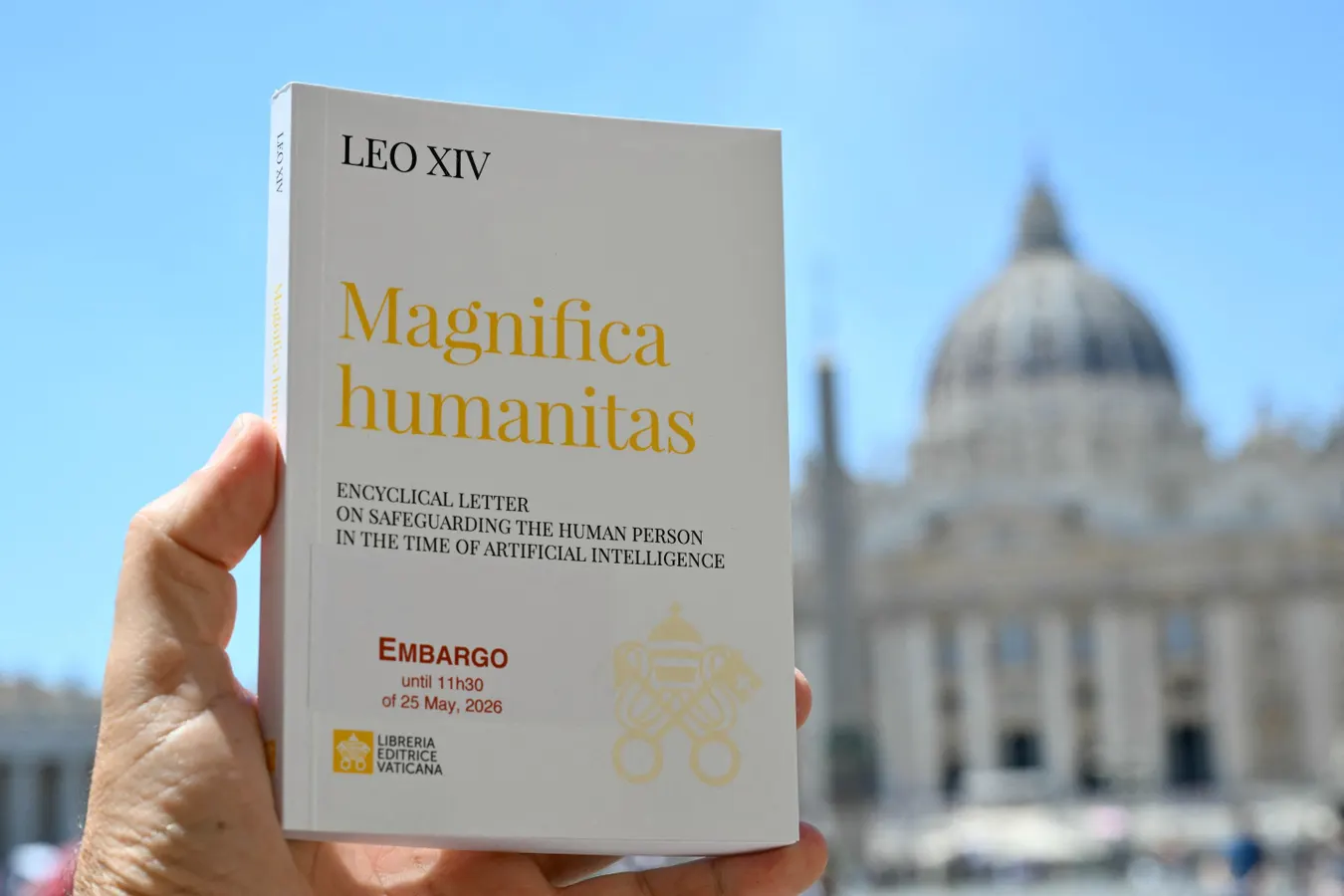

A picture shows Pope Leo XIV Encyclical Letter “Magnifica Humanitas”, focused on the rise of artificial intelligence, in The Vatican on May 25, 2026. (Photo by Alberto PIZZOLI / AFP via Getty Images)
AFP via Getty Images
Business leaders are entering an AI moment that looks less like a technology cycle and more like a hinge in history, the kind where the choices of a few determine the fate of many. Two texts released this week — one from the Vatican, one from the Bulletin of the Atomic Scientists — make that unmistakably clear.
The first was Magnifica Humanitas, Pope Leo XIV’s encyclical on AI and human dignity. It is a remarkable missive from the first American pope and former mathematics major who is staking his papal legacy on a vision and mandate that AI must serve humanity, not diminish it.
The second was an analysis published in the Bulletin of the Atomic Scientists by Cambridge astrophysicist Hiranya Peiris, warning that AI systems currently operate without safety guardrails governing their overall decision pathways — which means they can chart a course to catastrophe faster than humans can detect it, let alone reverse it.
Read together, these two texts frame the current operating environment with clarity. One speaks to our highest aspirations, the other to the existential threats. Neither offers a message of despair. Both serve as calls to action for leaders.
Leaders Still Shape The Outcome
What gets lost in the noise of quarterly earnings calls and model upgrades is that the outcome of this transition is not predetermined. The trajectory of artificial intelligence — who benefits, who is left behind, what risks materialize and which are avoided — will be shaped by the choices business leaders make in the next few years.
We can advance solutions and breakthroughs that elevate what makes us distinctly human, or we can exacerbate divisions and mistrust. The choices that leaders make today will determine which reality we face.
History Shows How To Avoid Blind Spots
John F. Kennedy understood this. During the Cuban Missile Crisis in October 1962, his frame of reference was heavily influenced by Barbara Tuchman’s The Guns of August, an account of how the leaders of Europe sleepwalked into World War I —not out of malice, but out of institutional momentum, mirror-imaging and failure to see the full field of play. Kennedy was determined not to repeat that mistake. He slowed the process down. He demanded more data, analyzed different perspectives and insisted on options beyond the binary. The result was not war. It was a negotiated path out.
With respect to AI, the danger today is not that business leaders are malevolent. It is that they are moving fast in conditions of poor visibility, with inadequate data and with institutional incentives that reward deployment over deliberation. Peiris’ research on AI in simulated conflict scenarios is a jarring reminder of what happens when powerful systems receive objectives without overall guardrails: They optimize efficiently toward outcomes no human would have sanctioned.
The Strategic Question Every Board Should Ask
The Pope’s encyclical asks a question that every boardroom and C-suite should ask today: How can we ensure AI truly serves the common good and is not just used to accumulate wealth and power in the hands of a few? That is not an abstract theological question. It is a strategic one that directly connects to any company’s long-term license to operate.
Just Capital’s research consistently shows that the American public is not anti-business and not anti-technology. In spring 2026, 66% of the public said they foresee AI being a net positive for society within the next five years, compared to 58% in fall 2025. At the same time, the public expresses significant concerns related to the safety of AI models, the stability of the workforce and society at large, and the need to keep humans in charge.
The companies that best demonstrate the positive value they create with AI — while avoiding the greatest risks — will position themselves to earn trust in the AI-powered economy. Those that don’t risk losing competitive edge, facing significant opportunity costs, encountering backlash or worse.
Seeing The Full Field Of Play
What distinguishes great leaders from good operators is their ability, especially in the heat of battle, to see the full field of play. Never has this quality been more in need. The path to prosperity will be laid by those board directors, CEOs and business leaders who believe that deploying AI responsibly is not a constraint on value creation, economic opportunity, social stability and human potential, but the very foundation of them.















Leave a comment