


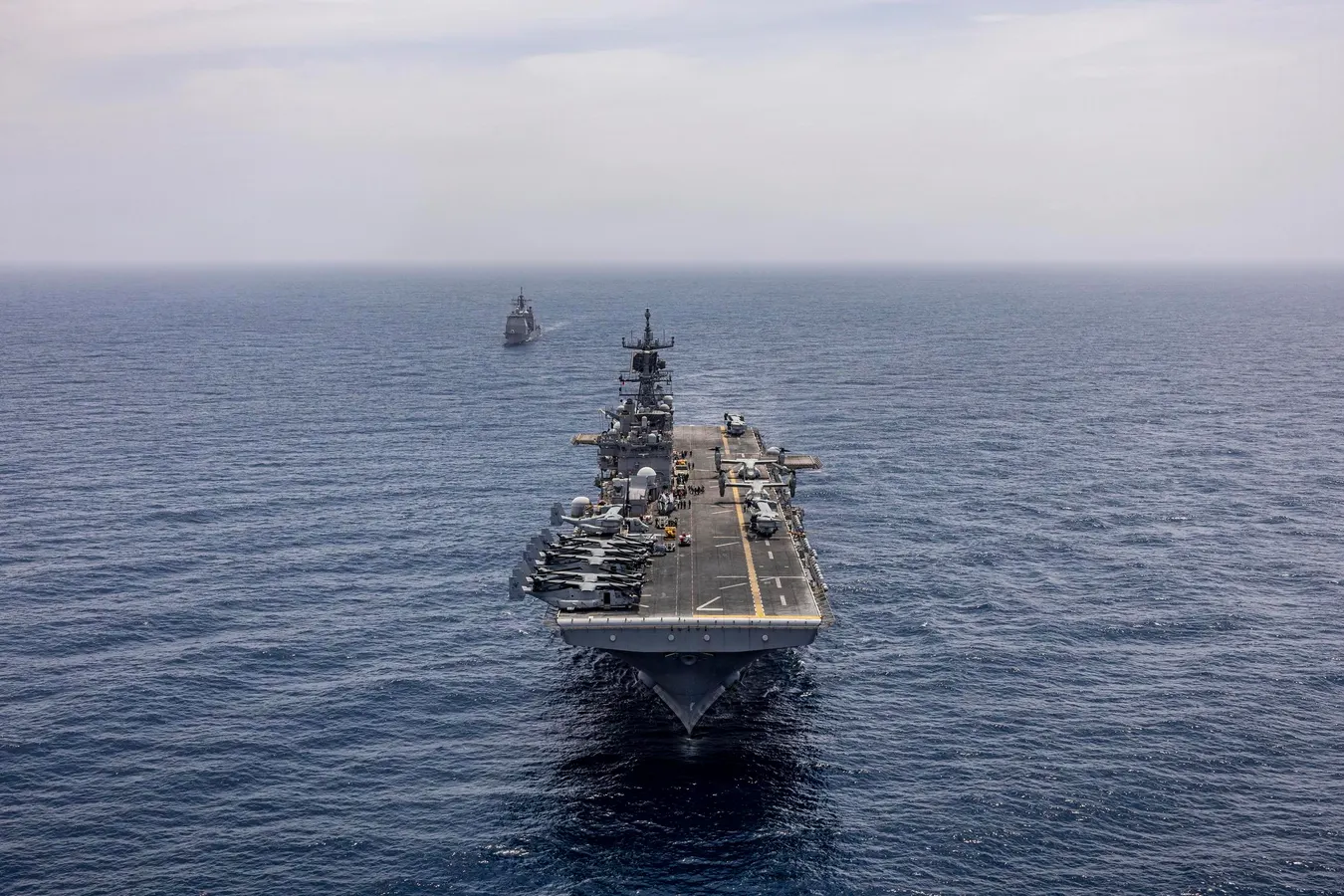

Wasp-class amphibious assault ship USS Iwo Jima (LHD 7) and Ticonderoga-class guided missile cruiser USS Lake Erie (CG 70), transit off the coast of Venezuela
(U.S. Navy photo)
Nearly two weeks ago, the United States Navy’s newest and largest nuclear-powered supercarrier, the USS Gerald R. Ford (CVN-78), finally returned to Naval Station Norfolk, ending a nearly 11-month-long deployment. By next week, another U.S. Navy “flattop” could also arrive in Norfolk after a deployment that lasted nearly as long.
The Wasp-class amphibious assault ship USS Iwo Jima (LHD-7), along with the San Antonio-class amphibious transport dock USS Fort Lauderdale (LPD-28) and the 22nd Marine Expeditionary Unit, departed from Naval Station Norfolk on August 14, 2025. The Iwo Jima Amphibious Ready Group spent nearly the entirety of the last 10 months primarily operating in the U.S. Southern Command area of responsibility.
USNI News reported that the LHD-7 and LPD-28 are now heading back to Norfolk.
Supporting Operation Southern Spear
The U.S. Navy had initially planned to deploy the group to Europe, but the ARG was forced to return to Norfolk to avoid Hurricane Erin, and then took part in a humanitarian aid mission in the Caribbean.
Following the hurricane relief efforts, the ARG remained in the region for a nearly 10-month deployment, heavily focused on counter-narcotics and disrupting illicit trafficking in support of Operation Southern Spear. In early January 2026, the ready group participated in strategic operations in the region, including the U.S. mission that led to the capture of Venezuelan President Nicolás Maduro and his wife, Cilia Flores.
Maduro and his wife were briefly held on the USS Iwo Jima before being sent to New York City, where he is now awaiting trial.
Another Extended Deployment
The deployment of LHD-7 and the 22nd MEU was originally intended to last the standard six to seven months, but was significantly extended, as the U.S. Navy moved other assets, including the USS Gerald R. Ford, to the Middle East as part of the buildup of U.S. military forces in advance of Operation Epic Fury, the bombing campaign against Iran that began on February 28, 2026.
The Iwo Jima Amphibious Ready Group had also included the USS San Antonio (LPD-17), lead vessel of the class of amphibious transport docks, with that warship returning to Norfolk last month.
Once the USS Iwo Jima and the remainder of the ARG return to Norfolk, the U.S. Navy could be stretched a bit thin in the Caribbean.
The U.S. Navy has one Ticonderogaclass guided-missile cruiser, the USS Lake Erie (CG-70), and one Littoral Combat Ship, the USS Billings (LCS-15), operating in the region. However, a supercarrier did arrive last week, but how long it will remain is unclear.
The U.S. Navy’s oldest nuclear-powered aircraft carrier, the USS Nimitz (CVN-68), and her escort, the Arleigh Burke-class guided-missile destroyer USS Gridley (DDG-101), are now transiting the Caribbean as the carrier is making a home port shift from Naval Base Kitsap, Bremerton, Wash., to Norfolk, ahead of its decommissioning in March 2027.
Even if CVN-68 and DDG-101 don’t remain in the region, another Wasp-class amphibious assault ship, the USS Kearsarge (LHD-3), has been operating in the Western Atlantic in advance of her next deployment and could soon take over for LHD-7. There has been speculation that the U.S. may build up forces in advance of strikes on Cuba, as Washington continues to apply economic and military pressure on the island nation’s Communist regime.
Not An Aircraft Carrier
With their flat flight decks, it would be easy to mistake LHD-7 or LHD-3 for “aircraft carriers.” However, each is a conventionally powered warship, a Wasp-class “amphibious assault ship,” designed for different mission objectives.
Although nearly as large as the aircraft carriers operated by several nations, the LHDs serve in a different role than the U.S. Navy’s time-proven Nimitz-class and the new Gerald R. Ford-class of nuclear-powered supercarriers. Each of the Wasp-class flattops is capable of transporting and deploying almost the full strength of a United States Marine Corps MEU, and landing them in hostile territory either via helicopters or landing craft.
The LHDs can also provide air support with short-takeoff-and-landing multirole fighters, previously the McDonnell Douglas AV-8B Harrier II and, with certain modifications, the Lockheed Martin F-35B Lightning II.
At 844 feet long with a beam of 106 feet, the Wasp-class is essentially a floating military base. There are six cargo elevators for moving materiel and supplies from the cargo holds, as well as two aircraft elevators. The LHDs can carry three Landing Craft Air Cushion, a dozen Landing Craft Mechanized, or upwards of 40 Amphibious Assault Vehicles. The flight deck features nine helicopter landing spots.
In addition to a crew of some 1,075 sailors, each LHD can carry upwards of 1,600 to 1,900 embarked Marines. Unlike the troop transports from the early 20th century, which were essentially floating cattle cars, the vessels offer reasonable accommodations for those on board. All manned spaces and berthing areas, which are subdivided to provide semi-private spaces without adversely affecting efficiency, are individually heated and air-conditioned. The warships would never be mistaken for luxury cruise ships, yet, they do offer multiple amenities, including a state-of-the-art Library Multi-Media Resource Center with Internet access, a weight room, arcade machines, and even satellite TV capabilities.
The ships are outfitted with medical and dental capabilities that can provide medical treatment for up to 600 casualties. There are six operating rooms, including four main and two emergency rooms; four dental operating rooms; x-ray rooms; a blood bank; and patient wards with sixty-four patient beds. An additional 526 beds can also be set up in an Overflow Casualty Ward. The vessels are fitted with medical elevators that enable the rapid transfer of casualties from the flight deck and hangar bay.
USS Iwo Jima Will Be Sidelined For Two Years
Following this deployment, USS Iwo Jima will undergo a major, multi-year maintenance and modernization availability at the BAE Systems shipyard in Norfolk, Virginia. In February, the U.S. Navy awarded BAE Systems a $204.1 million contract to provide maintenance services for LHD-7. During the upcoming “selected restricted availability,” its shipboard systems will be updated to operate with the fifth-generation F-35B. The F-35B could enable the U.S. Navy’s LHDs to operate as “Lightning Carriers,” where the fifth-generation fighters can be employed in strike, surveillance, and data-gathering roles when a large supercarrier isn’t available.
Work is set to begin on the amphibious assault ship in August, with the full refit completed by February 2028.
LHD-7 is the third United States Navy warship to be named in memory of the Second World War’s Battle of Iwo Jima, fought between February 19 and March 26, 1945.















Leave a comment