


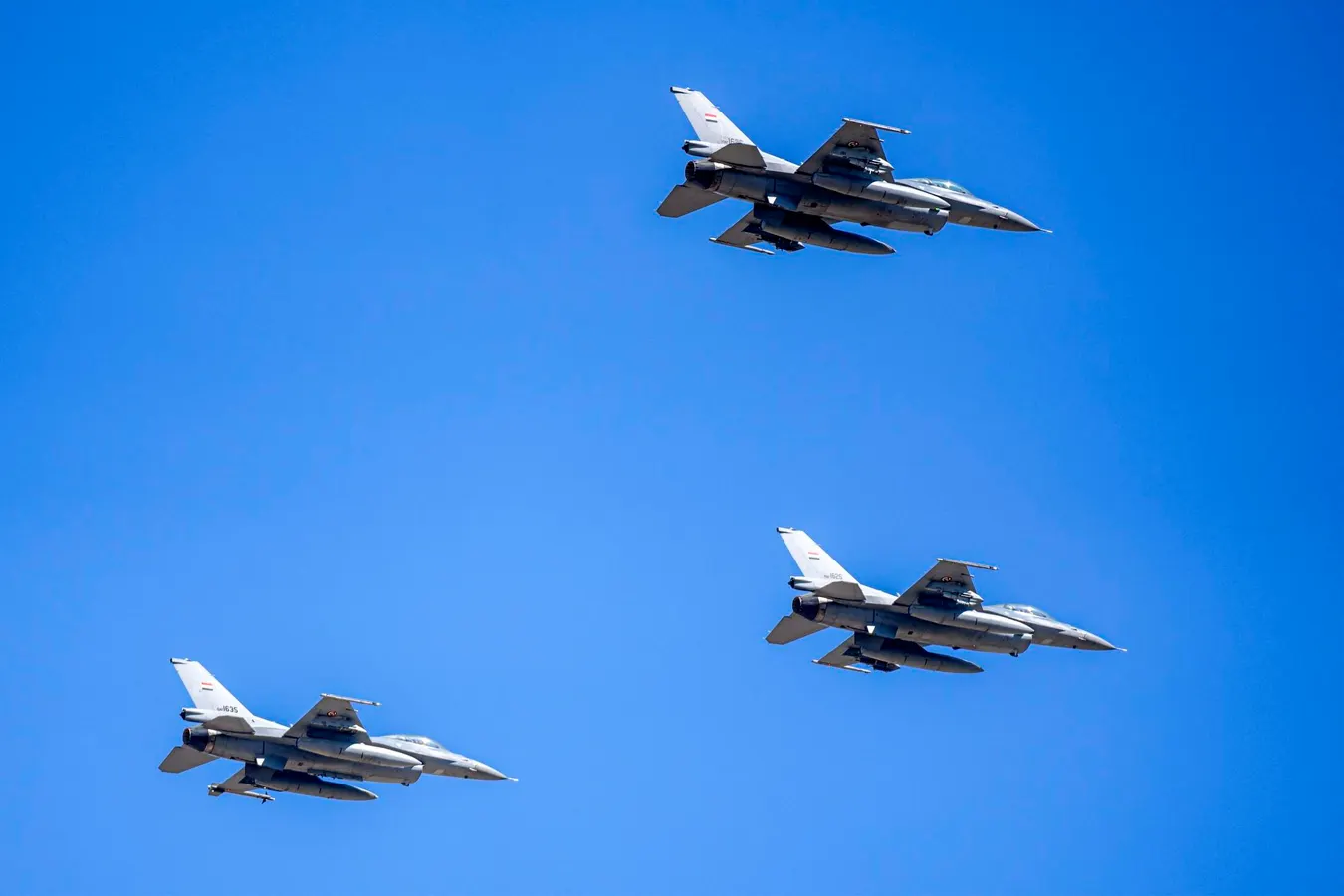

Iraqi air force F-16 fighter aircraft fly over during an airshow above Baghdad on October 3, 2025, for the country’s 93rd national day, marking the country’s independence and the end of the British Mandate. (Photo by MURTADHA RIDHA/AFP via Getty Images)
AFP via Getty Images
Iraq is taking tangible steps to enhance and upgrade its air defense. It has ordered South Korea’s medium-range surface-to-air Cheongung-II missile systems and Turkey’s short-range Korkut anti-aircraft gun. Furthermore, it’s holding simultaneous negotiations with France and Pakistan over acquisitions of Dassault Rafale and JF-17 Thunder multirole fighter jets. Even with such high-end systems in its inventory, Iraq may still face the same problem that plagued it decades ago: namely, its inability to adequately maintain and field such sophisticated equipment independently.
Whether it ultimately acquires the Rafale or JF-17, or approximately a dozen of both, their arrival will mark Iraq’s most advanced aircraft acquisition since taking delivery of Lockheed Martin F-16C/D Block 52 Vipers in the mid-2010s. However, without continuous hands-on support from foreign contractors and technicians, these French and Sino-Pakistani jets could become severely underutilized.
Iraq’s F-16 fleet has faced similar issues over the past decades. Their readiness depends heavily on contractor support from their manufacturer, Lockheed Martin. Additionally, their overall air defense capabilities have been greatly constrained by their lack of AIM-120 air-to-air missiles, leaving them with inferior, much less reliable, shorter-range missiles.
Recurring reports over the past few years indicate that Iraq’s Viper fleet has often faced chronic readiness issues and repeated groundings. The latest occurred during the February 28-April 8 U.S.-Israeli war with Iran. While its airspace was repeatedly violated by all sides, Iraq’s F-16s remained in their hangars at Balad Airbase after Lockheed contractors evacuated for their safety. Once again, the temporary departure of the Americans saw these aircraft at risk of becoming mere “scrap,” according to an April 1 report in Asharq Al-Awsat.
In some ways, Iraq is facing the same third-world air power problem it faced before 2003. As highlighted in a June 1993 paper by U.S. Air Force Major Douglas A. Kupersmith, “lack of industrialization in most third world nations prevents them from ever fielding an air force capable of decisive action in conventional warfare.”
Citing Iraq’s defeat in the 1991 Persian Gulf War and the limits of its air force’s performance in the preceding Iran-Iraq War of the 1980s, Kupersmith observed that while many developing nations are attracted by the destructive potential of modern fighters and bombers, “they are far from actually realizing the full capacity of these weapons.”
The F-16s are undoubtedly Iraq’s most prestigious acquisition in the post-2003 period but certainly haven’t lived up to their full potential as either air defense fighters or ground-attack jets. In the latter role during the war against the Islamic State, Iraq often used much less advanced aircraft, including modified Antonov An-32 cargo planes, more against the militants. The immediate deterioration in the operability of its F-16s after the American contractors evacuated Balad also underscored its debilitating dependence on the U.S. to keep these aircraft in a state of basic readiness, in ways that appear to vindicate Kupersmith’s thesis decades later.
Iraq may well seek to diversify its fighter fleet with Rafale or JF-17 acquisitions, with analysts reasonably speculating that Baghdad opened these negotiations simultaneously to secure the best deal by playing Islamabad and Paris “off each other.” Either way, it will likely still find itself highly dependent on French or Pakistani contractors and technicians to keep these combat aircraft airworthy and suppliers for essential spare parts and armaments.
For decades, pre-2003 Iraq diversified its fighter fleet with acquisitions from Western and Eastern countries. As previously summarized here, the Iraqi Air Force simultaneously operated British de Havilland Vampires and Hawker Hunters alongside Soviet MiG-17s, MiG-19s, and MiG-21s in the 1960s. By the 1980s, it operated Soviet MiG-23s, MiG-25s, and eventually fourth-generation MiG-29s alongside French Dassault Mirage F1s. Were it not for the ensuing Persian Gulf War, Baghdad had plans to follow these acquisitions with purchases of fourth-generation Su-27 Flankers from Moscow and Mirage 2000s from Paris.
Decades later, Iraq may similarly operate a mixed fleet of F-16s, Rafales, and JF-17s, or at least its existing F-16s and one of those other types. While diversification obviously reduces its dependence on any single foreign supplier for its air force, it could still face significant constraints.
Kupersmith’s thesis again has contemporary relevance for Iraq, especially where he noted that: “Dependence on outside technology increases third world air forces’ predictability compared to that of self-sufficient militaries.”
“The training they receive is at the whim of the supplying nation and is subject to exploitation,” he wrote. “Additionally, reliance on a foreign nation’s expertise limits the inclusion of the training into doctrine because unreliable sources bring unexpected changes into a country’s plans to employ its air power.”
“Without a comprehensive doctrine, a nation’s air force becomes a loose collection of pilots with no common employment foundation.”
The latter description could become more apt for Iraq as it once again proceeds to purchase advanced fighter aircraft from more than one source.
Interestingly, Kupersmith also highlighted some alternatives to air power that developing countries could pursue, including surface-to-air and ballistic missiles.
Regarding the former, he gave the example of Egypt in the October 1973 Israeli-Arab War. After having its air force decimated by a surprise Israeli air offensive in the June 1967 war, Cairo invested more heavily in its surface-to-air missile arsenal.
“The result was an effective umbrella over their ground forces that cost the Israeli air force considerable losses during the opening engagements of the campaign,” Kupersmith wrote. “Although the Israelis eventually overcame the problem, Egyptian doctrine showed that a country without effective aerial assets could wreak destruction upon a superior air force.”
Iraq’s present day acquisition of the South Korean Cheongung-II, also known as the KM-SAM Block II, marks its single most consequential ground-based air defense acquisition in the post-2003 period. Its more recent order for Korkuts suggests it may aim to build a layered defense. Such an array could see the Cheongung-II focused on combating advanced threats like high-altitude drones, fighter jets, and ballistic and cruise missiles, all of which have crossed through Iraqi airspace in the recent Iran wars. At the same time, the Korkuts might provide point defense for these sophisticated Korean systems, protecting them against potentially devastating close-range threats like small first-person-view drones, which have destroyed multi-billion-dollar strategic air defense systems in recent wars.
Still, analysts are similarly skeptical that Iraq can realize the full potential of these advanced Korean systems. While the eight Cheongung-IIs Iraq ordered could theoretically cover large parts of its airspace, they may ultimately remain confined to defending parts of the greater Baghdad area, marking yet another prestigious weapons acquisition with severely circumscribed combat utility.
Regarding ballistic missiles, Kupersmith noted that “many third world nations are turning to these weapons to augment or replace many functions previously performed by their air forces.” Nevertheless, he underlined the many limitations of relying on these missiles in lieu of a modern air force.
While Iraq’s Scud missiles terrorized Iran throughout the Iran-Iraq War and later Israel and Saudi Arabia in early 1991, they did little else. Baghdad has never invested in ballistic missiles or other long-range offensive weapons since that time.
Interestingly, Kupersmith’s observations have contemporary relevance for neighboring Iran. Tehran fielded one of the most advanced and well-equipped American-made air forces in the 1970s but lacked ballistic missiles. Starting during the Iran-Iraq War, it went on to largely neglect its once state-of-the-art air force in favor of developing an enormous arsenal of increasingly accurate and longer-range ballistic missiles and armed drones. Iran has arguably utilized that imperfect air power alternative outlined by Kupersmith better than any other country.
While Iraq may well make significant strides in improving its air defense through these ongoing acquisitions, it will still inevitably face many of the same fundamental problems and shortcomings that were observable 33 years ago.
















Leave a comment