


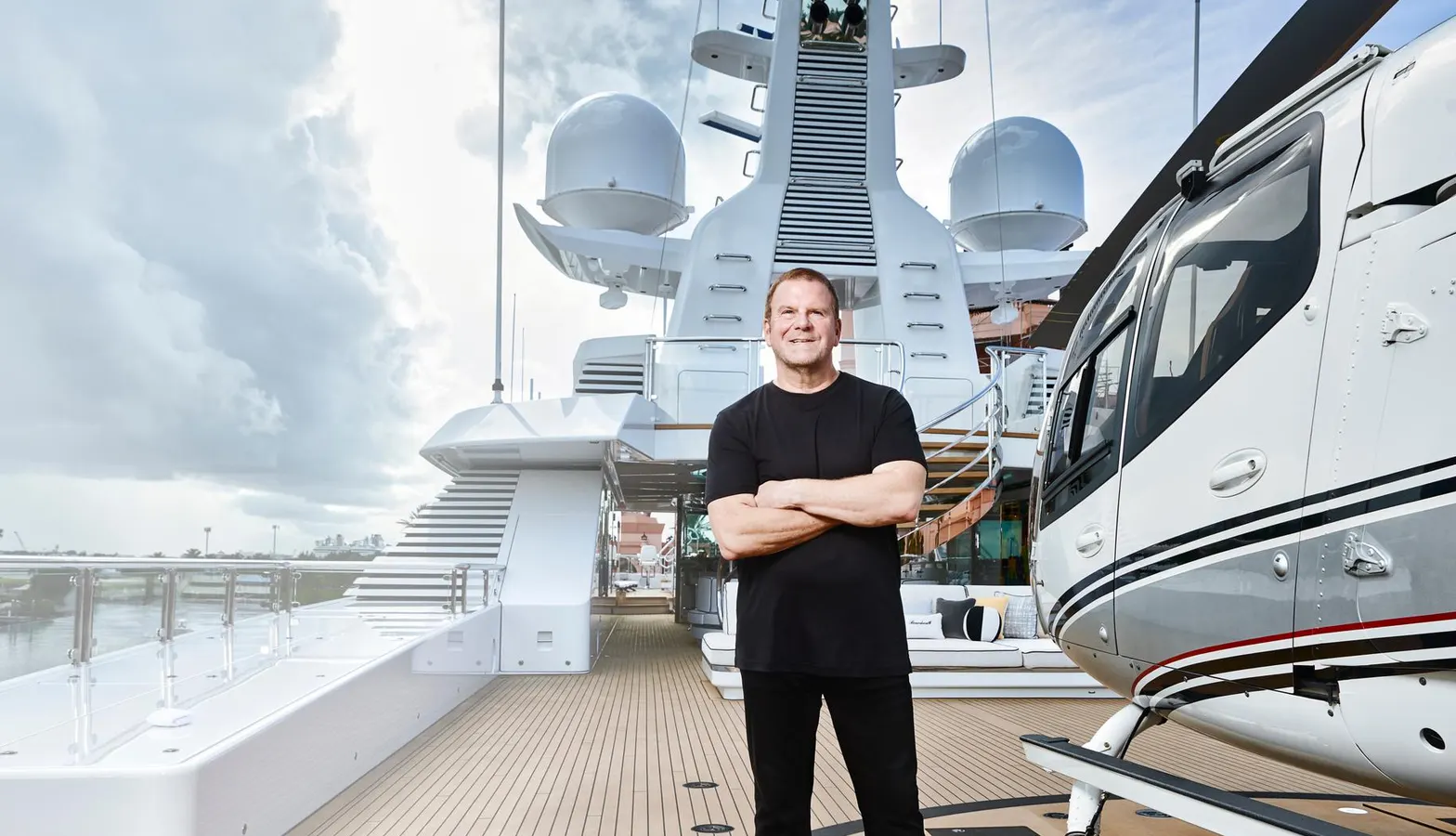

Fertitta on his yacht in 2021, before Trump tapped him to be ambassador to Italy.
Jamel Toppin for Forbes
Despite challenges from prediction markets, Ozempic and rising costs, the restaurateur owner of the Houston Rockets seeks to add 50 locations, and a mountain of debt, to his existing empire.
Houston billionaire Tilman Fertitta has spent the past year living in Rome as Donald Trump’s ambassador to Italy. It’s a lot more work than he thought it would be, Fertitta told Forbes last year, but thrilling. His Instagram is a curated parade of meetings with one-name dignitaries such as Meloni, Prada, Rubio and the Pope — in resplendent Roman settings, accompanied by his second wife Lauren.
And now the fun never has to end. When his term is over, Fertitta will have his own Eternal City to return to in the form of casino giant Caesars Entertainment, which he agreed last week to purchase for $6 billion in cash plus the assumption of more than $12 billion in debt.
Fertitta already owns 500 restaurants, 5,000 hotel rooms, eight Golden Nugget casinos through his Fertitta Entertainment, as well as the Houston Rockets. For $300 million he just bought the WNBA’s Connecticut Sun (to become the Houston Comets).
Taking over Caesars gives him a vast new canvas for his imperial ambitions. Caesars, with $12 billion in revenue, vies with MGM Resorts and Las Vegas Sands as America’s biggest gaming company. It has more than 50 casino properties across the U.S., with 46,000 guest rooms. Its $32 billion balance sheet includes $14 billion in property assets, billions more in digital gaming assets as well as $10 billion of intangible goodwill.
On the liabilities side, even bigger than $12 billion in debt is Caesars’ $14 billion in long-term lease obligations — this is rent it owes on previously owned properties it leases back after selling them a decade ago to real estate investment trust (REIT) VICI Properties. On top of Caesars’ liabilities, Fertitta Entertainment already carries some $5 billion of debt and Fertitta is borrowing even more to finance the cash portion of the Caesars deal.
According to Morningstar analyst Dan Wasiolek, a key reason why Caesars’ stock has underperformed in recent years is its high debt load. Including its lease liabilities, Caesar’s debt-to-ebitda was 6.9x in 2025, higher than Wynn Resorts 5.5 times and more than double Las Vegas Sands’ 3 times.
Ambassador Fertitta and wife Lauran greet Vice President J.D. Vance upon arrival to the Milano Cortina 2026 Winter Olymipics in February.
Getty Images
While the merger won’t solve that right away, Wasiolek thinks it’s smart that Fertitta is keeping top management in place at Caesars. They’ve successfully integrated Eldorado and Tropicana into the Caesars portfolio (and customer loyalty program) in recent years, and should be able to do the same with Fertitta’s Golden Nugget and also incorporate some of his restaurant brands like Strip House, Morton’s Steakhouse, Bubba Gump Shrimp Co., and Rainforest Cafe.
Analyst Joe Stauff at Susquehanna Investment Group is even more bullish, saying that counterintuitively, Caesars’ $800 million of expected free-cash generation this year will help stabilize Fertitta’s existing business. Of all of Fertitta’s motivations, Stauff notes, “the most important one is to secure a high free-cash flowing asset to help reduce the implied leverage of his current conglomerate that is restaurant heavy and in a difficult operating environment” facing higher costs and rents at the same time that appetite suppressing drugs like Ozempic are reducing spending on food, alcohol and dining out.
He also has a different take on the debt levels, explaining that the number looks better, if you focus on “traditional leverage.” Instead of including lease obligations as debt, Stauff backs out the $1.2 billion in annual lease expense from Caesars $3.6 billion in Ebitda to get an adjusted Ebitda of $2.4 billion. Divided into $12 billion of long-term debt gives a more manageable 5x multiple.
“That’s what makes this deal interesting,” writes Stauff. That Fertitta is buying a highly levered operating company “tells me that land-based casino assets are still very stable.”
A big wild card in determining the deal’s success is the fate of prediction markets. Sportsbook operators like Caesars and DraftKings (in which Fertitta is a large investor) are pushing lawmakers to rein in prediction platforms like Kalshi and Polymarket, which they view as direct competition to their already contracting regulated sports gambling business.
Even if Fertitta gets jammed up with too much debt, he has plenty of options. He could sell some assets, which state gaming regulators may push Fertitta to do regardless, says Barclays analyst Brandt Montour. (Nobody needs four casinos in Atlantic City or seven in Las Vegas, which is what Fertitta will have after the merger goes through.)
Alternatively, Fertitta could market more of the real estate underlying casinos to REITs like VICI or Gaming & Leisure Properties or even liquidate the 12% stake (worth $1.3 billion) in Wynn Resorts that he’s personally acquired in recent years. In short, Fertitta has options and plenty to keep himself busy after his time as ambassador is over. A shareholder vote on the deal is expected later this year with potential close in mid 2027.














Leave a comment