


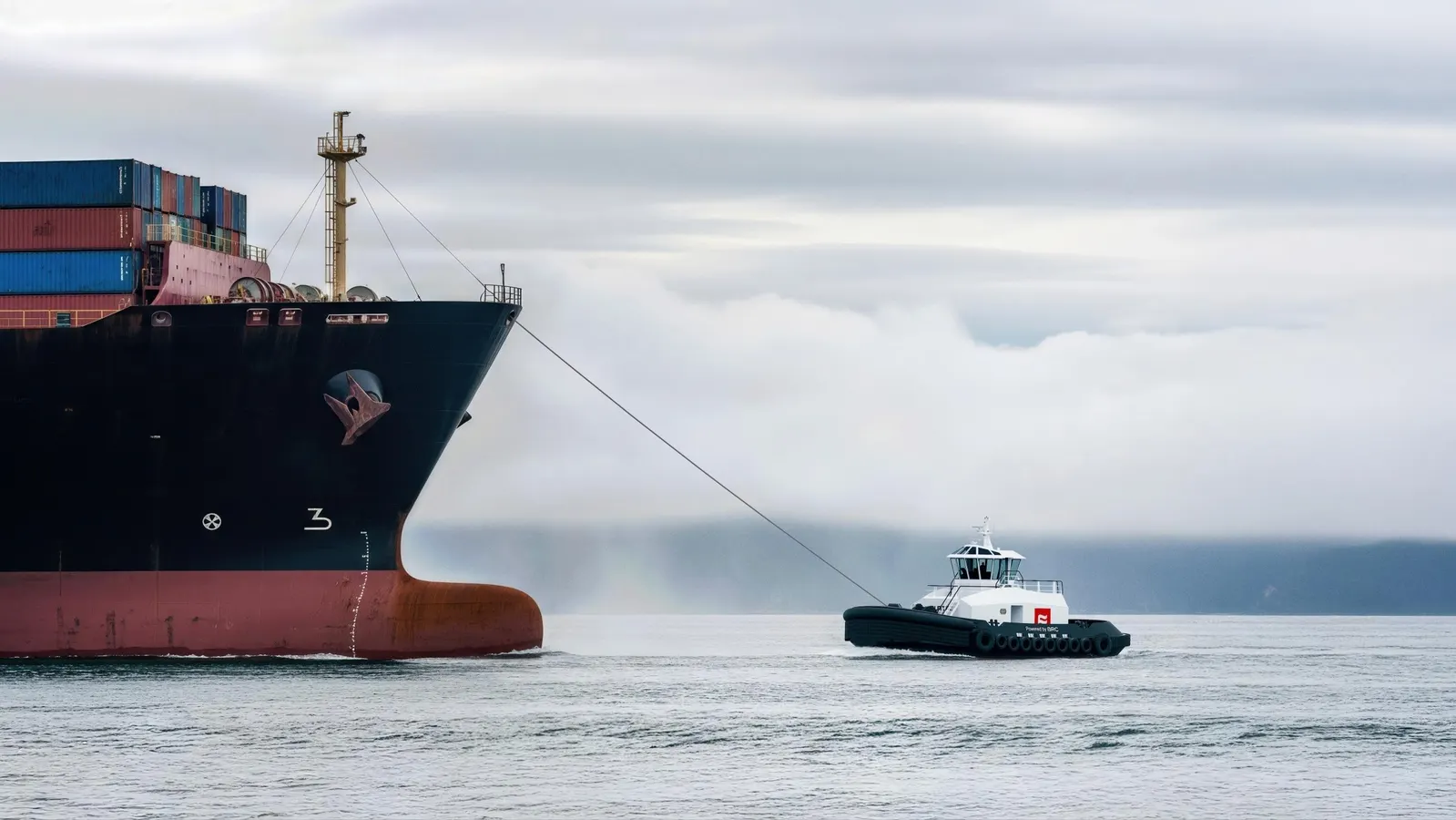
Arc Marine’s electric tugboats are heading for the Port of Long Beach, California.
Arc Marine, Curtin Maritime
The next hot electric vehicle may not come with gullwing doors, a self-driving mode or the ability to provide backup power to your home. It may be an 80-foot tugboat, nearly four stories tall, built to pull massive cargo ships around the Port of Long Beach.
That’s the bet Arc Marine is making. The Los Angeles startup, cofounded by software engineer Mitch Lee and former SpaceX rocket designer Ryan Cook, launched their electric boat startup to target the luxury watercraft market, selling sleek, fast $300,000 e-boats for wealthy weekenders. Now, with oil prices at historic highs, it’s pushing into the commercial marine space with $20 million battery-powered tugs capable of pulling ginormous cargo ships into container ports. It’s an opportunistic, timely shift from polished recreational toys to industrial machines with brutal duty cycles, big fuel bills and regulators at the door.
“Over the next 10 to 15 years, every segment of marine is going to go primarily electric”
Arc’s first commercial boats, being built at a Seattle-area shipyard, are already heading toward proof of concept. Its tech is being used to power the world’s first electric tugs that are about to go into service at the Port of Long Beach, under a deal worth $160 million announced in late 2025. If they perform as well as Arc and initial customer Curtin Maritime expect, the company aims to expand into electric ferries, barges and even military watercraft, CTO Cook told Forbes.
“It’s our strong hypothesis that over the next 10 to 15 years, every segment of marine is going to go primarily electric,” he said. “That could mean primarily hybrid electric, like diesel electric, but the fact is electric is just far more efficient and cost-effective at moving really heavy loads. This happened in the train industry. Now it’s happening in the marine industry.”
Cars still dominate the electrification conversation, even as U.S. EV demand has tanked since the Trump administration axed $7,500 tax credits to help offset higher price tags, though other transportation segments are starting to electrify. Tesla has begun regular production of its much-anticipated electric Semi, with California expected to be its first major market, aided by generous state subsidies. So it’s not a surprise that electric tugboats are also being deployed first in California, where tough state air pollution rules are pushing operators at ports, especially in Los Angeles and Long Beach, to slash harmful emissions created by diesel- and bunker-fuel powered ships.
The war in Iran has made fuel prices more than background noise. The price of diesel fuel has jumped by about 50% since it began three months ago. That’s boosted the economic case for Arc’s electric boat tech in the highly fragmented marine space. Why not swap exposure to fuel-price chaos for durable lithium-iron phosphate batteries that are getting cheaper?
“With the volatility of fuel prices–plus the fact that we’re already working on the Curtin deal–interest that we’ve seen on the commercial side has just been ballooning over the last few months,” Cook said. “We’re bidding and in conversations with many ferry operators, barges, pretty much anything on the water. We’re getting a flood of inbound interest to see if we can electrify or hybridize things to help.”
The first electric tugboat using Arc Marine’s technology under construction at a shipyard in Washington state.
Arc Marine, Curtin Maritime
The boats it’s doing with Curtin are much beefier than Arc’s sleek wake sport boats. They’re about 80 feet long and nearly four stories high and will be able to pull up to 100 ton-loads. The first models will have 6 megawatt-hour battery packs–the equivalent of 75 Tesla Model Y SUVs–to support a massive 4,000-horsepower propulsion system.
Arc, which has raised about $150 million since its founding in 2021, is supplying more than batteries. It is also supplying the battery management system and all the software, offering what it believes is the only comprehensive electrification system in the marine industry.
That matters in commercial marine, where integration is not a nice-to-have. It is the business. Tugboats are workhorses critical to port operations, particularly those in Southern California that handle the highest volume of inbound cargo in North America.
Martin Curtin, CEO of Curtin Maritime and a tugboat captain, has been looking for a way to electrify his fleet for several years to comply with California pollution rules. But until connecting with Arc, options were thin.
“There are very few options for batteries and integration in the commercial space,” he told Forbes. There’s a group that does batteries, but then they don’t do any integration, and that’s kind of tricky for us. So when we set out to do the electric tugboat program, we knew that we wanted to be vertically integrated from the very bottom – from initial scope to design to construction and then end use all in one place.”
The challenge is not just engineering. It is money. California doesn’t offer the same kind of generous subsidies for commercial boats that are available to operators of heavy-duty truck fleets to shift to cleaner electric models.
“We expected a lot more traction on this than we’ve received. We’re patiently waiting for the world to get up to speed, or at least California to be able to support what they’re forcing,” Curtin said. “We’ve seen it in the trucking industry, but for the new construction of tugboats, we just haven’t seen as much funding as what’s needed for this to take off.”
Still, Curtin sees a fit for electric tugs in Long Beach. Harbor work is intense but localized, which makes charging easier than it would be for vessels that spend days at sea. “When you look at the operational loads and the maintenance and all these components, it’s our belief that going with an electric setup and battery energy storage is just a much simpler and much more cost-effective way of doing it.”
“When you crack the code on commercial marine powertrain in the United States, I think the world’s your oyster”
The bet is still just that: a bet. The first boats are costly, custom-built and arriving in an industry where equipment can stay in service for 40 to 50 years. Proving the economic advantage of going electric will take time.
“I think long-term, it will. We’re building the first boats, and so time will tell, but I’m willing to bet $160 million on it,” Curtin said.
The tugboat market isn’t particularly large, with only a couple of dozen new units entering service annually, according to Curtin. That’s because they typically last 40 to 50 years. Still, these are bespoke, custom vessels with big price tags – like the $20 million units Arc is supplying.
“So if I were in Arc’s shoes, I’d be focused on the commercial side, and I think they are. That market is huge,” he said. “I think when you crack the code on commercial marine powertrain in the United States, I think the world’s your oyster.”














Leave a comment