


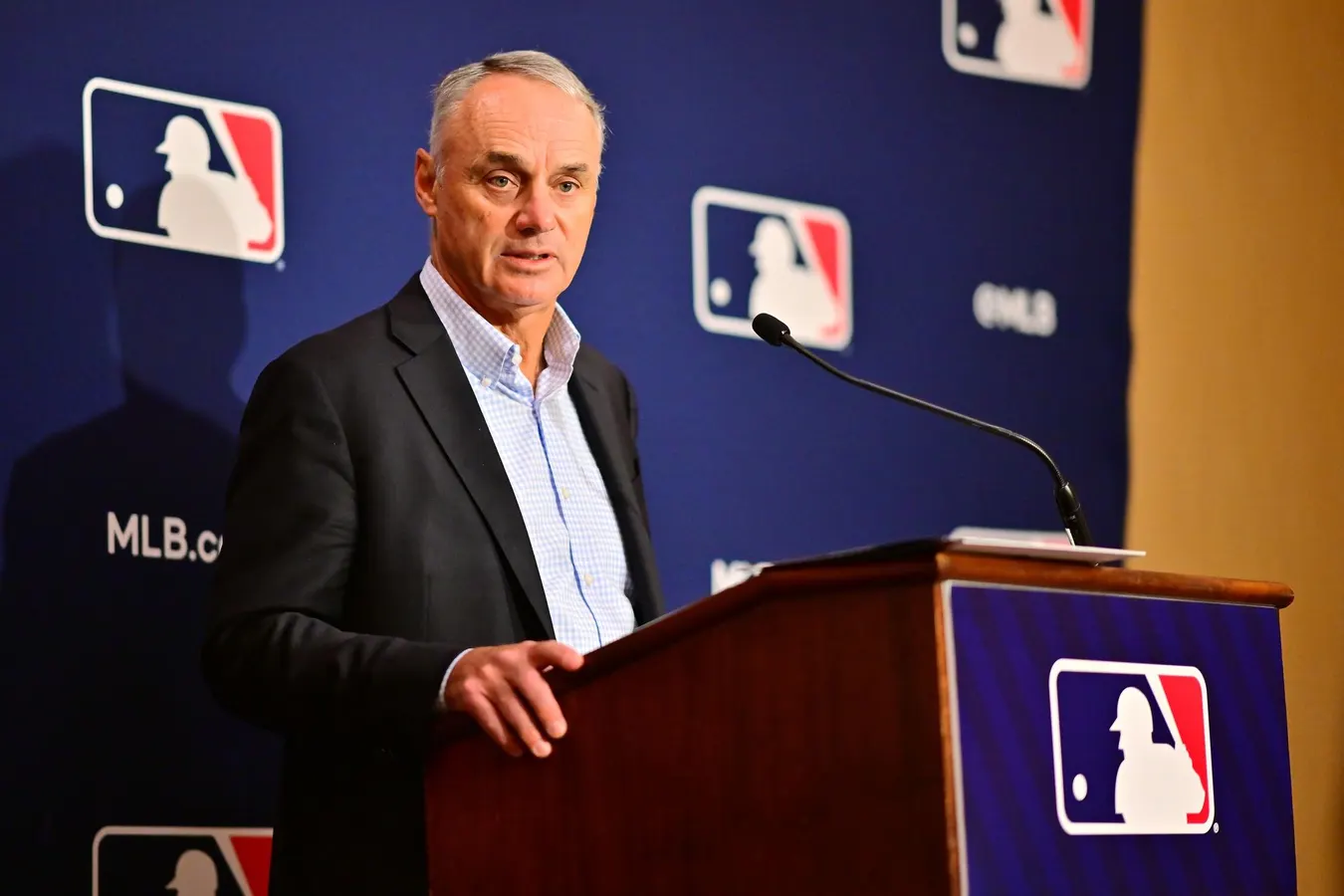

MLB Commissioner Rob Manfred and the 30 owners in the league have proposed a salary cap system for the first time since 1994. (Photo by Julio Aguilar/Getty Images)
Getty Images
As part of early negotiations for the next labor deal between the owners and players, Major League Baseball proposed a salary cap system for the first time since June of 1994. What was offered then, and what is being offered now, are eerily similar.
The year 1994 will be remembered for many things, but one that will forever stand out is the strike by the players that lasted nearly eight months, stretching into 1995 and causing the cancellation of the 1994 postseason, including the World Series. The impetus for the strike in 1994 plays out today: MLB’s owners felt that they were in an increasingly difficult financial situation. Back then, there was an overall feeling that the health of the league was on a deteriorating financial footing. Now, it’s about a chasm of economic disparity between low and high-revenue clubs.
The parameters of what a salary cap would look like as part of the 1994 proposal, and the proposal made today have similar parts:
50/50 Revenue Split
In both 1994 and now, the owners proposed a 50/50 split of baseball-related revenues. Currently, under the free market system, percentages have ebbed and flowed. While neither the league nor the MLB Players Association publicly releases financial information, in 2018, I was able to obtain verified league revenue and player salary information that covered 2010-2017, with the percentages of just MLB player salaries, benefits, and compensation, along with the percentage when accounting for the addition of Minor League player salaries. As that data showed, historically, MLB player salaries range from as low as 48.5% to a high of 51.2% of baseball-related revenues, the revenues from each of the 30 clubs at the local level, net income from MLB Advanced Media, MLB Network net income, centralized revenues, and a portion of MLB Properties through distribution for 2016 and 2017.
A visual comparison of baseball industry revenues compared to MLB player salary, benefits, and compensation.
Maury Brown
The percentage of MLB player salary, benefits and compensation compared to baseball industry revenues, as well as the percentage of MLB player plus Minor League salaries, 2010-17.
Maury Brown
Leading up to recent negotiations, the public pronouncements of how much is going to the players have fallen along party lines. MLB commissioner Rob Manfred has said players received 47% of revenue in 2024, compared with 63% when he started as chief labor negotiator in 2002. Bruce Meyer, now the interim executive director of the MLBPA, said the split was closer to 50/50.
The reason the recent numbers are important is that the proposal would lock in a 50/50 split, whereas the free-market system has historically hovered around it. A key consideration for the players is this: in the free-market system, if league revenues decline, there are no locked-in parameters that would move the cap and floor to achieve lower totals. As an example, when the league and players went to a shortened 60-game season in 2020 due to the pandemic, the players retained their prorated salaries, even though the league saw a significant decline in revenues.
Revenue Sharing Of Local Media Rights
As part of MLB’s June 1994 proposal to the players about a cap system, they proposed sharing local broadcast rights to increase equity between high and low-revenue-making clubs. As part of the proposal this past week, the league said that local media rights would be shared between all 30 clubs to increase revenue sharing, but only if a salary cap system were put in place. So, like 1994, so is the owners’ position in 2026.
Parameters Of The Salary Cap
This is the one aspect that is different from 1994 to what was proposed today. The recent proposal would set a cap a hard cap at $245.3 million and a floor at $171.2 million.
There had been no revenue-sharing heading into the 1994 labor negotiations. In January, the owners approved a plan, contingent on implementing a salary cap, around revenue sharing.
A proposed “soft” cap system would be phased in over four years. As opposed to figures defined at the top and the bottom as the league did this past week with a hard cap proposal, in 1994 the limits at the top would be based on league-wide revenues that included TV rights, gate receipts, and merchandise sales. Penalties for exceeding the cap included fines or loss of draft picks. The union also argued that a salary cap would violate the terms of free agency established in Messersmith-McNally in 1975.
In the Luxury Tax system, as it is known today and put in place in 2001, clubs are taxed at varying amounts when exceeding thresholds agreed to as part of collective bargaining.
In the proposal, salary arbitration would have been completely eliminated, and free agency would have begun at five years of service time as opposed to six.
As is the case today, the union for the players rejected the cap proposal, saying it would create constraints. Last week, the union said a cap system would lead to the elimination of guaranteed contracts, and ultimately mean that within a cap, $1 awarded to one player would be taking $1 from another, pitting players against each other.
When Will There Be Movement?
While there will be continued proposals, real movement doesn’t occur until deadlines approach. That is why a lockout seems near certain at midnight on December 1st. It also seems that the real deadline would be sometime in March when Spring Training is at risk, and the start to the 2027 regular season was nearly upon us. At that stage, the real game of chicken will begin.















Leave a comment