


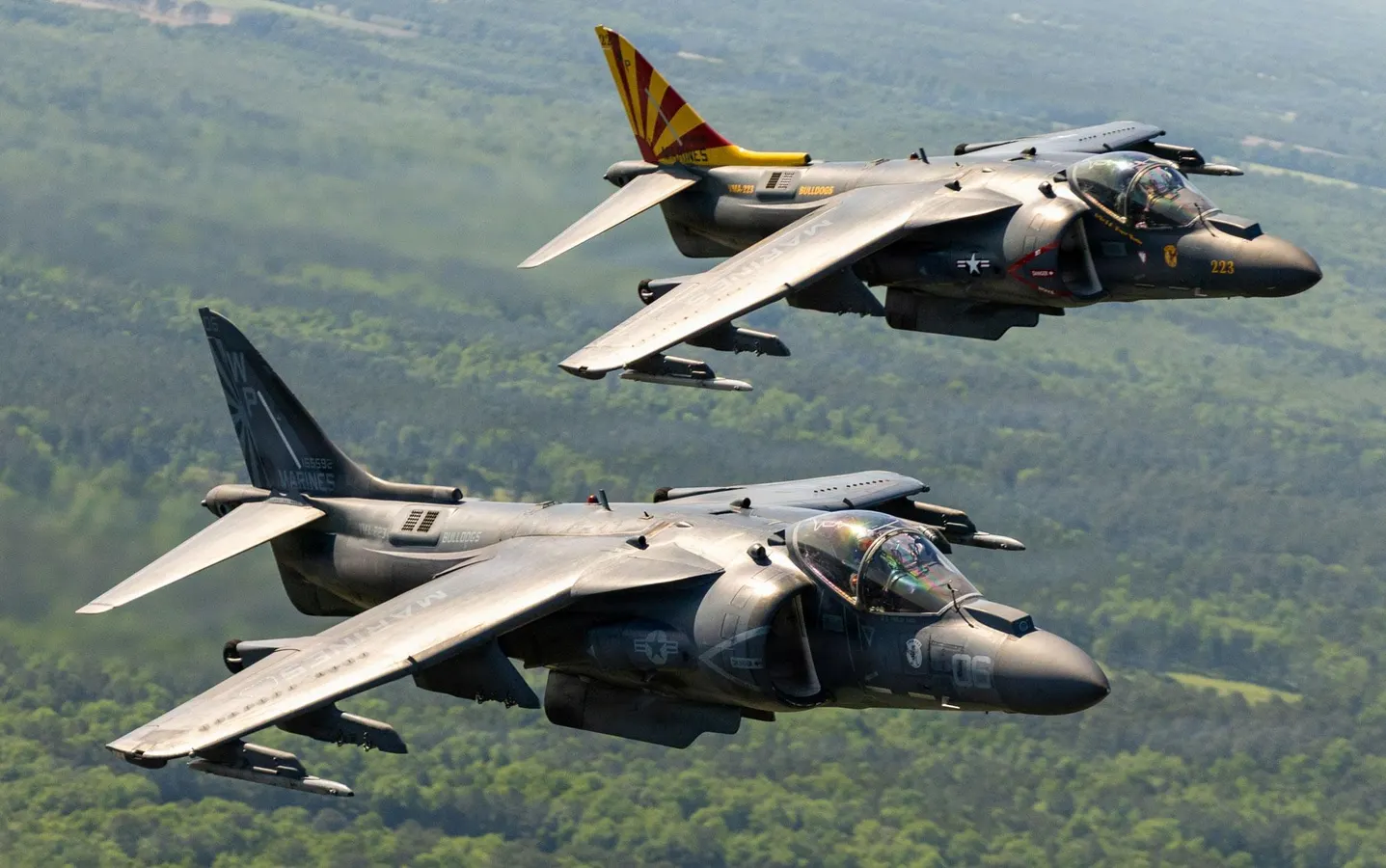

U.S. Marine Corps AV-8B Harrier II aircraft with Marine Attack Squadron (VMA) 223, Marine Aircraft Group 14, 2nd Marine Aircraft Wing, fly over Eastern North Carolina, May 15, 2026
(U.S. Marine Corps photo by Sgt. David Ornelas Baeza)
The United States Marine Corps is marking the end of an era at Marine Corps Air Station Cherry Point, N.C., with the 2nd Marine Aircraft Wing and Marine Attack Squadron 223 (CVW-223) hosting the official AV-8B Harrier II “Sundown Ceremony” on the flightline on Wednesday.
“The ‘sundown’ of the AV-8B Harrier II, an iconic aircraft that has supported joint and Marine Corps operations for over 40 years, also represents the dawn of a new era; it paves the way for 2nd MAW’s full transition to the F-35B and C Lightning II,” the USMC
The USMC has been preparing for the AV-8B Harrier II’s upcoming retirement for several years.
In 2025, one of the oldest fighter squadrons concluded flight operations with its McDonnell Douglas AV-8B.
Marine Attack Squadron 231 (VMA-231), the “Ace of Spades,” which was established as the 1st Division, Squadron 1, in February 1919, had operated the AV-8B since September 1985 and became the first unit to operate the Harrier II in combat during 1991’s Operation Desert Storm. It went on to take part in Operations Allied Force, Odyssey Dawn, Inherent Resolve, and Prosperity Guardian.
During its combat service history, the Harrier II was typically armed with a wide range of weapon systems, including the air-to-air AMRAAM and Sparrow missiles, air-to-surface AGM-65 Maverick missiles, anti-ship Harpoon and Sea Eagle missiles, a 25mm cannon, and various bombs and rockets.
As of this year, VMA-223, the “Bulldogs,” remains the final operator of the AV-8B. Established during World War II as Marine Fighting Squadron 223 (VMF-223), it has flown the Harrier II since October 1987.
Transition From AV-8B To The F-35 Lightning II
The iconic “jump jet” has been in service with the USMC for more than four decades, but the service has steadily been transitioning to the fifth-generation F-35 Lightning II.
The USMC already operates two versions of the stealth aircraft.
These include the F-35B, the short takeoff and vertical landing variant of the Joint Strike Fighter, which will fill a role similar to that of the Harrier II, including operating from the United States Navy’s amphibious assault ships and remote airbases without traditional runways. The STOVL capability allows the aircraft to take off and land on short, damaged runways, dirt strips, and small island-hopping outposts.
In addition, the USMC will operate the carrier-based F-35C alongside the U.S. Navy, with embarked air wings aboard some of the Nimitz-class and Gerald R. Ford-class nuclear-powered supercarriers.
The AV-8B Harrier II isn’t the only aircraft being phased out of service with the USMC. The Corps is also in the process of retiring its legacy F/A-18 Hornet fleet, with all remaining operational squadrons slated for complete deactivation by 2030. MCAS Beaufort, South Carolina, will end F/A-18 Hornet operations by August 1, 2028; MCAS Miramar, California, will follow a year later on August 1, 2029; and Naval Air Station Joint Reserve Base Fort Worth, Texas, will cease Hornet ops by August 1, 2030. Several overseas-based units have already replaced F/A-18 Hornet units with F-35 squadrons.















Leave a comment