


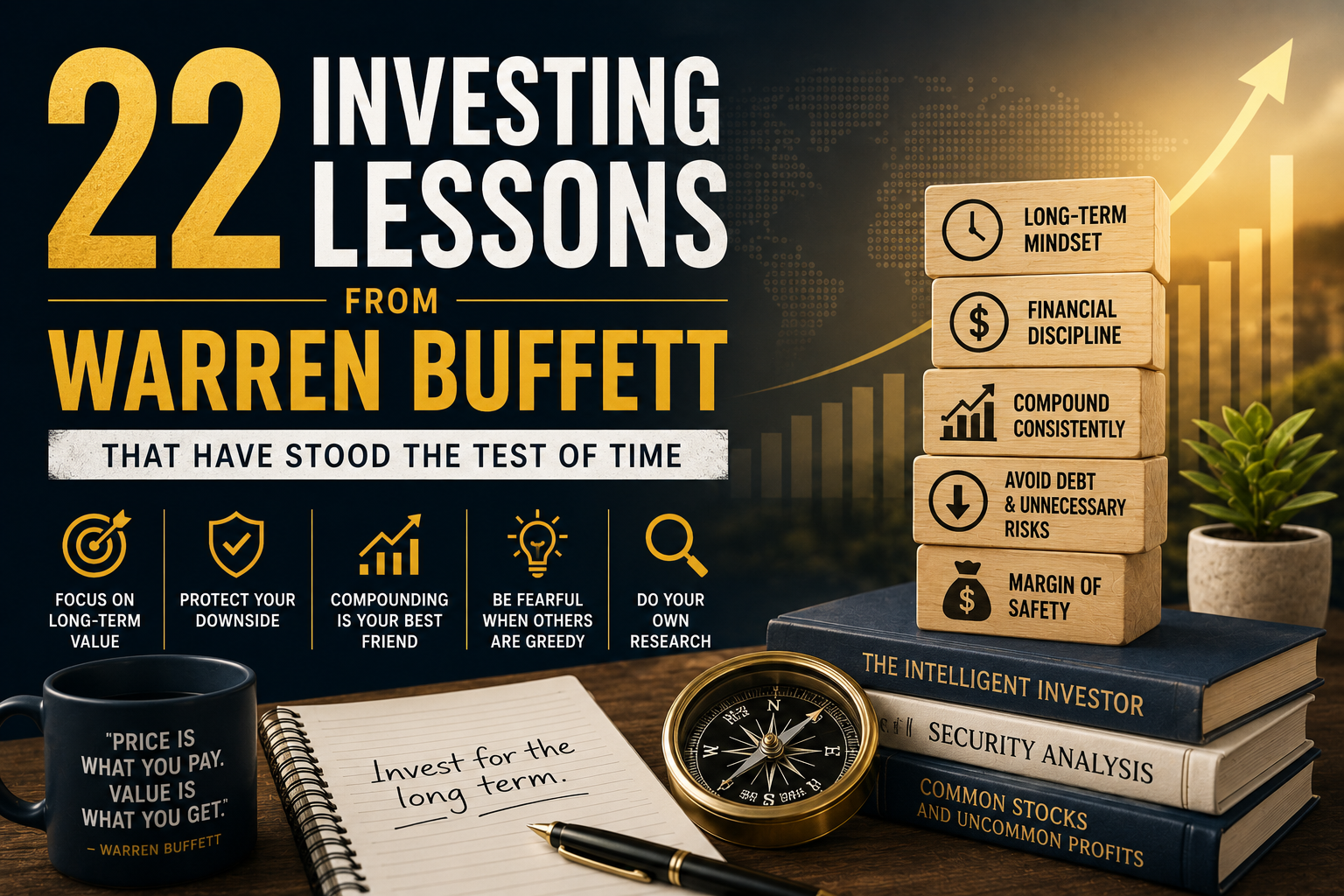
22 Investing Lessons from Warren Buffett That Have Stood the Test of Time
By Jamie McIntyre
Chief Editor, Australian National Review
Author of Stock Market Lessons Learnt from Warren Buffett
Few investors in modern history have had a greater influence on long-term wealth creation than Warren Buffett. In a remarkable one-hour lecture delivered in 1998, Buffett shared timeless insights into investing, business, risk management and personal success.
Nearly three decades later, those lessons remain just as relevant, offering guidance not only for investors but also for entrepreneurs, business owners and anyone seeking to build lasting wealth.
As someone who has spent decades teaching Australians about investing through shares, property and alternative assets, I have always found Buffett’s principles refreshingly simple. Markets evolve, technology changes and new investment trends emerge, yet the fundamentals of successful investing remain remarkably consistent. Buffett’s wisdom is as relevant today as it was when first delivered.
The following are 22 of the most valuable investing and life lessons drawn from Warren Buffett’s famous masterclass, together with observations on why they continue to stand the test of time.
1. Protect Your Capital First
Buffett argued that there is little point taking excessive risks once you have already accumulated meaningful wealth.
His philosophy is simple: the upside from taking unnecessary risks is often insignificant compared with the devastating consequences if things go wrong.
Successful investors understand that preserving capital is just as important as growing it.
2. Never Risk What You Need for What You Don’t
One of Buffett’s most memorable observations was that many people risk money they cannot afford to lose in pursuit of money they do not actually need.
He believes no investment opportunity is worth risking financial ruin.
3. Intelligence Alone Is Not Enough
The collapse of Long-Term Capital Management demonstrated that exceptionally intelligent people can still make catastrophic financial mistakes.
Knowledge without sound judgment and humility can become dangerous.
4. Risk Isn’t Volatility
Buffett has long rejected the idea that volatility equals risk.
Instead, he defines real risk as the permanent loss of capital caused by poor decisions, excessive leverage or investing in businesses that are not properly understood.
5. Invest Only in What You Understand
One of Buffett’s most famous principles is staying within your “circle of competence.”
If you cannot clearly explain how a business makes money, you probably should not invest in it.
Complexity often hides danger.
6. Look for Businesses with Wide Economic Moats
Buffett compares great businesses to castles protected by wide moats.
Those moats may come from strong brands, low costs, patents, distribution networks or customer loyalty.
The objective of management should always be strengthening that competitive advantage.
7. Competitive Advantages Can Disappear
History shows that no company is invincible.
Businesses such as Kodak once appeared untouchable before losing their competitive edge, while companies such as The Coca-Cola Company have continued strengthening theirs over decades.
Investors must continually assess whether a company’s moat is widening or shrinking.
8. Brand Matters
Buffett believes that occupying a customer’s mind is often more valuable than simply holding market share.
Strong brands reduce customer uncertainty, allowing businesses to command premium prices and maintain long-term loyalty.
9. Pricing Power Is Gold
Exceptional businesses can increase prices without significantly reducing demand.
Buffett frequently cites See’s Candies as a textbook example of a company with extraordinary pricing power and minimal capital requirements.
10. Capital-Light Businesses Often Win
Businesses requiring relatively little ongoing capital investment can generate exceptional returns for shareholders.
Companies that earn royalties, licensing income or transaction fees often produce outstanding long-term economics.
11. Stay Within Your Circle of Competence
The size of your expertise matters far less than knowing its boundaries.
Successful investors are comfortable saying, “I don’t know.”
12. Ignore Macro Forecasts
Buffett has never based investment decisions on economic forecasts, interest rate predictions or political events.
Instead, he focuses on buying outstanding businesses at sensible prices.
13. Patience Is a Competitive Advantage
Wall Street rewards activity.
Buffett rewards inactivity.
Rather than constantly trading, he prefers buying outstanding businesses and holding them for many years.
14. Diversification Has Limits
For most investors, diversified index funds remain an excellent solution.
However, Buffett argues that investors with exceptional analytical ability often benefit more from concentrating capital into their highest-conviction opportunities rather than spreading investments too thinly.
15. The Biggest Cost Is Often Opportunities Missed
Buffett believes his largest investing mistakes have not been the investments that lost money.
Instead, they were the outstanding businesses he understood but failed to buy.
Opportunity cost is often invisible but enormous.
16. Focus on the Business, Not the Timing
Even world-class companies experience difficult periods.
Investors who continually wait for the “perfect” entry point often miss decades of compounding.
17. Hire for Integrity First
When evaluating people, Buffett looks for three qualities:
* Integrity
* Intelligence
* Energy
Without integrity, the other two become liabilities rather than strengths.
18. Character Determines Long-Term Success
Buffett encourages students to imagine buying 10% ownership in one of their classmates.
Most would choose the generous, trustworthy and dependable individual rather than simply the smartest.
Character compounds just as powerfully as capital.
19. Invest in Yourself
The habits that create outstanding people are largely choices.
Kindness, honesty, discipline and humility can all be developed over time.
Since each person owns 100% of themselves, Buffett believes becoming a better person is the highest-return investment available.
20. Habits Shape Your Future
Good habits are easy to build early and difficult to replace later.
Likewise, destructive habits become increasingly difficult to break with age.
21. Do Work You Love
Buffett advises young people to pursue careers they would happily choose even if money were no object.
Long-term success becomes much easier when passion and purpose align.
22. Never Forget How Fortunate You Are
Perhaps Buffett’s most philosophical lesson is gratitude.
He reminds audiences that where we are born, our talents, our health and our opportunities are largely matters of luck.
Recognising that reality encourages humility, generosity and perspective.
Lessons That Extend Beyond Investing
Although Buffett’s lecture focused on investing, many of its principles apply equally to business, entrepreneurship and life itself.
Successful people protect their reputation as carefully as their capital. They focus on long-term thinking rather than chasing the latest trend. They remain patient when others become emotional and they understand that great wealth is built over decades, not weeks.
Many of these principles also apply directly to property investing. Buying quality assets, understanding what you own, avoiding excessive debt, protecting cash flow, and allowing compound growth to work over long periods have created far more millionaires than speculation ever has.
Throughout my own investment career I have often found that the greatest fortunes are rarely created by constantly searching for the next exciting investment. They are created by making sound decisions, avoiding catastrophic mistakes, staying disciplined during market cycles and allowing time to become your greatest ally.
Perhaps Buffett’s greatest lesson is that investing is ultimately less about predicting markets and far more about mastering human behaviour. Those who learn patience, discipline, humility and continuous learning place the odds firmly in their favour.
Nearly three decades after this famous lecture, Warren Buffett’s timeless wisdom continues to guide investors around the world, reminding us that while markets constantly change, the principles of successful investing rarely do.





Leave a comment