


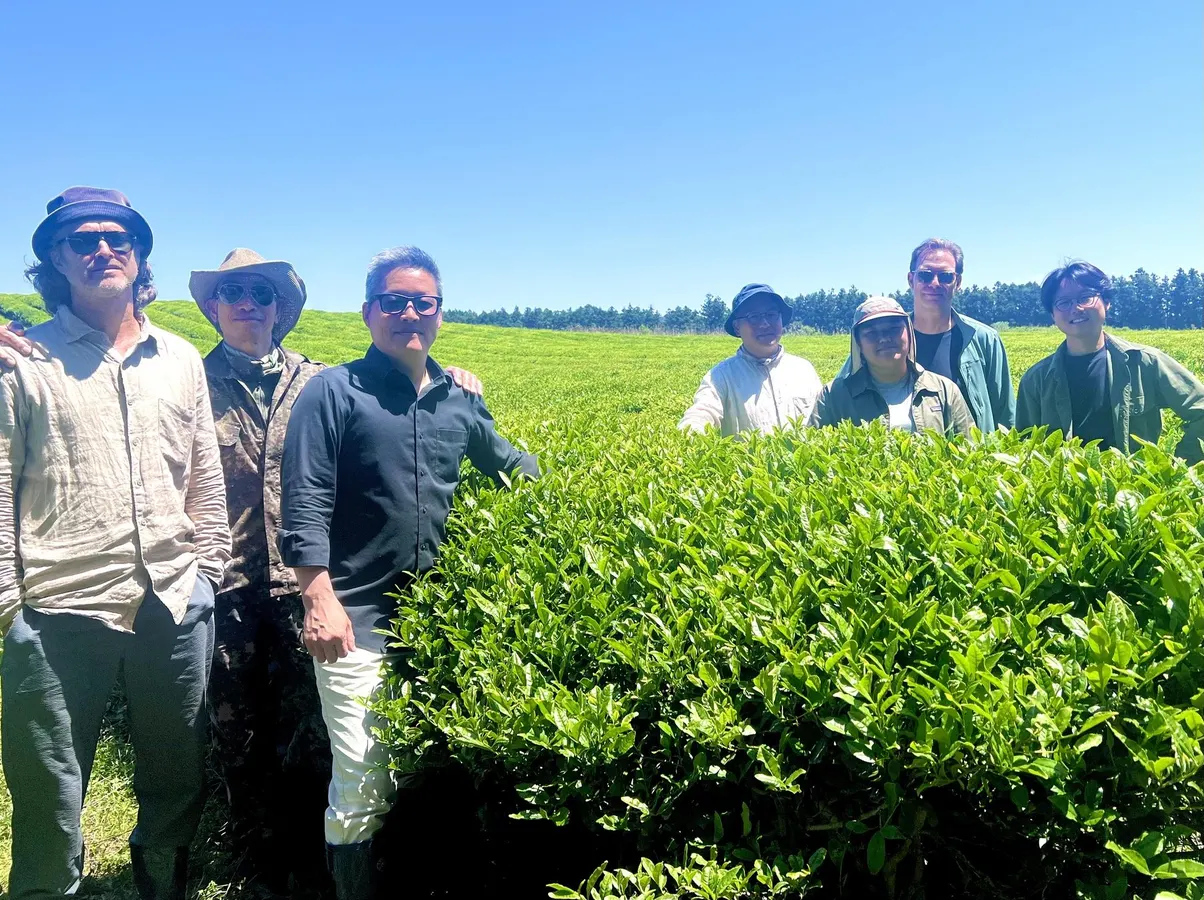

Wild Orchard Team on its Regenerative Organic Certified Tea Farm Jeju Island, South Korea
photo by author
Most tea trees today are planted from propagated cuttings, making their roots grow sideways in the ground.
At Wild Orchard Farmstead on South Korea’s enchanting Jeju Island, regenerative organic tea seeds are planted into the dark, pliable, nutrient-rich soil that allows its roots to grow as deep as the trees are tall.
Those living roots carry minerals down into the earth to create a thriving subterranean ecosystem–fungi, earthworms, nitrogen–biodiversity–on this storied 1,000 acre plot of land; the largest tea farm in Korea on this tiny island. The soil here is full of life–dig your nose into it and you practically smell salty seawater that drifted from the nearby ocean.
25 years in the making, and continuing to improve, this land has bloomed some of the most prized tea in the world. With nearly 30 international awards to its name, Wild Orchard is breaking new ground and regenerating old ground–through careful stewardship by humans and the most natural of lives by wildlife; specifically, orange-billed geese that graze its tea fields.
It is the visual embodiment of regenerative organic agriculture: utilizing what we have been given, not synthesizing a deceptive reality. From its proprietary tea blends like After Rain–harvested after the first rainfall in Spring–to the introduction of Black Matcha–oxidized powdered tea intended for lattes–these teas are crafted by a cast of co-op members who promote a zenith of health and peace, reshaping the meaning of Korean tea in the mainstream market.
“If we take on the principles of regenerative farming, which is really nature at its core, then we believe it’s a universal law that the company will do well and everyone will be fulfilled,” Michael Ham, cofounder of Wild Orchard, tells me. “This is not just about the absence of chemicals, but the presence of life,”
Mongjungsan cofounder Master Choo
photo by author
The Mountain Between Dreams
Regenerative organic farms can be challenging to maintain–its stewards don’t take shortcuts, but they make up for it with efficiency and a long-term plan that sets future generations up for success. Wild Orchard Farmstead’s operation, which takes its cues from nature itself, is so efficient that it does not require any irrigation system. Part of that reason is because of the specific geography of this treasured land.
Radish cover crop in the foreground, and Hallasan in the backdrop of Wild Orchard tea fields
photo by author
Nestled in the shadow of Jeju Island’s signature Hallasan, a dormant volcano and South Korea’s highest mountain peak, the plot of land that makes up Wild Orchard Farmstead experiences its own microclimate. It was chosen by B.E. Yoo in 1996.
“Back in the day, the land was barren,” says Joel Baek, Assistant Manager at Wild Orchard Farmstead. “Mr. Yoo fed the cattle organic food and they spread their organic matter, stomping on the ground and pushing it deep in the soil before the tea seeds were planted.”
Seed-grown tea is a rarity today. The seeds of the Camellia Sinensis, which we understand as the standard tea plant, were planted three years after Yoo committed to repairing the damaged land for the sake of human and environmental health.
These seeds originated on Mongjungsan, its Mother farm in the town of Boseong, on the southern coast of the Korean peninsula. The tea seeds take many years to grow deep into this volcanic soil, whereas cuttings take a fraction of the time, which is why they are more commonly used. But regenerative organic agriculture is not about rushing for maximum yield.
“Many things we do here, you can’t see with your eyes,” Baek adds.
These deep roots help bring up nutrients and flavor into the tea leaves. Structuring the farm in this fashion has enabled the regenerative organic systems that define it today, including the immense amount of rainfall it receives.
Tea seeds at Wild Orchard that originated at Mongjungsan create deep, straight roots
photo by author
“It’s imperative for a high-quality tea to have a lot of moisture,” Ham says. “The magic of being able to retain water naturally here is because we planted from seed. Shallow roots from cuttings don’t have the ability to retain the water as well,” he continues. “Other farms have sprinklers because their root system is not capable of retaining the water as well. You will never see any sprinklers here.”
Together with a protege of his named K.Y. Choo (more commonly referred to by his peers as Master Choo) Mr. Yoo brought Mongjungsan to life. Their vision was to create a regenerative organic farm as we know it today, but that was not a term back then, it was simply the practices they knew would allow nature to do what it was designed to do.
“Mongjungsan means ‘the mountain between dreams.’ There is a mist that covers the mountains, and the clouds come by,” Master Choo says. “We took some of the seeds from Mongjungsan and then in 1999 took a boat to Jeju with the seeds. The same way we took care of the gardens there, we take care of here at Wild Orchard.”
Master Choo harvesting tea
photo by author
Mongjungsan is the first tea field to earn the Korean Organic certification and the first Korean tea field also to receive USDA Organic Certification. “No one knew about organic at the time,” Master Choo adds. “We never used any chemical inputs, which was a first in Korea. We put a lot of effort into maintaining this land as 100% organic.”
A 6th degree Black Belt in Judo, Master Choo jokes that his nickname is T.J.T. “It stands for Tea, Judo, then more Tea,” he says amusingly. “Exercise promotes circulation. Tea builds up your capillaries and strengthens your blood vessels. We need to have tea and exercise together, it promotes longevity and health. This is how we need to live.”
Clover, mugwort and radish act as cover crops around the tea trees at Wild Orchard, protecting the soil from the sun’s powerful rays and adding their unique nutritional profiles to the underground ecosystem. The farm has grown so drastically in the past 27 years so the primary harvest comes from newer tea trees. But the same trees planted initially from Mongjungsan remain as a symbol of where the farm began and what the farm will look like in the future.
“Every few decades most farms have to uproot the plants. You don’t have to do that here, “Ham explains. “This is a side component of regenerative organic. You’re extending the lifespan of the plants…It’s a stewardship model.”
Wild Orchard cofounder Michael Ham among the farm’s original tea tress
photo by author
The Highest Standard
As one of the cofounders of the Wild Orchard brand who’s diligently working to expand this top-quality tea in America, Michael Ham is deeply ingrained in the story of these tea fields.
When Ham was beginning his career in nonprofits in the early 2000’s, a college friend, Keith, invited him to see where his dad was building a new business on Jeju Island. Ham wasn’t particularly a tea drinker even though he grew up in a Korean household drinking cultural infusions like barley and buckwheat, but it was nothing like what he had experienced here.
Highly-nutrient rich soil at this Regenerative Organic Certified farm
photo by author
“When the farmers spoke about their vision for the farm, I was enamored,” Ham says. “It was to create a pure, healthy, nourishing tea and share it with the world, but in a way that respects the environment.”
Keith’s father is Mr. Yoo. He’s not only a visionary in tea, but for mother earth. “When Korea came out of the Korean War, it was the fastest-developing country in the world,” Ham explains. “A lot of nature was being destroyed for development.”
That concept irked Mr. Yoo, so instead, he planted trees. That became Mongjungsan.
Ham himself now drinks green tea throughout the day. “I have a lot more energy and focus in my 50’s than even in my 30’s,” he says. “Incorporating tea and matcha in my daily life has changed my physiology and my mental makeup.”
In 2020, once the Wild Orchard brand gained steady footing in Korea, Ham established its North American presence, around the same time he heard about the new Regenerative Organic Certification. “We’re already exactly doing this,” he remembers thinking when he read its standards. Wild Orchard soon became the first ROC-Certified Tea farm, the highest standard for responsible farming practices. Subsequently, Mongjungsan also earned the ROC Certification.
Geese grazing the Wild Orchard tea fields
photo by author
Grazing Geese
Wild Orchard Farmstead is a quintessential regenerative organic property that stimulates every sense. Visually, the regenerative organic nature presents itself in the way it has integrated livestock into its farming practices; in this case, geese.
“Geese are a legend here,” Shin Kuk Jae, President of Wild Orchard Farmstead, tells me.
Geese act as natural pest management on Wild Orchard’s regenerative organic farm
photo by author
These mesmerizing Embden geese graze in large gaggles throughout the tea fields. Spraying aggressive pesticides on our food is not natural nor healthy–and not regenerative–so the geese function as a natural form of pest control, grazing the weeds and grasses, while allowing their manure to act as fertilizer for the soil. This is the regenerative cycle that mimics the way ecosystems are designed to work–Organic food to organic manure to organic soil.
“This reduces our costs,” Shin says. “Only five percent of farms in the whole world practice organic cycling farming.”
While still not perfect, the farm has implemented new practices, like fencing, to limit the amount of geese killed by coyotes. “We stopped the practice many years ago because their feathers were causing problems and wild animals were killing them,” Shin adds. “But we had problems without them, so we brought the geese back.”
Young Ho Choi, Wild Orchard’s poultry farmer
photo by author
The geese are a spiritual symbol of Wild Orchard–part of the reason they are pictured in its logo. It all connects to the origins of the Farmstead, when cattle would roam the land in preparation for planting the tea trees. Geese became more practical to roam the fields because cattle were too heavy for the grounds once the tea matured. But Wild Orchard does raise dairy cows and sells its regenerative organic A2 dairy in South Korea, in addition to raising other livestock, including 9,000 chickens, also selling their eggs.
A regenerative practice implemented here is to reduce as much waste as possible, so the same cows are also raised for their meat, whereas most dairy cows are used strictly for their milk, often enjoyed later on the farm as a delicious bulgogi lunch.
“Farming regeneratively teaches resiliency,” Ham says. “If you go and allow nature to work as designed, even though it takes a lot of discipline, it’s very rewarding. You feel like you have this purpose every day when you’re aligned between the farm and the business.”
Joel Baek (l) and Shin Kuk ‘Kuky’ Jae (r) at Wild Orchard Farmstead
photo by author
Catechins And Polyphenols
After working at Wild Orchard for nearly a decade, Shin became President of the cooperative. “I much prefer working in the field, but they elected me and I have a responsibility,” he says. “My primary mission here is to be able to teach a younger generation about maintaining this philosophy in farming to sustain the future as well.”
This philosophy he speaks of goes back to the story of Mr. Yoo creating Wild Orchard, fostering land for the health of humans and the environment. “Our history is very simple,” Shin explains. “Food should be something that you profit off of. Food is something to make people healthy, not just physically, but mentally.”
Freshly-harvested tea
photo by author
Shin and his family moved to Brazil when he was a teenager during a big emigration wave. He eventually met his wife, Bonnie, who is from Jeju, and was also living in São Paulo. Green tea is extremely special to the couple, as Bonnie began drinking a lot of it after having infertility struggles, ultimately crediting the health benefits of green tea for helping her have their first child. Although they were planning to move to Canada, visa issues got in the way, so they decided to return to Jeju to teach their daughters about their Korean heritage.
“I wasn’t planning to work at the farm,” Shin says. “But I knew about Mongjungsan from Master Choo, so I had a deep appreciation for the philosophy of Wild Orchard.”
The deep emphasis on health at Wild Orchard is vividly seen in its non-vivid matcha. Its signature green matcha is not the bright green color that’s gotten matcha so much attention in recent years. It’s more of a pastel green, intentionally, because it was grown to be healthier. In reality, it’s not the shade of the matcha that defines its quality, but the way in which the leaves were grown.
“Our matcha is sun-grown,” Ham says. “This is healthier because it’s producing more catechins, and it may be a little bitter, but when you make it into a latte, it’s a perfect mix.”
Farmers at Wild Orchard Farmstead
photo by author
Green tea is one of the greatest natural sources of ultra-antioxidant-rich catechins, proven to balance metabolism, fight the growth of cancer cells, and lower blood pressure, among other health benefits. They are bioavailable and not impacted by the temperature of water. “Wild Orchard teas are packed with catechins because our seed-grown trees push deep tap roots into Jeju’s volcanic soil for a more potent leaf,” Ham explains. “Because matcha is ground from the whole leaf, you get its full potency in every cup.”
While all crops function differently, when it comes to tea, more sunlight equals more nutrients. Most other tea around the world is grown in shaded areas, may create a sweeter-tasting product, but contains less catechins and other nutrients. Wild Orchard matcha, which was designed specifically to make matcha lattes as a lower barrier to entry, does receive some shade prior to harvest to increase its umami.
“We have one extended Spring harvest. Most tea farms have a few every year,” Baek says. “That means for the entire year, we are building up the amino acids, catechins and polyphenols which develop slowly over the winter.”
This does provide less yield, but yield is not the goal at Wild Orchard–human and environmental health is. The extended harvest also allows the farmers to reduce tillage. They are also now preparing land to grow other herbs and botanicals that will become part of the tea blends, adding more biodiversity to the farm, and placing all of its products, including its Sunday Brunch and English Cottage tea blends, on the path to receive ROC Certification in addition to its pure green, black and oolong teas.
Wild Orchard is beginning to roll out additional ways to consume its green tea, including single-serve shots and concentrated tablets–all different vessels to retrieve these hyper-intensive health benefits with utmost efficiency.
Wild Orchard teas
photo by author
Generational Tea
Every individual tea leaf grown at Wild Orchard is plucked by hand, totaling about 100 kilograms per day during peak harvest season. Farmers pick the soft, bright leaves, not too deep into the bush where they get no sunlight, but also not too high up where they have grown too large; just underneath the canopy is the sweet spot. Each leaf is a different size–wildly imperfect. That’s regenerative agriculture. Everything looking exactly the same is unnatural.
Years ago at Mongjungsan, Master Choo created a process to wash the tea leaves as the first step post-harvest, and this is now the standard at Wild Orchard. Washing is not a standard process at other tea facilities around the world.
Wild Orchard’s unique tea-washing process
photo by author
The tea leaves are placed in bubbling jacuzzis four times over, ridding them of any impurities, albeit minimal given that the farm is organic and so large that there is no pesticide drift from neighboring farms.
“In Asia, you get a yellow dust from China. Most tea farms package it because you can’t see it,” Ham explains. “But the motto that Mr. Yoo said, is ‘a clean harvest can only come from a clean conscience.’ So we cannot package this knowing that there’s gunk on there.”
One of Wild Orchard’s head tea makers, Jason Jeong, imparts his love for tea making in every wash, every roll, and every scoop of matcha he creates with his hands.
“When I work here day-to-day, it’s not on my radar that people around the world are consuming this,” Jeong tells me. “I see myself as a bridge between this wonderful thing that nature makes and the people who are connected to it by consuming it.”
Wild Orchard’s Jason Jeong drying tea
photo by author
Once the leaves are washed, the goal is to remove all of the moisture. To make green tea, the leaves are roasted in a 400 degree Fahrenheit stainless steel bowl as tea makers like Jeong massage the leaves throughout for several minutes. “This fixation process is the most important part of tea making,” Baek says. “You need to be precise to bring out the green tea flavors. Oils are released and the fibers break down. It works with all of your senses.”
Black and oolong teas are not roasted, but oxidized to bring out different aromas. “Green tea is what we think of as the healthiest tea,” Ham says. “Some components change during the oxidation process, so you get a little less antioxidants with black and oolong, but you get more caffeine, more like a half a cup of coffee, and green tea is like a quarter cup.”
The final bit of moisture is removed during the rolling process, which also helps break down the tea leaf cells before they are completely dried and ready to be packaged.
Jeong roasting tea
photo by author
Wild Orchard lives up to its Regenerative Organic Certified promise, which consists of a social fairness component. The farmstead is a cooperative made up of 3,000 members, including the Jeong family. “My dad is the head tea maker here,” Jeong says. “He taught me the sensory aspects of what makes good tea.”
The past 25 years of stewardship have grounded Wild Orchard in a strong foundation for a new generation to take the reins of this powerful company. Jeong and his sister, Helen, are second generation tea makers in an era when the profession is largely aging out as younger generations decide to move to big cities. But the two siblings witnessed the prosperous lives their parents have lived, enabled by the Wild Orchard cooperative, empowering the two to continue their family trade. “It’s great to be part of a cooperative, but more than that, I’m humbled to be part of this green tea movement,” Jeong says. “I’m able to cultivate my skills and contribute to something that goes beyond anything I ever imagined.”
Ham adds, “Wild Orchard is not a typical CPG company where we build it up and exit. This is something we want to leave in the hands of the next generation to prolong and live the same mission we have today.”
Wild Orchard Farmstead sits in the valley among four different mountains, each which now has the best view of the transformation that has occurred here on Jeju Island, starting with one seed–a radical act in itself–now a global example of what it means to regenerate the land through loving stewardship, and creating a product for all humans to feel that same sense of regeneration.
“If we respect nature,” Shin says, “nature will reward us.”
















Leave a comment