


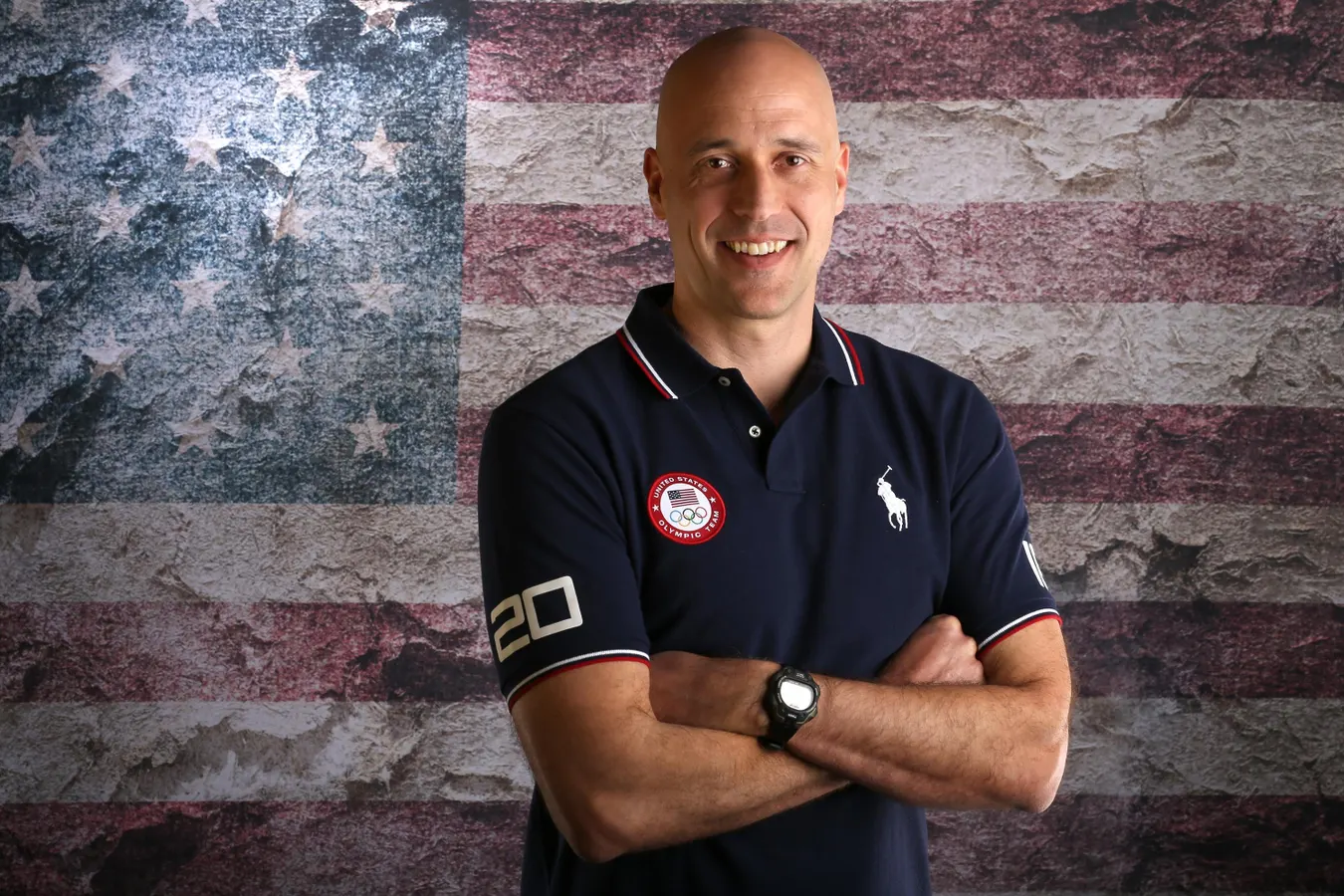

BEVERLY HILLS, CA – MARCH 08: Head coach John Speraw of the men’s US Olympic indoor volleyball team poses for a portrait at the 2016 Team USA Media Summit at The Beverly Hilton Hotel on March 8, 2016 in Beverly Hills, California. (Photo by Sean M. Haffey/Getty Images)
Getty Images
USA Volleyball’s Director of National Teams reflects on Olympic heartbreak, legendary UCLA coach Al Skates and the leadership philosophy shaping America’s pursuit of gold at LA28.
(This is part one of a two-part story is based on a Forbes exclusive interview with John Speraw on July 10, 2026. All quotes are taken directly from a transcript of the interview. Part two will be published Thursday August 6, 2026)
As Los Angeles prepares to welcome the world for the 2028 Olympic and Paralympic Games, few leaders are more closely connected to Southern California’s volleyball legacy than John Speraw.
Raised in the West San Gabriel Valley before starring at UCLA, Speraw has spent more than three decades helping shape American volleyball—from NCAA championships to Olympic podiums. After leading the U.S. Men’s National Team to bronze medals at the Rio 2016 and Paris 2024 Olympic Games, he now oversees all of USA Volleyball’s national team programs as Director of National Teams, helping position the sport for what could become its defining moment when the Olympic spotlight returns to Los Angeles.
Long Beach, CA – May 04: Head coach John Speraw, left, of UCLA Bruins poses with athletic director Martin Jarmond with the championship trophy after defeating Long Beach State 25-21, 25-20, (29-27), 25-21 to win the NCAA men’s volleyball national championship in the Walter Pyramid on the campus of Cal State Long Beach in Long Beach on Saturday, May 4, 2024. (Photo by Keith Birmingham/MediaNews Group/Pasadena Star-News via Getty Images)
MediaNews Group via Getty Images
In an exclusive interview with Forbes, Speraw spoke about the mentors who influenced and shaped his career, the culture that fueled Team USA’s success, and the Olympic moments that still occupy his thoughts years later.
Great Coaches Have Mentors
Throughout the conversation, one name would surface repeatedly.
Al Scates.
For volleyball fans, Scates is synonymous with another UCLA coaching legend: John Wooden. Scates coached at UCLA for 50 years (1963-2012) and won 19 NCAA men’s volleyball championships. Yet Speraw believes the broader sports world still doesn’t fully appreciate Scates’ influence—not only on volleyball, but on generations of leaders who learned under him.
“He’s one of the great coaches in American sports history,” Speraw said. “So many of us are still in this sport because of the positive influence he had on our lives.”
Portrait of Coach Al Scates
Bettmann Archive
An Education Beyond Volleyball
Speraw’s education at UCLA extended well beyond the volleyball court. He describes arriving in Westwood at a unique moment in Bruins history, where the philosophies of basketball icon John Wooden still resonated, while Scates would continue to build what became the winningest coaching résumé in UCLA athletics.
“The Wooden influence was such a core philosophy of what we did at UCLA,” Speraw explained. “Then there was Al Scates, the winningest coach in UCLA history. I had the opportunity to absorb from both of them.”
While Wooden became known worldwide for the Pyramid of Success, Speraw says Scates possessed a different genius—one built around relentless innovation. Long before analytics became fashionable across professional sports, Scates was charting every serve, attack and rotation by hand. Each evening after matches, assistants painstakingly recorded individual statistics before Scates spent hours calculating patterns himself.
UNITED STATES – MARCH 21: College Basketball: NCAA Final Four, UCLA coach John Wooden victorious with team, trophy, and net after winning championship game vs Duke, Kansas City, MO 3/21/1964 (Photo by Rich Clarkson/Sports Illustrated via Getty Images) (SetNumber: X9899 TK2)
Sports Illustrated via Getty Images
The process bordered on obsession.
Speraw laughed while recalling the night he accidentally left one of those stat sheets in his backpack. At nearly three o’clock in the morning, his phone rang. Scates couldn’t finish his nightly analysis because one page was missing.
“I had to drive to a 24-hour Kinko’s and fax it to him,” Speraw recalled. “He literally couldn’t go to sleep until he finished all the statistics.”
Today, every elite volleyball program relies on sophisticated analytics. Three decades ago, Scates was doing the same work with paper, pencils and determination.
Sicily Changed Everything
Ironically, coaching wasn’t part of Speraw’s original career plan. Unlike many future coaches, he wasn’t drawing up lineups as a teenager or dreaming about standing on a sideline. After graduating from UCLA, he expected medicine—not volleyball—to define his future. He worked at UCLA Medical Center while considering medical school and preparing for the MCAT. Volleyball appeared to be ending.
Instead, it quietly began again. When Doug Beal asked Scates to coach Team USA at the 1997 World University Games in Sicily, Skates invited his former player to become his assistant. That decision permanently altered Speraw’s career. His first coaching assignment also came with an unexpected bonus. He shared a hotel room with one of the greatest coaches in American sports.
There, spread across two beds inside a modest room in Sicily, Scates walked his young assistant through opponent tendencies, statistical matchups and strategic planning before matches. Looking back nearly three decades later, Speraw still speaks about that experience with visible gratitude.
FAIRFAX, VA – MAY 06: Head coach John Speraw of UCLA Bruins is interviewed on the court after defeating the Hawaii Rainbow Warriors during the Division I Mens Volleyball Championship held at EagleBank Arena on May 6, 2023 in Fairfax, Virginia. (Photo by Scott Taetsch/NCAA Photos via Getty Images)
NCAA Photos via Getty Images
“I was getting one-on-one tutoring with one of the all-time greats in American sports history,” he said. “It was incredible.”
For Speraw, Sicily wasn’t merely a coaching assignment. It became his graduate school.
Building Leaders, Not Just Teams
Perhaps Skates’ greatest legacy isn’t measured by championships. It’s measured by the people he developed. Speraw points toward an extraordinary coaching tree that includes Olympic legends, collegiate coaches and professional leaders who continue shaping the sport (and beyond) decades after wearing UCLA uniforms. He describes annual gatherings where former Bruins from multiple generations reunite around the coach who connected them.
“It’s like a fraternity,” Speraw said. “We’re all the same.”
The common characteristics are striking. Competitiveness. Curiosity. Humility. Humor. Speraw laughs when discussing another side of Scates rarely seen publicly.
“Most people don’t know he is absolutely hilarious,” Speraw said. “He knew when it was time to compete, but he also knew when it was time to enjoy yourself. We all learned that balance.”
Those lessons would later become foundational as Speraw assumed one of the most demanding coaching jobs in international sport.
Changing The Culture
USA’s coach John Speraw (L) speaks to his players during the men’s semi-final volleyball match between Italy and USA at Maracanazinho Stadium in Rio de Janeiro on August 19, 2016, at the Rio 2016 Olympic Games. / AFP / Juan Mabromata (Photo credit should read JUAN MABROMATA/AFP via Getty Images)
AFP via Getty Images
When Speraw became head coach of the U.S. Men’s National Team, he inherited extraordinary talent. He also inherited strong personalities. Olympic veterans brought years of professional experience, strong opinions, and competitive drive. Managing that environment required more than technical expertise. It demanded emotional intelligence.
“My initial focus was trying to build a much more cohesive team culture,” Speraw explained.
Rather than emphasizing tactics alone, Speraw concentrated on psychology. His program rested on two words: Tough and Together
CURITIBA, BRAZIL – JULY 04: John Speraw, head coach of the Unites States in action during the match between France and the Unites States at Arena da Baixada Stadium during day one of the FIVB World League 2017 – Group 1 Final, on July 04, 2017 in Curitiba, Brazil. (Photo by Alexandre Schneider/Getty Images for FIVB)
Getty Images for FIVB
The philosophy became the emotional foundation of Team USA. How would players respond during Olympic pressure? How would they support one another after mistakes? Could collaboration become a competitive advantage?
“I wanted to maximize our potential through collaboration,” Speraw said. “The values we emphasized were tough and together.”
Over twelve years, that philosophy helped produce one of the most consistently successful eras in American men’s volleyball. Yet the Olympic Games have a way of defining careers by the thinnest possible margins.
The Medal That Wasn’t Enough
Most Olympic coaches would celebrate two bronze medals. Speraw appreciates them. He also remembers what almost happened. Rio 2016. Paris 2024. Two Olympic semifinals. Two heartbreaking five-set defeats that denied Team USA an opportunity to play for gold.
RIO DE JANEIRO, BRAZIL – AUGUST 21: United States team seen with their bronze medals following the Men’s Gold Medal Match between Italy and Brazil on Day 16 of the Rio 2016 Olympic Games at Maracanazinho on August 21, 2016 in Rio de Janeiro, Brazil. (Photo by Tom Pennington/Getty Images)
Getty Images
“My regrets are the semifinals,” Speraw admitted. “We were there twice.”
Even now, he replays moments from those matches. A substitution. A serve. One decision. One point. Elite sport often compresses years of preparation into seconds.
“The margins are close,” he said. “That’s why sport is great—and sometimes hard.”
What gives Speraw the greatest satisfaction, however, wasn’t simply the medals. It was how his teams responded after devastating disappointment. Winning a bronze medal match immediately following an Olympic semifinal loss may be one of the most difficult emotional challenges in sports. Twice, his players found the resilience to regroup. Looking back, Speraw believes that achievement reflected something deeper than volleyball.
The USA men’s volleyball team celebrates their bronze medal win with a 3-0 victory against Italy on Friday, Aug. 9, 2024, at South Paris Arena 1 during the 2024 Paris Olympic Games. (Brian Cassella/Chicago Tribune/Tribune News Service via Getty Images)
TNS
It reflected culture.
“It probably speaks to the team part more than anything,” he said. “When you have the heartbreak of the semifinal, you’ve got to come together.”
Leading USA Volleyball Into LA28
As Los Angeles counts down to LA28, Speraw now finds himself leading American volleyball from an even broader perspective—not as one national team coach, but as the executive responsible for also expanding the sport’s reach across the country.
It is a challenge every bit as ambitious as preparing a team for the Olympics. It could become his most significant legacy.
In Part Two: John Speraw discusses why the years leading into LA28 represent a once-in-a-generation opportunity as volleyball in America continues to surge through youth participation, commercial investment and the continued rise of women’s sports.














Leave a comment