


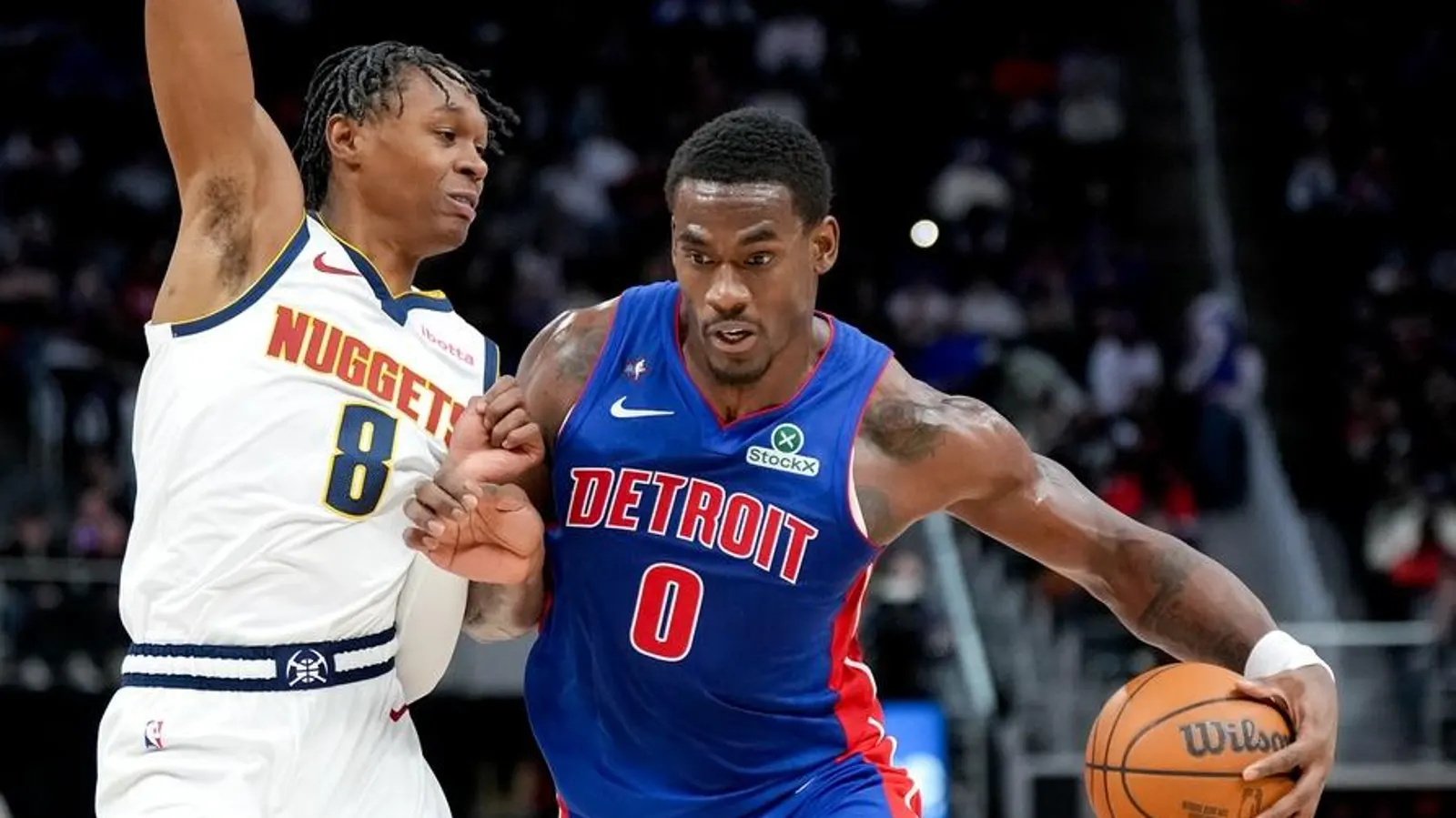

DETROIT, MICHIGAN – FEBRUARY 03: Jalen Duren #0 of the Detroit Pistons dribbles the ball against Peyton Watson #8 of the Denver Nuggets at Little Caesars Arena on February 03, 2026 in Detroit, Michigan. NOTE TO USER: User expressly acknowledges and agrees that, by downloading and or using this photograph, User is consenting to the terms and conditions of the Getty Images License Agreement. (Photo by Nic Antaya/Getty Images)
Getty Images
The NBA and its players union appear poised to lock horns over the second apron during their next round of collective-bargaining-agreement negotiations in the next few years. That isn’t the only battle that the National Basketball Players Association should be looking to pick, though.
Restricted free agency is badly hampering players’ potential earning power, particularly with teams becoming more cautious than ever about handing out long-term, big-money deals. For every Walker Kessler, who cashed in this offseason with a four-year, $130 million deal in a sign-and-trade with the Los Angeles Lakers, there’s a Jonathan Kuminga, Quentin Grimes, Jalen Duren, Bennedict Mathurin and Peyton Watson, all of whom found themselves without many options once they became restricted free agents.
Grimes didn’t reach an agreement with the Philadelphia 76ers as a restricted free agent last summer, so he instead accepted his one-year, $8.7 million qualifying offer so he could become an unrestricted free agent this offseason. He proceeded to sign a four-year, $60 million deal with the Lakers on July 1, but not every RFA is so lucky.
After a four-month standoff with the Golden State Warriors last offseason, Kuminga took a two-year, $46.8 million deal with a second-year team option. At the time, ESPN’s Shams Charania described that team option as such: it was “designed for the Warriors—or another team if and when Kuminga is traded during the upcoming season—to rip up and complete a fresh new contract after the 2025-26 campaign.”
The Warriors did trade Kuminga to the Atlanta Hawks in February, and the Hawks did decline that team option ahead of free agency. It’s still unclear whether they’ll be footing the bill for his next contract or if another team will, though.
Duren likewise finds himself in a stalemate with the Detroit Pistons after his first All-Star and All-NBA season. A disappointing playoff showing closed the door on Duren possible receiving a max contract starting at 30% of the salary cap, but there’s still reportedly a wide gap between the two sides.
Had Duren been an unrestricted free agent, perhaps the Lakers would have splurged on him instead of having to give up two first-round picks and two first-round pick swaps to convince the Utah Jazz not to match their offer sheet for Kessler. Instead, the Pistons may be tamping down Duren’s market by threatening to match any offer sheet that he signs.
In essence, unless a player is willing to gamble on himself by taking the qualifying offer, teams have control over their first-round picks for at least the first four years of their careers and as many as the first nine. And their ability to match any offer sheet that a player signs in restricted free agency often deters interest in RFAs entirely.
How could the players’ union fix that? A few simple solutions could go a long way.
Move Up The Matching Window
Under the current system, restricted free agents can reach agreements on an offer sheet during the July Moratorium, but they aren’t allowed to put pen to paper until the moratorium lifts on July 6. At that point, their incumbent team has at least 36 hours to decide whether to match it.
However, free agency tends to move quickly these days. If a team saves its cap space for an entire week to spend on an offer sheet for a restricted free agent, it might not have many appealing options left if the player’s incumbent team decides to match.
As a result, most teams don’t even bother with handing out offer sheets in the first place. That in turn depresses the market for restricted free agents, particularly when teams telegraph through reporters that they plan to match any offer sheet that a player signs. (We’ll circle back to that later.)
But what if restricted free agents didn’t have to wait until July 6? What if the matching window began as soon as they agreed to an offer sheet, even if it happened during the moratorium?
The biggest hiccup with this proposal is that no agreements made during the July Moratorium are binding. (Just ask the Dallas Mavericks about DeAndre Jordan.) So, even if the RFA’s incumbent team declined to use its right of first refusal because it had its eyes on other free-agent plans, it could theoretically pull an about-face once the moratorium lifted on July 6.
That’s something the NBA and NBPA would have to negotiate during the next round of CBA talks. The NBPA should push to make a team’s right of first refusal binding, even if it happens during the July Moratorium.
But that isn’t the only chance it should pursue when it comes to restricted free agency.
Shorten The Matching Window
The NBPA has already made headway when it comes to the matching window for restricted free agents. Incumbent teams previously had 72 hours to decide whether to match an offer sheet, which further depressed interest in RFAs.
Currently, if a player’s incumbent team receives notice of an agreed-upon offer sheet prior to 12 p.m. ET, it has until 11:59 p.m. ET the following day to decide whether to match. If it receives notice after 12 p.m. ET, it has two full days to decide whether to match.
So, let’s say the NBA and NBPA agreed to move up the matching window and allow RFAs to put their incumbent teams on the clock during the July Moratorium. Even if a player agreed to an offer sheet on June 30, his incumbent team would have until July 2 to decide whether to match in this scenario. That’s a drastic improvement over the current system, but the free-agent board still could be relatively barren by July 3.
What if teams instead had 24 hours to decide whether to match regardless of when they received the offer sheet? Combined with the accelerated matching window, RFAs could have their answer as soon as July 1.
Granted, it might be tough to get teams to sign off on this change. The whole point of restricted free agency is to make it easier for teams to retain their free agents. These changes would run counter to that.
But as more bridges get burned during drawn-out RFA negotiations, teams might realize that they’re playing with fire whenever they go down that road.
‘We’ll Match Any Offer’
Back in 2015, Marc Stein reported for ESPN that the National Basketball Players Association believed that when teams pledged to match any offer sheet that a restricted free agent signs, it was “a circumvention of the salary cap.” The NBA sent a memo to teams that while it didn’t concur with the NBPA’s view, “league official see enough potential merit in the union’s stance to advise those who persist with match-and-offer chatter that they could be opening themselves up to legal action.”
Front office executives aren’t outright proclaiming their intentions regarding their RFAs like they once did, but they have enough media connections to get their message out loud and clear. That essentially has the same effect.
What if the next CBA gives the league commissioner leeway to punish teams for leaking messages like that? After all, the current CBA does allow the commissioner to punish agents and players for making public trade requests.
If the NBPA is truly concerned about “we’ll match any offer” proclamations being a form of CBA circumvention, it could eventually decide to push the issue via the legal system. Does the NBA want to risk going down that road?
If not, banning teams from leaking those types of messages to reporters could go a long way toward making more teams willing to gamble on offer sheets to RFAs as well.
Unless otherwise noted, all stats via NBA.com, PBPStats, Cleaning the Glass or Basketball Reference. All salary information via Spotrac and salary-cap information via RealGM. All odds via FanDuel Sportsbook.
Follow Bryan on Bluesky.














Leave a comment