


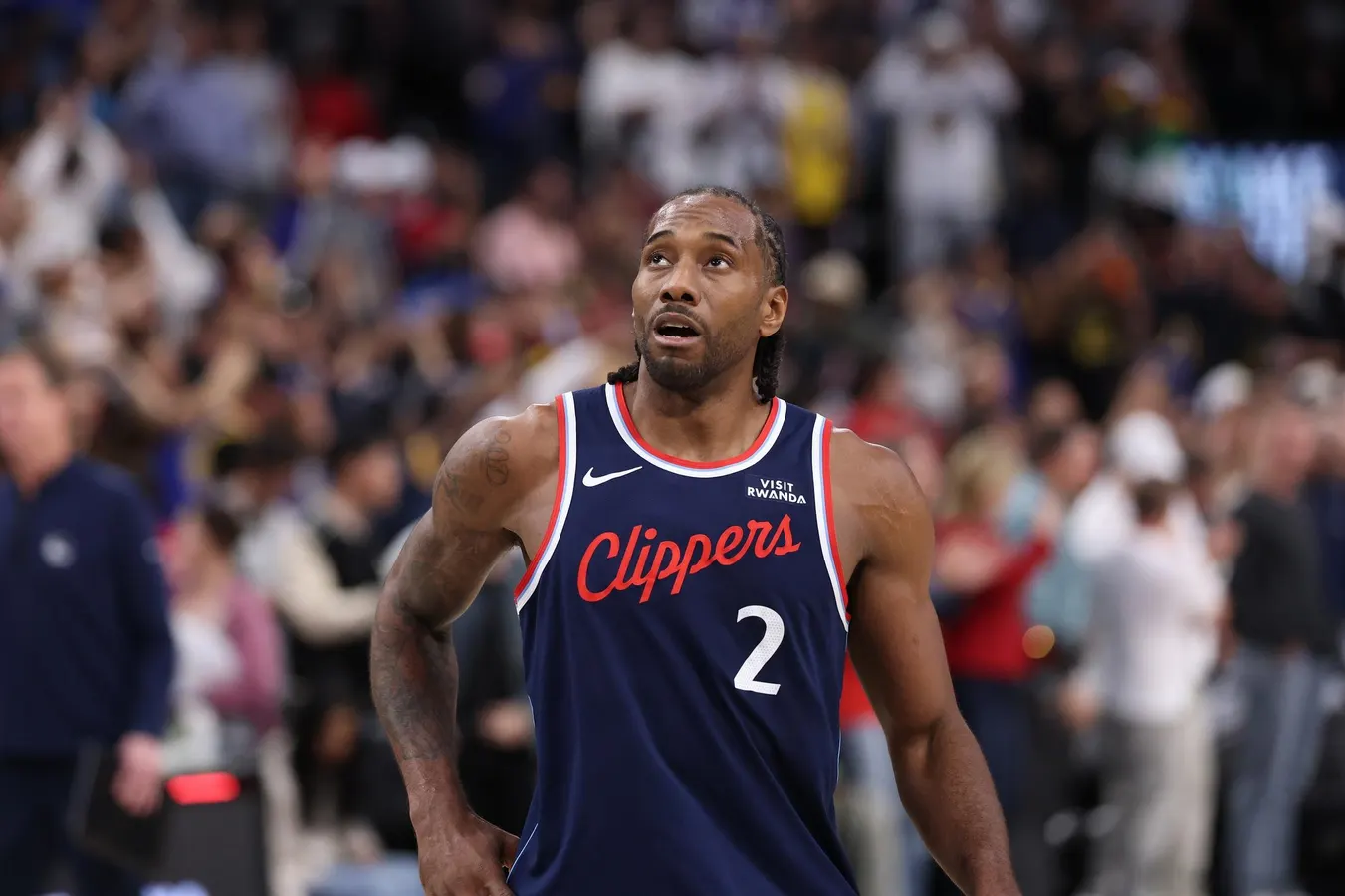

INGLEWOOD, CA – APRIL 15: Clippers forward Kawhi Leonard, #2, walks off the court after their season-ending loss to the Golden State Warriors during an NBA play-in-tournament at the Intuit Dome in Inglewood Wednesday, April 15, 2026. (Allen J. Schaben / Los Angeles Times via Getty Images)
Los Angeles Times via Getty Images
It’s been nearly one year since Pablo Torre of Meadowlark Media first reported on a “no-show” endorsement deal for Los Angeles Clippers forward Kawhi Leonard that was allegedly designed to circumvent the NBA’s salary cap. The NBA hired a law firm to investigate those allegations, but it’s still unclear when that investigation might wrap up.
Meanwhile, Torre dropped another bombshell last week. Leonard had another previously undisclosed sponsorship deal with the company that designed the Jumbotron for the Clippers’ new stadium, the Intuit Dome.
And once again, salary-cap circumvention was at the center of it.
“One of the high-level sources familiar with the relationship between the Clippers and Daktronics, who was under contract for the Clippers’ Intuit Dome project for years, goes on tape with us to say, ‘It was 1,000% a way to circumvent the salary cap,'” Torre reported.
The same source told Torre: “People at Daktronics, people within the Clippers’ organization themselves, had told me about this multimillion-dollar deal with Kawhi and Daktronics—they’re not a company that you would see a celebrity endorser for—that it wasn’t coming out of their end, that the Clippers were technically kind of funding it, and that it was funneling money from the Clippers through Daktronics back to Kawhi.”
In mid-July, Mike Vorkunov of The Athletic reported that the law firm’s investigation “has examined if Leonard had a previously unreported endorsement deal with another company.” Vorkunov has not commented on whether the alleged Daktronics deal is the one that he was referencing, although if it wasn’t, that would open an additional can of worms for Leonard and the Clippers.
Either way, NBA commissioner Adam Silver told reporters in mid-July that he wants the investigation to be “wrapped up before the beginning of next season.” The Clippers have already agreed to trade Leonard to the Toronto Raptors, but the Raptors plan to wait “until the league’s investigation is complete” before finalizing that deal.
On Monday, Jake Fischer of The Stein Line reported that Leonard “strongly believes that the trade will ultimately go through.” He added that the Clippers “are prepared to go to arbitration depending on the severity of the potential penalties that the league office could order after digesting the investigation’s complete findings.”
But if the NBA’s investigation finds Torre’s reporting to be accurate, it might have no choice but to drop the hammer on the Clippers. Failing to do so could set a dangerous leaguewide precedent, particularly as the second apron sinks its fangs into championship hopefuls.
A Not-So-New Path For Big Threes?
In January 2024, Leonard signed a three-year, $149.5 million extension that was roughly $10 million less than the maximum amount that he could have received. In doing so, it looked like the Clippers “just created the blueprint of how to build around Big Threes under the NBA’s new collective bargaining agreement,” as we wrote at the time.
That’s what makes the cap-circumvention allegations so damning if they’re true. If Leonard only accepted a below-max contract because he made up for his lost earnings (and then some) with bogus sponsorship deals, that gave the Clippers a major leg up on their competitors.
The past few years have demonstrated how the second apron is wreaking havoc across the NBA. The Boston Celtics blew apart a championship team to avoid an NBA-record luxury-tax bill. The Oklahoma City Thunder salary-dumped Aaron Wiggins, Isaiah Joe and Lu Dort this offseason to help trim their tax bill and get themselves under the second apron, too. (And the financial pain is only just beginning for them.)
Getting stars to take less than their maximum salary—as San Antonio Spurs wunderkind Victor Wembanyama did this offseason—is the one way for teams to wrest back control from the NBA’s draconian collective bargaining agreement. Otherwise, it might require a moonshot like landing LeBron James on a veteran-minimum contract to bring balance to prohibitively expensive rosters.
Ironically, Leonard’s below-max contract might have backfired on the Clippers even prior to Torre blowing the cap-circumvention whistle.
The Paul George Domino Effect
At first, the Clippers reportedly offered Leonard’s teammate, fellow forward Paul George, a two-year, $60 million extension, which he found “kinda disrespectful.” Once Leonard signed his extension, George signaled a willingness to accept the same deal, but the Clippers “didn’t wanna do that” at the time.
After the 2023-24 season, George was set to become an unrestricted free agent. The Clippers were eventually willing to give him the same deal that Leonard received, but George then wanted a no-trade clause as well. When they balked at that as well, George pivoted and signed a four-year max deal with the Philadelphia 76ers worth nearly $212 million. The Sixers traded him two years later to the Boston Celtics in their deal for Jaylen Brown.
Before George left L.A., team president Lawrence Frank explained why the Clippers weren’t willing to hand him and Leonard a blank check.
“This is a business, and the reality of the new CBA impacts teams like us,” Frank told reporters. “When your better players are in their 30s and you’re trying to build a sustainable roster, it impacts it. Like if there was no CBA, with [owner] Steve Ballmer, it would be carte blanche. With the new CBA, it’s not even about the money as it is how are you going to build a sustainable roster, maintain your tools to have transactional flexibility? And with that comes really, really hard decisions.”
Losing George to the Sixers wound up being the beginning of the end for Leonard’s tenure with the Clippers. They shipped James Harden to the Cleveland Cavaliers for Darius Garland at this year’s trade deadline, which all but guaranteed that the 35-year-old Leonard was the next one out the door.
Had Leonard not taken a below-max contract, the Clippers would have faced even tougher financial decisions with regard to George and Harden. It wound up not mattering in the end—both Harden and George have since left L.A.—but the results are far less consequential than the process when it comes to their alleged cap circumvention. What if Leonard’s below-max deal had paved the way for them to keep George and Harden as well?
That’s what makes these allegations such a big deal. The second apron is effectively designed to break expensive teams apart and distribute star talent more evenly across the NBA. If teams use under-the-table sponsorship deals to help offset the savings they get from players accepting below-max contracts, they’re undermining the NBA’s entire financial system.
Despite his exhaustive reporting, Torre seems skeptical that the NBA will drop the hammer on Ballmer and the Clippers. But if the law firm’s investigation confirms his reporting, the NBA will be hard-pressed not to impose severe punishments on Leonard and the Clippers, threats of arbitration be damned.
The integrity of the league’s entire salary-cap system is at stake.
Unless otherwise noted, all stats via NBA.com, PBPStats, Cleaning the Glass or Basketball Reference. All salary information via Spotrac and salary-cap information via RealGM. All odds via FanDuel Sportsbook.
Follow Bryan on Bluesky.









Leave a comment