


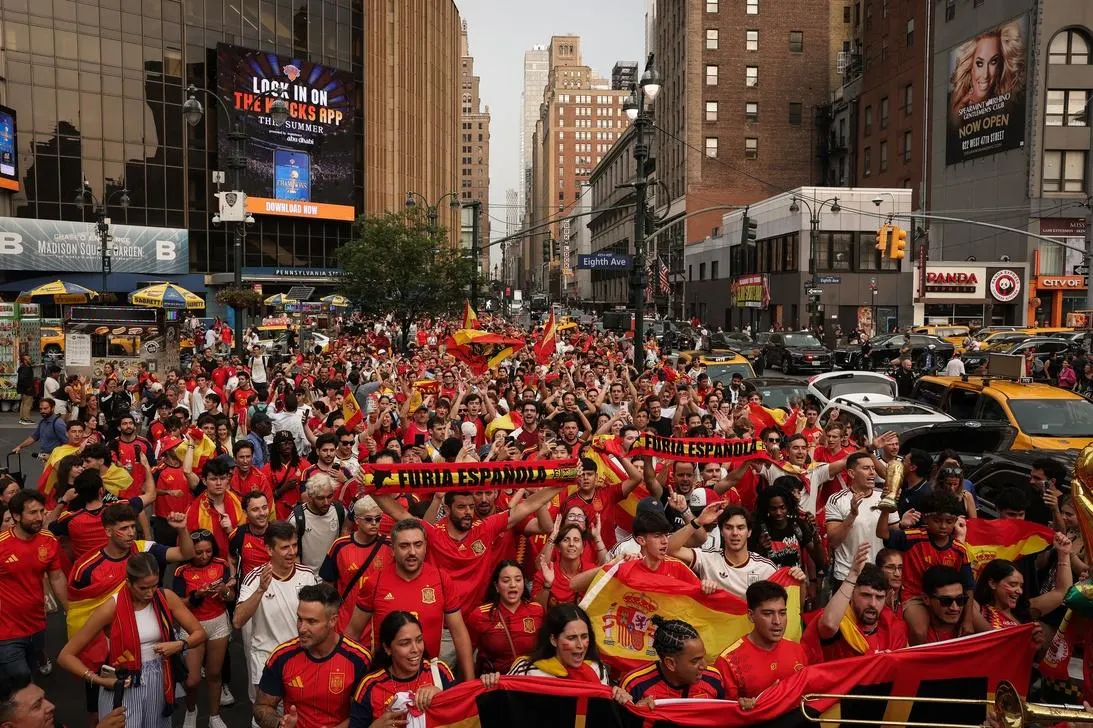

NEW YORK, NEW YORK – JULY 18: Fans of Spain show support to their team ahead of the FIFA World Cup 2026 Final Match against Argentina on July 18, 2026 in New York City. (Photo by Alex Pantling – FIFA/FIFA via Getty Images)
FIFA via Getty Images
The 2026 FIFA World Cup generated an estimated $3.5 billion in total economic impact across New York and New Jersey — surpassing the region’s original projection by $200 million, according to a post-tournament analysis released Wednesday by the tournament’s New York/New Jersey host committee.
The study, conducted by Tourism Economics, found that the tournament generated approximately $1.9 billion in direct economic activity, supported 27,424 full- and part-time jobs and produced roughly $1.4 billion in total labor income. State and local governments collected an estimated $414.2 million in tax revenue tied to World Cup activity.
“The final numbers demonstrate that New York and New Jersey didn’t just rise to the occasion — we exceeded expectations and delivered an impact that will be felt long after the final whistle,” Alex Lasry, CEO of the New York/New Jersey Host Committee, said in a statement.
The findings come after the region hosted eight World Cup matches at New York-New Jersey Stadium, including the final won by Spain 1-0 against Argentina in extra time, as well as free official fan events and related programming across New Jersey, New York City’s five boroughs and elsewhere in New York state.
More than 645,000 fans attended the eight matches, while another 626,300 non-local visitors traveled to New York or New Jersey for World Cup-related activities, including fan experiences outside the stadium. Together, match and non-match visitors accounted for approximately $1.7 billion in direct spending.
The economic activity was spread across several major sectors of the regional economy. Lodging businesses received approximately $653 million in direct spending, while food and beverage businesses accounted for $346 million. Retail generated approximately $264 million, transportation $200 million and recreation and entertainment $195 million.
The initial $1.9 billion in direct spending also generated additional economic activity as businesses purchased goods and services from regional suppliers and workers spent their tournament-related earnings.
The report estimated that those effects produced another $693 million in indirect business activity and $916 million in induced activity, resulting in the $3.5 billion overall impact.
Lasry said the World Cup brought billions of dollars to hotels, restaurants, small businesses and communities while supporting tens of thousands of jobs. He also pointed to investments and partnerships created around the tournament as benefits that could continue after the event.
“Just as importantly, the impact did not end with the final,” he added. “The investments, partnerships and global visibility created through this World Cup will continue benefiting our communities and have once again shown that there is no better place in the world to host the biggest moments in sports and culture than New York and New Jersey.”
New Jersey Gov. Mikie Sherrill also highlighted the tournament’s broader economic effects, citing increased hotel occupancy, community events and state revenues during this summer’s tournament.
“From the first match through the World Cup final, we showed that New Jersey has the infrastructure, workforce, diversity, and hospitality to bring people together and successfully host events of this scale,” Sherrill said. “The impact reached far beyond the stadium, supporting local businesses, jobs, and economic activity across our state.”
The employment impact extended beyond the tournament’s direct operations. Food and beverage businesses supported approximately 4,500 jobs, the largest employment impact among the sectors examined. Transportation supported roughly 4,400 jobs, while lodging supported approximately 4,000.
Of the $1.4 billion in total labor income generated by the tournament, about $792 million was attributed to direct activity. Another $580 million resulted from indirect and induced economic effects.
The public sector also benefited. World Cup-related activity generated an estimated $759 million in total federal, state and local tax revenue, including approximately $174 million in sales taxes and nearly $39 million in bed taxes.
The final $3.5 billion figure was higher than the $3.3 billion projection released by Tourism Economics in July 2025. For its post-event analysis, the firm used the same methodology as the original study but updated key model inputs with actual tournament data.
Several factors contributed to the higher-than-expected result. Operational spending by the host committee, governments and other stakeholders was greater than initially projected. Official Fan Events also drew more attendees than anticipated, although a larger share of those visitors were local residents. The region likewise attracted a larger proportion of international match attendees than projected, partially offset by a higher share of local match attendees.
The tournament’s organizers said the legacy of the event extends beyond the economic figures. Seventeen community mini-pitches have been completed or are in development across New York and New Jersey. Host Committee programs also reached more than 5,000 young people through soccer clinics, tournaments and community events.
With the World Cup now concluded, organizers said they hope that the infrastructure, partnerships, tourism exposure and soccer programs created around the tournament will continue to generate benefits for the region.
“Our mission was to welcome the world to New York, while making sure that every New Yorker had the chance to participate in and benefit from this once-in-a-generation event,” said New York Gov. Kathy Hochul. “And that’s exactly what we did. … We want to continue to ensure that New Yorkers are reaping the benefits and joy of the World Cup by building more soccer infrastructure for our kids to play across the state.”














Leave a comment