


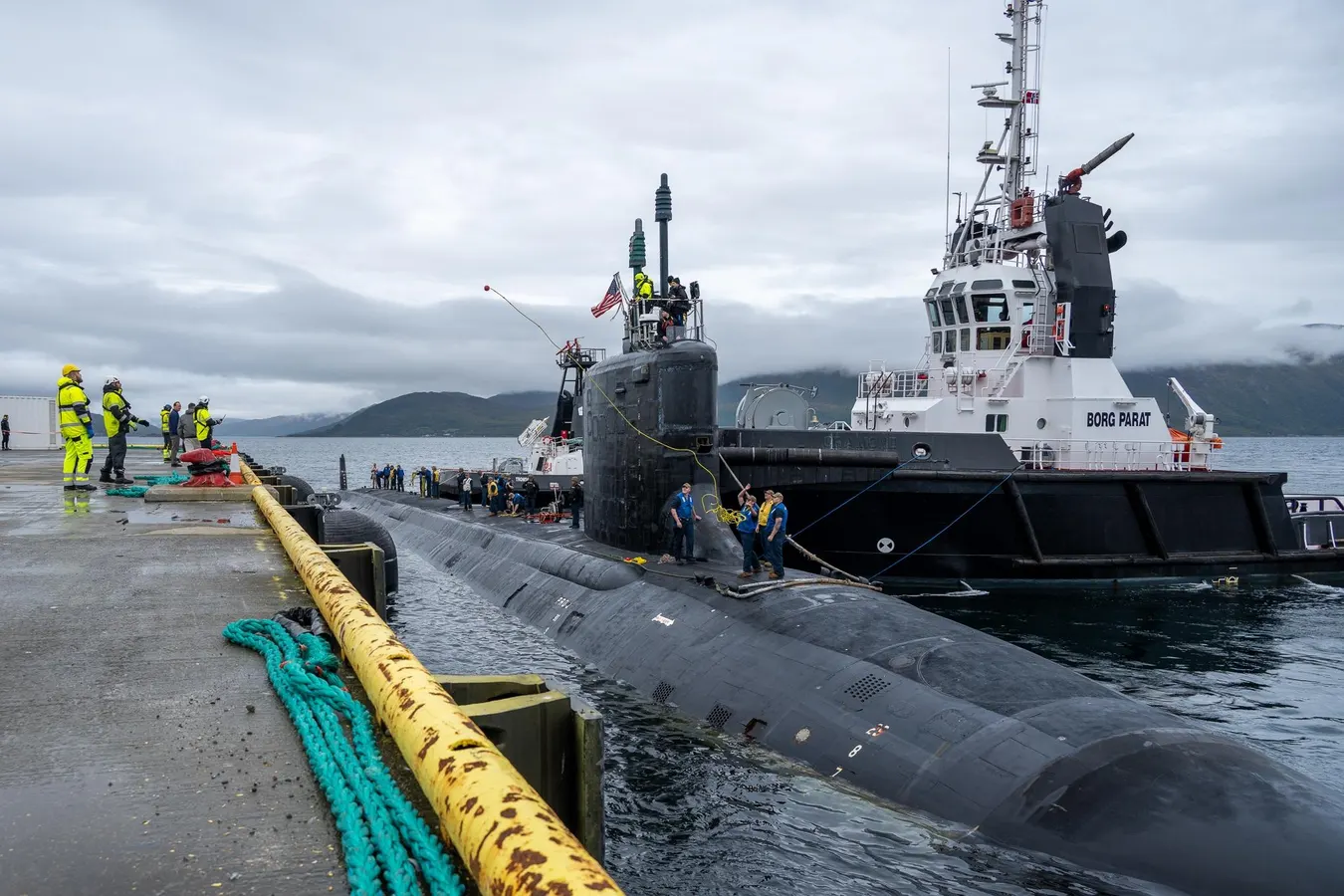

USS Delaware (SSN-791) arrived at Grøtsund, Norway, on Tuesday.
(U.S. Navy photo by Mass Communications Specialist 1st Class Austin Ingram)
In the early hours of Wednesday morning, one of the largest United States Navy warships, the Nimitz-class nuclear-powered supercarrier USS Abraham Lincoln (CVN-72) arrived in Pattaya, Thailand, its first port call in more than 200 days. The Thai port city has had less than a stellar tourist year, local officials confirmed. Hence, the arrival of the warship and its 5,000 sailors and Marines was welcome, even if local officials had to issue warnings on the dos and don’ts for those wishing to partake in the city’s nightlife and entertainment.
Pattaya is not alone in welcoming a U.S. warship to town.
In several major strategic ports around the world, there are bars and other entertainment venues that operate exclusively when a United States Navy aircraft carrier strike group (CSG) or other major naval vessel docks for liberty. That’s because a single port visit can often generate enough revenue to cover the annual rent or operating costs.
Halfway across the world, another U.S. Navy vessel is also making a port call, but with approximately 132 personnel onboard, it may not leave as much of a lasting impact on the local economy.
The U.S. Navy confirmed that the Virginia-class nuclear-powered fast attack submarine USS Delaware (SSN-791) arrived in Grøtsund, Norway, for a routine port visit on Tuesday.
What makes the arrival of SSN-791 even more noteworthy is that the U.S. Navy rarely announces the arrival of its submarines in advance due to operational security. However, it added, “submarines routinely operate around the High North to provide maritime domain awareness and ensure security and stability in the region.”
In March, USS Delaware surfaced at the North Pole.
Primary Fast Attack Boats
The Virginia-class is currently the U.S. Navy’s primary submarine for land, surface, and anti-submarine attack missions, and its armaments include cruise missiles and torpedoes.
The boats were developed to replace the aging Cold War-era Los Angeles-class submarines, and were designed to incorporate the latest advancements in stealth and weapons systems technology. Each Virginia-class fast attack submarine can undertake a variety of open-ocean and littoral missions, and that includes anti-submarine warfare as well as intelligence gathering.
“Fast attack submarines are multi-mission platforms enabling five of the six Navy maritime strategy core capabilities – sea control, power projection, forward presence, maritime security and deterrence,” the U.S. Navy noted. “They are designed to excel in anti-submarine warfare; anti-ship warfare; strike warfare; special operations; intelligence, surveillance and reconnaissance; irregular warfare and unmanned systems.”
About The USS Delaware
SSN-791 is the seventh U.S. Navy vessel named for “The First State” – as it was the first of the original colonies to ratify the U.S. Constitution. The very first was a 24-gun frigate built in 1776, but which was subsequently captured by the British Royal Navy, which renamed it the HMS Delaware. It was sold to the merchant fleet, where it was operated as the United States, before being sold to France and renamed again to Dauphin.
Four other warships named USS Delaware were in service between 1798 and 1869, including a 20-gun ship, a 74-gun ship of the line, a side-wheel steamer, and a screw steamer.
The most recent previous ship named for The First State was the lead ship of the Delaware-class of two dreadnought battleships – the other being the USS North Dakota (BB-29) – built for the U.S. Navy before World War I. Armed with a main battery of ten 12-inch (305mm) guns all on the centerline, the USS Delaware (BB-28) was the most powerful battleship at the time of its construction, and it was also the first U.S. Navy capital ship capable of steaming at full speed for a continuous 24 hours without suffering a breakdown.
The current USS Delaware is the eighth and final Block III Virginia-class attack submarine, featuring a redesigned bow with two large-diameter Virginia Payload Tubes and a water-backed large-aperture bow sonar array, replacing earlier configurations. SSN-791 was commissioned in April 2020.
Current plans call for the U.S. Navy to transfer three of its Virginia-class boats to Australia as part of the flagship AUKUS submarine partnership. The likely transfer of the USS Delaware and two other boats is to provide Australia with a sovereign capability that bridges the gap until its domestically built submarines arrive in the 2040s. All three of the transferred hulls must have at least 20 years of remaining nuclear reactor service life, of which SSN-781 will have to fulfill the Royal Australian Navy’s requirements.














Leave a comment