


Topline
The U.S. Postal Service’s controversial new rule governing mail-in voting will stay blocked in court, a federal judge ruled Thursday, extending a previous order against the rule days after an anonymous whistleblower warned the policy could “derail the midterm elections.”
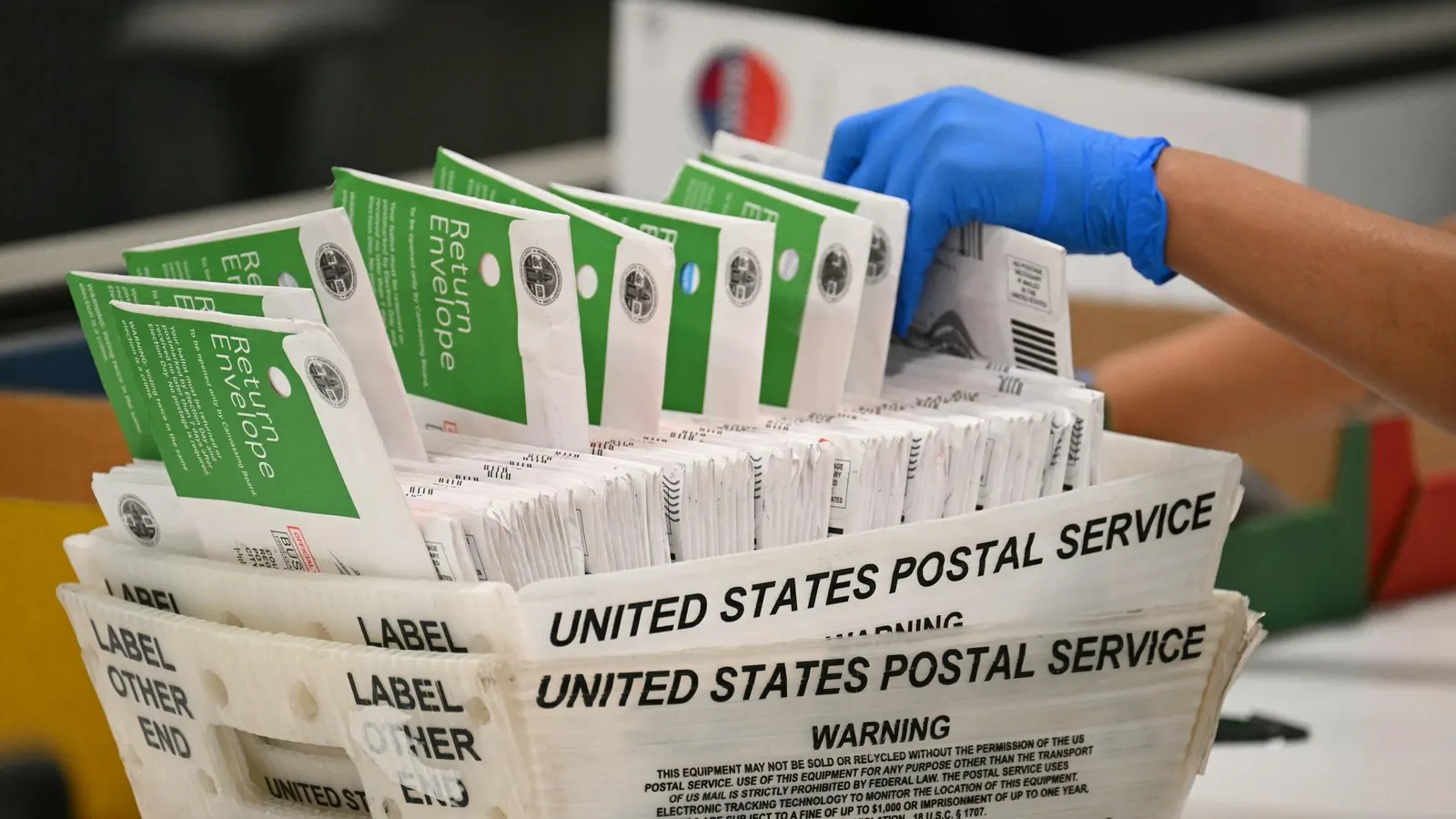
An election worker processes mail-in ballots at the Los Angeles County Ballot Processing Center on June 2.
AFP via Getty Images
Key Facts
Judge Indira Talwani issued a preliminary injunction against the U.S. Postal Service’s mail-in voting rule, after previously ruling last week to temporarily block the rule for 14 days while she mulled issuing a lengthier ruling.
USPS’ new rule would require election officials to submit voter information to a federal database and use special barcodes in order to have ballots sent out to voters through the Postal Service, with postal officials being directed to reject and send back any ballots that weren’t properly approved.
Voting rights advocates have long warned the rule could disenfranchise voters by adding additional hurdles to mail-in voting, but those fears ramped up earlier this week, when an anonymous USPS whistleblower told Congress the new system was being hastily implemented and risked “catastrophic failure which could derail the midterm elections.”
Talwani said in her decision the implementation of the USPS rule “threatens disenfranchisement of millions of United States citizens who seek to vote by mail,” noting the short time between its potential enforcement and midterm elections in November.
The judge’s ruling came after a testy hearing Thursday, in which Talwani repeatedly questioned USPS about the agency’s ability to implement the new system, the Associated Press reports, and after the Trump administration asked the Supreme Court on Thursday to lift Talwani’s earlier temporary ruling—even as she was due to issue a fresh order at any time.
What To Watch For
The Trump administration said prior to Friday’s ruling they would take the case to the Supreme Court if the USPS rule was blocked. The administration has already asked the court to lift a prior 14-day block against the rule, with Justice Ketanji Brown Jackson asking groups challenging the rule to respond by Tuesday. It remains to be seen if the Trump administration appeals the longer-lasting rule made Friday. North Carolina began sending out ballots Friday while the rule is blocked, meaning states will not have to use the federal database for the ballots even if the rule took effect later.
Surprising Fact
USPS told Talwani at the hearing Thursday that states can voluntarily “opt-in” to using the new system right away even as it was blocked in court, with a postal official noting in a separate filing that Talwani’s order that temporarily blocked the policy still “permits States to voluntarily comply with provisions of the Final Rule,” like registering for the new portal or submitting new envelope designs. The agency could not identify a single state that has chosen to opt into the new system so far, however. Twelve Republican-led states intervened in the lawsuit to argue in favor of the Trump administration, but none have actually signaled they voluntarily choose to participate, according to the AP.
What Did The Whistleblower Say?
In a report to lawmakers made public Tuesday, lawyers for the anonymous whistleblower alleged creating and implementing the new USPS rule had been a “secretive, rushed, chaotic, and fundamentally flawed process.” The policy relies on a new IT system that had been “rapidly built and minimally tested,” the whistleblower alleged through their attorneys, also alleging employees had been asked to continue working on the IT system even while the USPS rule was blocked in court, potentially violating the court orders. The biggest risk for voter disenfranchisement, according to the whistleblower, was because USPS had adopted a “zero percent fail rate policy” for the new barcodes that have to be printed on mail-in ballots. That policy means that even if one barcode in a batch of 10,000 ballots fails to scan properly, the whistleblower alleged, all 10,000 ballots would be rejected and sent back to election officials, rather than out to voters. “Even under ordinary circumstances” the “zero-percent failure rate” policy “would be problematic because of predictable errors in any barcode scanning process,” the whistleblower’s attorneys wrote, adding the whistleblower “is particularly concerned that the Portal (where the bar codes are stored) will almost certainly have significant operating problems … due to the rushed IT development.” Any issues with ballots being rejected and sent back could lead to delays with voters receiving their ballots, or risk voters not receiving a ballot in time at all. USPS said in a statement the agency is “carefully reviewing” the whistleblower’s concerns, and argued its work developing a new portal “has at all times been conducted in a manner consistent with court orders.”
Key Background
The USPS’ mail-in voting rule was first proposed in June and finalized on Aug. 21, and was based on President Donald Trump’s executive order targeting mail-in voting—a practice he has long decried and falsely tied to fraud, even as he typically votes by mail. Talwani’s ruling was the latest in a series of back-and-forth decisions over the rule in recent weeks. The USPS rule was initially blocked in June and August by two different court orders against it, before the Supreme Court ruled on Aug. 24 to lift one of those two orders. The justices did not rule on the legality of the rule itself, but voted 6-3 that the legal challenge against the policy was brought too early, before USPS had actually finalized it. Talwani then lifted her separate order blocking the rule a day later, based on the Supreme Court’s decision, which meant the policy could take effect. USPS finalizing the mail-in voting rule made the Supreme Court’s rationale for blocking it outdated, however, and the voting rights groups and Democratic state attorneys general challenging it swiftly brought fresh legal complaints taking aim at the final rule. That led Talwani to reverse course and temporarily block the rule again on Aug. 27, only days after she let it take effect.
Further Reading
USPS Whistleblower Warns New Rule Could Keep Voters From Getting Ballots—What To Know (Forbes)













Leave a comment