


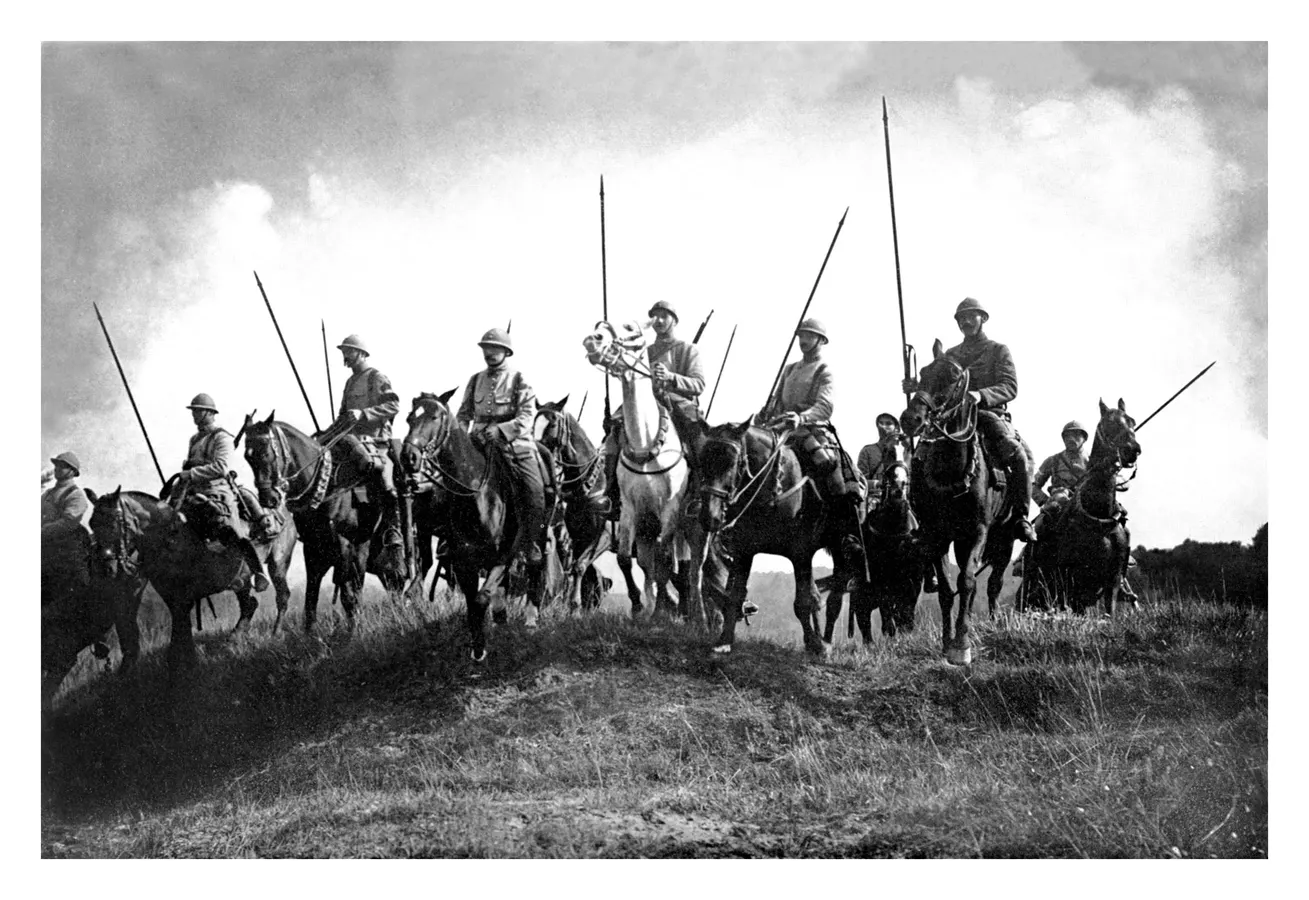

French Lancers preparing to pursue retreating German forces in 1914.
Getty Images
An argument is raging among military experts over how future wars will be fought. Drones see and hit anything that moves in Ukraine, turning it into an almost static war of attrition. Maneuver warfare, characterized by armored units moving rapidly to outflank, break through, or disrupt enemy forces, seems to have disappeared. The question is whether it has gone for good.
Analyst Amos C. Fox makes the case that maneuver will not be back in his new book “Maneuver is Dead”. The other side returns fire in military journals, with headlines like “Maneuver Warfare Is Not Dead, But It Must Evolve” and “Maneuver Isn’t Dead, Armor Isn’t Obsolete” and “The tank isn’t dead, but its old battlefield playbook may be.”
Whenever armor appears in Ukraine now, it is greeted as the return of maneuver by one side, and as proof that tanks have no future by the other.
A look at a previous debate, at a time when new technology was challenging old certainties, may shed some light on how matters will unfold.
Before World War 1: When Cavalry Reigned Supreme
Armies were built on cavalry and infantry for thousands of years. Artillery, initially siege engines and later cannon, was a subsidiary arm. Cavalry always had the highest status, and a determined cavalry charge would often decide the outcome of a battle. Much of the history of warfare has been the result of attempts to make foot soldiers cavalry-proof, from ancient pike phalanxes to Napoleonic infantry squares.
Attack of the ‘Savage Division’ on the Austrian Infantry, 1916-17 (oil on canvas)
Art Images via Getty Images
At the outset of WW1, cavalry was still a vital element of modern armies. Machine guns and modern artillery might have changed things in colonial wars, but Europe was different.
“Cavalry is more necessary than ever to complete the victory, to exploit it, and to turn it into the utter destruction of the enemy,” wrote German cavalry general Friedrich von Bernhardi in 1910, arguing that infantry was too slow to produce decisive results.
Cavalry in the U.S. was armed with pistols and carbines and were trained to dismount and fight as infantry. Their swords were ceremonial. European cavalry still carried sabers and lances.
“It must be accepted as a principle that the rifle, effective as it is, cannot replace the effect produced by the speed of the horse, the magnetism of the charge, and the terror of cold steel,” stated the British Army’s Cavalry Manual of 1907.
WW1 changed that. Only a few days into the war in 1914, at the Battle of Halen, some 4,000 cavalry of the German 4th Division repeatedly charged Belgian positions and took heavy casualties from rifle and machine-gun fire. Eight separate charges failed. The action was known as the “Battle of the Silver Helmets” from the way discarded headgear was scattered across the battlefield.
Re-enactors recreate the charge of the ANZAC (Australian and New Zealand Mounted Division) at Beersheba
AFP via Getty Images
As WW1 progressed, the combination of mud, craters, barbed-wire entanglements and trench lines made cavalry charges even less feasible. By 1918, horses were useful for rapid movement, but mounted charges had almost disappeared. While they could be devastating when conditions were right—like the celebrated Light Horse charge at Beersheba—they were becoming outdated.
In the subsequent decades, improvements in motor vehicles edged out horses, and many cavalry squadrons were converted into tank units.
This might have looked like the end of the cavalry charge for good. But some theorists and generals believed otherwise.
The Cavalry Ride Again
Some nations retained not only cavalry but also lances and sabers. This did not always work out as you might expect. (Incidentally, the story about Polish lancers charging German panzers is a myth which has been long since debunked).
In 1920 Poland was at war with the Soviet Union. At the Battle of Komarów, the fighting swayed first one way and then the other in a fast-moving battle. It was finally decided when the Polish cavalry charged with drawn sabers, hitting the Russian flank and rear and breaking their line.
A platoon of Polish cavalry with rifles in 1939 1939.
Bettmann Archive
During the Battle of Alfambra in 1938 during the Spanish Civil War, Franco’s Nationalist forces disrupted the Republican front line with artillery fire and attacks by 200 aircraft. Then 2,500 cavalry charged in, some with rifles, some wielding traditional cavalry weapons. The Republican defenses collapsed and the Nationalists took several thousand prisoners.
In 1942, when Italian forces were fighting the Soviets at the Battle of Izbushensky, the 3rd Regiment of Savoy Cavalry unexpectedly came into contact with a Russian infantry regiment at dawn. The Italians were severely outnumbered, but their horse artillery and machine guns opened fire to pin down the enemy. The 2nd Squadron, approximately 100 cavalry, carried out a flanking maneuver using a ravine that shielded them from observation. The squadron charged across the entire width of the Russian position, attacking with sabers and hand grenades. When they reached the far end, they regrouped and charged back the other way, while at the same time the 3rd Squadron made a frontal mounted charge. The Russians broke and surrendered or fled.
The Italians suffered about 80 human casualties and lost more than 100 horses. The Russians had more than 400 killed and wounded. Another 600 were taken prisoner, along with 50 machine guns and four artillery pieces.
Even at the time this seemed insane. A German liaison officer commented to the Italian commander “Colonel, these kinds of things, we cannot do them anymore.”
History Does Not Repeat But It Does Rhyme
There were even later cavalry actions, though historians argue about whether they involved actual mounted charges or were instances of infantry moving on horseback and fighting on foot. And more than a century after WW1, horses remain in military use, both as draft animals and for riding, with Russian troops seen fighting on horseback in Ukraine.
Russian mounted troops exercising with drone
Via X
The situation with armored vehicles and maneuver warfare is likely to follow a similar pattern. The debate will continue and the true picture may not emerge for many years.
As with the cavalry charge, maneuver warfare is still possible under the right conditions. Cavalry charges were successful when artillery and machine guns were sufficiently neutralized, and maneuver warfare will work when drones can be sufficiently neutralized. The question is if and when this will happen.
Even when charges were not possible, horses were still useful transport when other vehicles were not practical. Armored vehicles will still be valuable as protected transport into the foreseeable future even if they are not used for traditional maneuver warfare.
WiIl maneuver still be possible in an age of massed, low-cost long-range strike drones?
U.S. Department of War
Any change will take place over an extended period. After WW1, some British generals, notably Douglas Haig, argued that horses were still as important as ever, and downplayed aircraft and tanks. This may seem absurd in hindsight, but the techno-optimists have been proven wrong with equal frequency. In exactly the same period, British Major General Seely, Secretary of State for Air, argued that aircraft would soon make land and naval forces obsolete.
There will always be traditionalists who believe in tried and trusted methods of warfare, as well as progressives who believe the latest technology makes everything that went before irrelevant. The truth may lie inconveniently in between these two poles. One side may suffer when they encounter machine guns, but the other may still be swept away by a surprise cavalry charge.
The cavalry debate did not have the neat and decisive ending you might expect at the Battler of Halen in 1914. There were still cavalry willing to charge – and do so successfully– 28 years later.
The arguments will be at least as long and heated this time. We can expect many more books explaining how tanks and maneuver are or are not dead before the question is decided.
















Leave a comment