


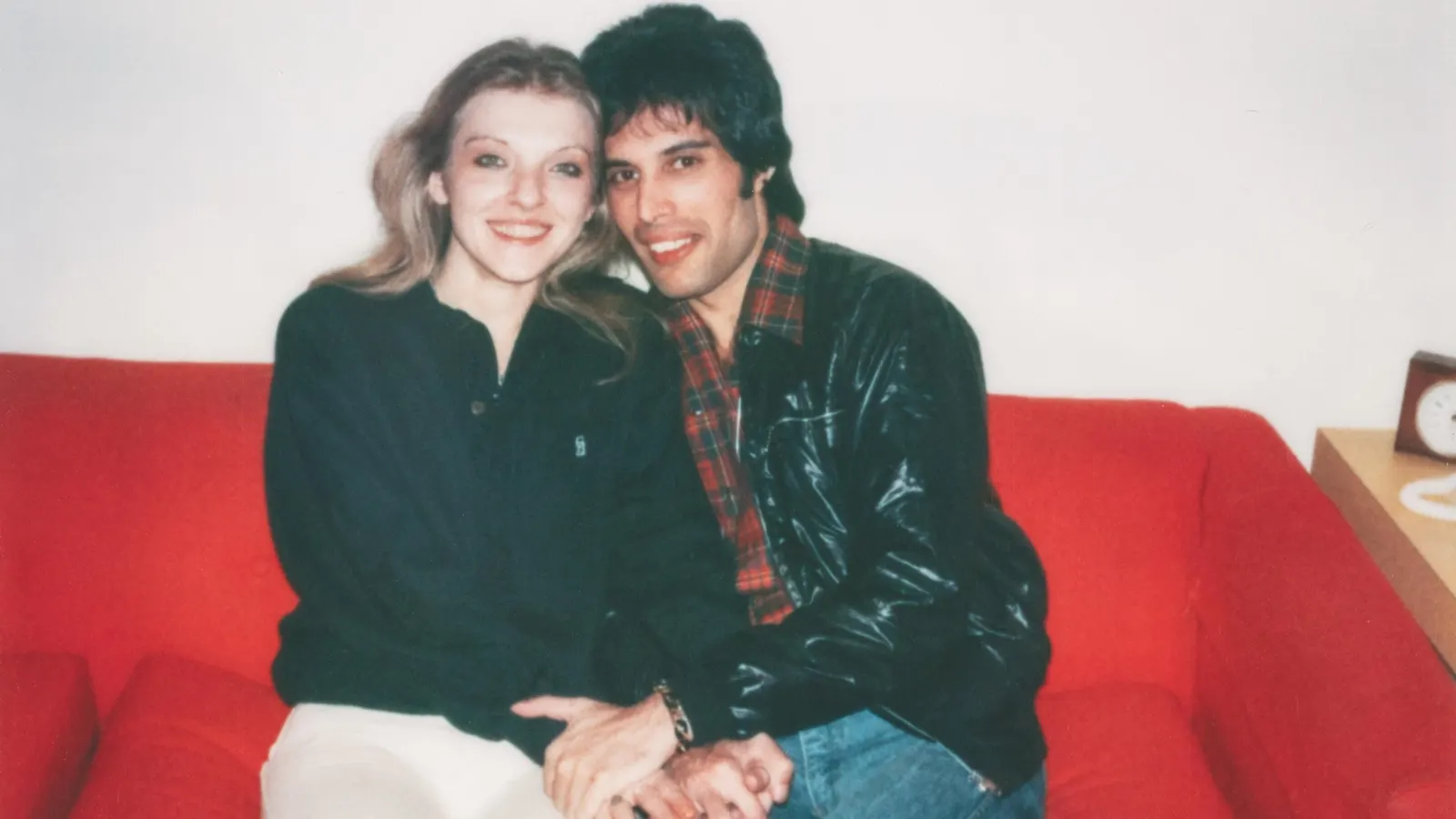

(L-R) Mary Austin and Freddie Mercury
credit: Image courtesy of Mary Austin
Nearly thirty-five years after his death from bronchopneumonia brought on by AIDS at age 45, the life and music of Queen lead singer Freddie Mercury continue to fascinate. The songs he wrote for the Rock and Roll Hall of Fame band have since become pop culture staples— among them “Killer Queen,” “Bohemian Rhapsody,” “Love of My Life,” “Somebody to Love,” “We Are the Champions,” “Don’t Stop Me Now” and “Crazy Little Thing Called Love.” His stirring performance at Live Aid in 1985 remains unforgettable, and the dramatization of his and Queen’s story in the 2018 box-office smash, Bohemian Rhapsody, earned an Oscar for actor Rami Malek, who portrayed the singer.
Mercury was enigmatic. On stage, he projected a flamboyant, charismatic persona. But off stage, he was reserved and private. Those dueling opposites have made him, over the years, the subject of documentaries and biographies.
Cover of ‘Freddie Mercury: A Life in Lyrics’
credit: Dey St.
When Mercury died in 1991, he left his beloved home, Garden Lodge, in Kensington, to Mary Austin, his former romantic partner, close confidante and faithful personal assistant. For many years after his death, she rarely spoke publicly about her time with Mercury until now.
Her new book, Freddie Mercury: A Life in Lyrics (published by Dey St.) provides a behind-the-scenes look at the popular frontman through Mercury’s handwritten song lyrics (including “Bohemian Rhapsody” and “Killer Queen”), sketches, stage photos, and never-before-seen images of him and with Austin. The book’s publication perfectly coincides with what would have been Mercury’s 80th birthday this Saturday.
Its pages contain Austin’s poignant recollections of Mercury and the stories behind some of his music. Certainly the most intriguing bits in A Life in Lyrics are about Mercury and Austin’s relationship dating back to when they first met in the early 1970s, before the band that would become Queen found fame and fortune.
(L-R) Freddie Mercury and Mary Austin
credit: Image courtesy of Mary Austin
“When I first met him, we were so young that everything felt provisional,” Austin writes. “We were inventing ourselves as we went along. He was funny, sharp, endlessly curious and already utterly himself. And he noticed you. With him you felt seen. And when you feel seen, you start to love very quickly.”
Austin witnessed Mercury and Queen’s rise to the top, culminating in the success of the epic smash song, “Bohemian Rhapsody,” from the band’s 1975 masterpiece A Night at the Opera. “I remember thinking how strange it must sound to people hearing it cold…There was such joy in it, such confidence, that it didn’t matter if you couldn’t immediately make sense of every part,” she recalls about the song.
A Life in Lyrics achieves something rare in rock music memoirs or tell-alls: it is both candid and respectful about the subject. Those expecting dishy and gossipy details about Mercury in the book will be disappointed. Instead, Austin’s book focuses on Mercury’s creative life, such as his use of a tape recorder to capture ideas for songs so he won’t forget him and his devotion to playing his Yamaha G2 grand piano when he acquired it.
But it’s far from a dull read. For instance, Austin details the breakup of the couple’s engagement when the truth emerged about his sexuality; in retrospect, she knew that he was struggling internally. “In early 1977, Freddie had told me he was bisexual, to which my response was, ‘No, you’re gay,’” Austin writes. “He didn’t reply to that. It wasn’t said to wound him, nor to deny him anything, just that I knew immediately what his proclamation meant for me. From that moment on, the relationship I had believed in was over. Everything that had felt undecided suddenly wasn’t.”
“The romance was gone,” she later adds,”the future we’d imagined had evaporated, but there was still a love and a deep friendship between us.”
From ‘Freddie Mercury: A Life in Lyrics’
credit: Dey St.
Another interesting revelation from the book is that it was Austin — by now Mercury’s personal assistant and dear friend— who convinced the singer to perform at Live Aid in 1985, a turning point that revived the Queen’s popularity. “Looking back, I can see that the day reminded him of who he was and what he could still do; it rebuilt something that had been missing – his confidence – and once that returned, everything else followed,” she remembers in the book.
There are other things Austin lovingly recalls about Mercury: his love for his pet cats, collecting trinkets, and his Garden Lodge home, where he spent his final days with Austin supporting and caring for him. Three years ago, his personal possessions — including his grand piano, handwritten lyrics and art objects — were auctioned off by Sotheby’s, with the proceeds going to the Mercury Phoenix Trust and Elton John AIDS Foundation.
“The world knew him as Freddie Mercury,” Austin writes in the book’s introduction. “But for me, the person captured within the pages of his lyrics, doodles and notes is Freddie Bulsara. This is the man I knew. And in sharing his work more widely, my hope is to honour a person who stood so humanely, and captivatingly, among us. To celebrate the magnificent creativity that was the core of Freddie.”
Freddie Mercury: A Life in Lyrics by Mary Austin is now available in bookstores.














Leave a comment