


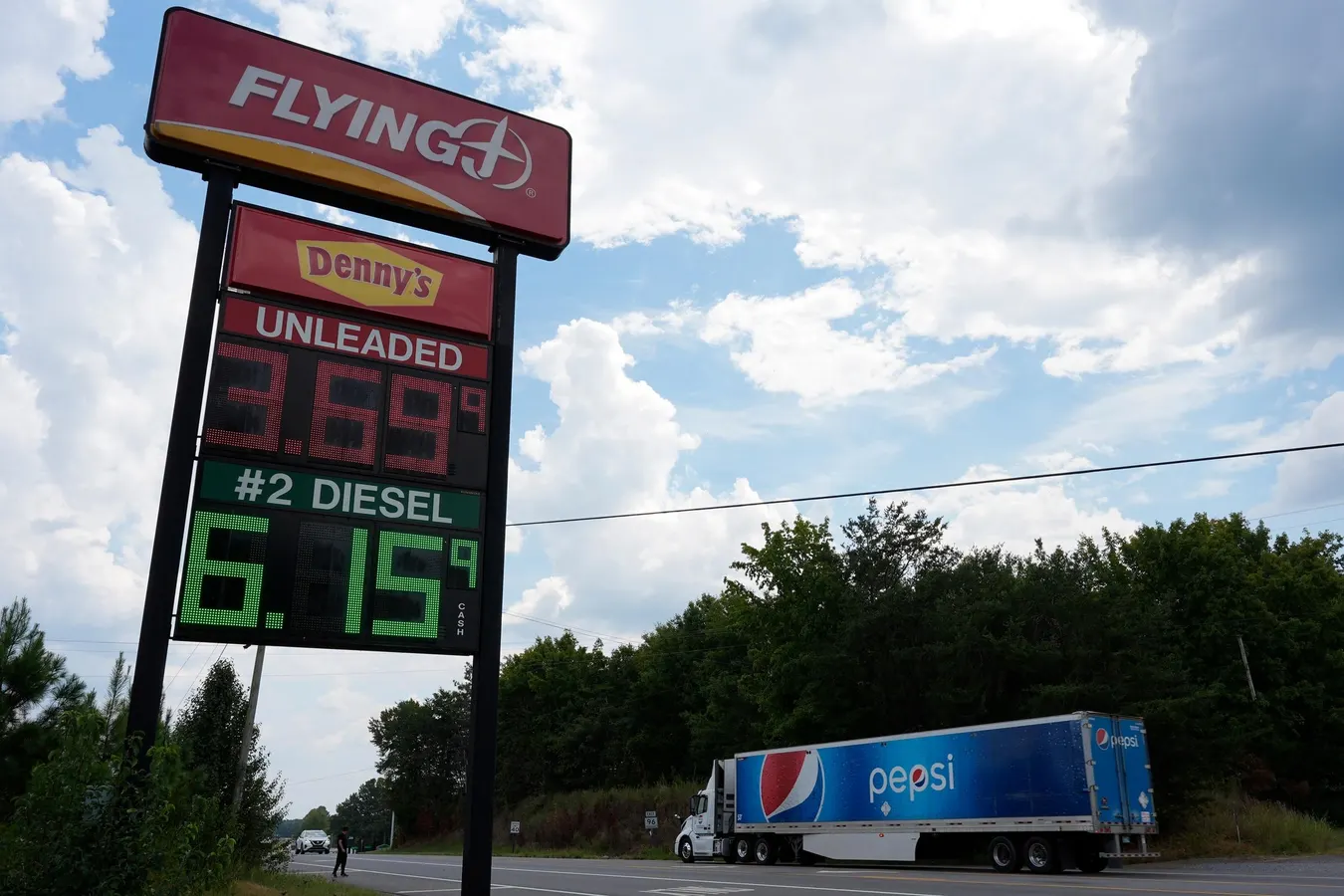

Fuel prices are displayed outside a truck stop Friday, Sept. 4, 2026, in Fairview, Tenn. (AP Photo/George Walker IV)
Copyright 2026 The Associated Press. All rights reserved
Diesel prices in the U.S. just climbed above the previous weekly record set in 2022, and the 2026 annual-average record is now within striking distance. Gasoline prices, while still elevated, are unlikely at this point to set a new annual record.
The latest EIA data sharpen that divergence. For September 7, on-highway diesel jumped 36.8 cents to $5.967 per gallon nationally, surpassing the previous nominal weekly high of $5.810 set in June 2022. Regular gasoline rose 8.6 cents to $4.157, still well below its $5.006 weekly peak in June 2022. That could leave 2026 with a new record annual average for diesel, while gasoline remains below the record it set in 2022.
Gasoline usually dominates the public discussion because it is the price most drivers see every week. Diesel is less visible to consumers, but it is embedded throughout the economy in trucking, agriculture, construction, rail, and other commercial activity. When diesel prices remain unusually high, the effects can extend well beyond the filling station.
The Math Behind The Record
According to the U.S. Energy Information Administration, on-highway diesel set its nominal annual-average record in 2022 at $4.989 per gallon. Regular gasoline also set its record that year, averaging $3.951 per gallon.
Using EIA’s 36 weekly price observations through September 7, I calculate a 2026 year-to-date average of about $4.895 per gallon for diesel and $3.772 for regular gasoline. That leaves 16 weekly observations for the rest of the year. To exceed the 2022 record, diesel would need to average about $5.20 per gallon over those remaining weeks. Gasoline would need to average about $4.35.
| Fuel | 2022 annual record | 2026 avg. through Sept. 7 | Needed final 16 weeks | Sept. 7 price |
| Diesel | $4.989 | $4.895 | $5.20 | $5.967 |
| Regular gasoline | $3.951 | $3.772 | $4.35 | $4.157 |
Source: EIA; author calculations using weekly national retail prices through Sept. 7, 2026.
The latest EIA reading makes the annual-record math more favorable for diesel. If the September 7 prices simply remained unchanged through year-end, diesel would finish 2026 at roughly $5.22 per gallon, comfortably above the 2022 record. Gasoline would finish around $3.89, still below its record.
That means diesel could fall by roughly 77 cents from the September 7 reading and still average enough over the remaining weeks to set a record. Gasoline would need to rise by about 20 cents from its latest reading and then maintain that higher level through a part of the year when prices normally face downward seasonal pressure.
Why 2022 Was So Expensive
The 2022 records were not caused by a single event. The petroleum market was already tight before Russia’s full-scale invasion of Ukraine. The pandemic had disrupted oil production and refining around the world, some capacity permanently closed, inventories were low, and demand was recovering as economies reopened. EIA documented the tightening diesel market before the invasion.
Russia’s invasion then hit a market with very little spare room. Crude oil prices surged amid uncertainty over Russian supply, sanctions, and private-sector decisions to reduce purchases of Russian energy. Gasoline demand strengthened into the spring and summer, while refinery output and inventories struggled to keep pace. Regular gasoline ultimately moved above $5 per gallon nationally for a time in June, as EIA later documented.
Diesel faced an even tighter situation. Russia was a major supplier of diesel and other distillates to the global market, particularly Europe. The loss and redirection of those barrels tightened an already constrained market, while U.S. distillate inventories remained below normal. By October 2022, EIA reported only about 25 days of distillate supply in U.S. inventories, compared with a 2017-2021 average of 34 days. High crude prices were only part of the diesel story. The world was also short of refining capacity and distillate inventories.
Why Diesel Is So Expensive In 2026
There are similarities between 2022 and 2026. Once again, a geopolitical shock has pushed crude oil and refined-product prices higher. This time, the pressure has centered on the conflict involving Iran and constraints on energy flows through the Strait of Hormuz, one of the world’s most important oil transit points. EIA has cited reduced shipments through the strait as a major source of pressure on global oil inventories and prices.
But diesel has also been hit by product-specific problems. Ukrainian attacks have damaged Russian refineries and constrained Russian fuel exports, while Middle Eastern refinery and product flows have also been disrupted. In August, Reuters reported that the U.S. diesel crack spread, the difference between diesel futures and crude oil futures, exceeded $100 per barrel for the first time. That is an extraordinary signal of how tight the refined-product market had become.
This is not primarily a story of U.S. refiners failing to run. Reuters reported refinery utilization at 98% in the week ending August 28, the highest level since 2018. Yet EIA showed total U.S. distillate inventories at only about 104.2 million barrels, while East Coast stocks fell to 19.3 million barrels. Refiners are running hard, but the global market is still pulling strongly on available U.S. distillate supplies.
Gasoline Is Entering Its Slow Season
Gasoline has also been expensive in 2026, but it now faces a seasonal pattern that makes a new annual record less likely. Prices typically rise during the spring and summer as driving increases and refiners switch to more expensive summer-grade fuel. After the summer driving season, demand generally declines and refiners can return to less expensive winter-grade gasoline. EIA notes that gasoline refining margins normally ease in the fall.
Diesel tends to receive more seasonal support in the fall. Diesel powers much of the equipment used for the agricultural harvest and the trucks that move those crops. EIA has found that U.S. distillate consumption increased by an average of about 4% from September to October over the five years from 2019 through 2023. Winter then adds heating-oil demand, particularly in the Northeast.
That seasonal divergence is important to the record calculation. Gasoline needs to average roughly $4.35 per gallon for the rest of the year, above the September 7 price of $4.157, during a period when prices normally ease. Diesel needs about $5.20, nearly 77 cents below the latest EIA price of $5.967, while entering a season that typically provides additional demand support.
The Record Is Not Guaranteed
None of this makes a diesel record inevitable. A ceasefire or meaningful restoration of energy flows through the Strait of Hormuz could bring crude and refined-product prices down quickly. Restored refinery operations in Russia or the Middle East could ease the distillate squeeze, and a sharp economic slowdown could weaken freight and industrial diesel demand.
August STEO projected a 2026 annual average retail diesel price of $4.85 per gallon and regular gasoline at $3.78, leaving both below their 2022 records. But that forecast was completed on August 6, before the late-August surge in diesel prices and before the September 7 reading set a new nominal weekly high at $5.967. I would not call a diesel annual-average record a certainty, but the current arithmetic puts it clearly within reach.
The Big Picture
The comparison between 2022 and 2026 is a useful reminder that there is no single “fuel price.” Crude oil is the largest common input, so a geopolitical shock can push gasoline and diesel higher at the same time. But refinery capacity, inventories, trade flows, product demand, and seasonality can cause the two fuels to behave very differently after that initial shock.
In 2022, rebounding demand, constrained refining capacity, low inventories, and Russia’s invasion of Ukraine drove both gasoline and diesel to record annual averages. In 2026, another geopolitical disruption has again pushed crude prices higher, but the more acute shortage is in distillates. Based on the September 7 reading and the seasonal path ahead, diesel has already set a weekly record and now has a credible path to a record annual average as well.
















Leave a comment