


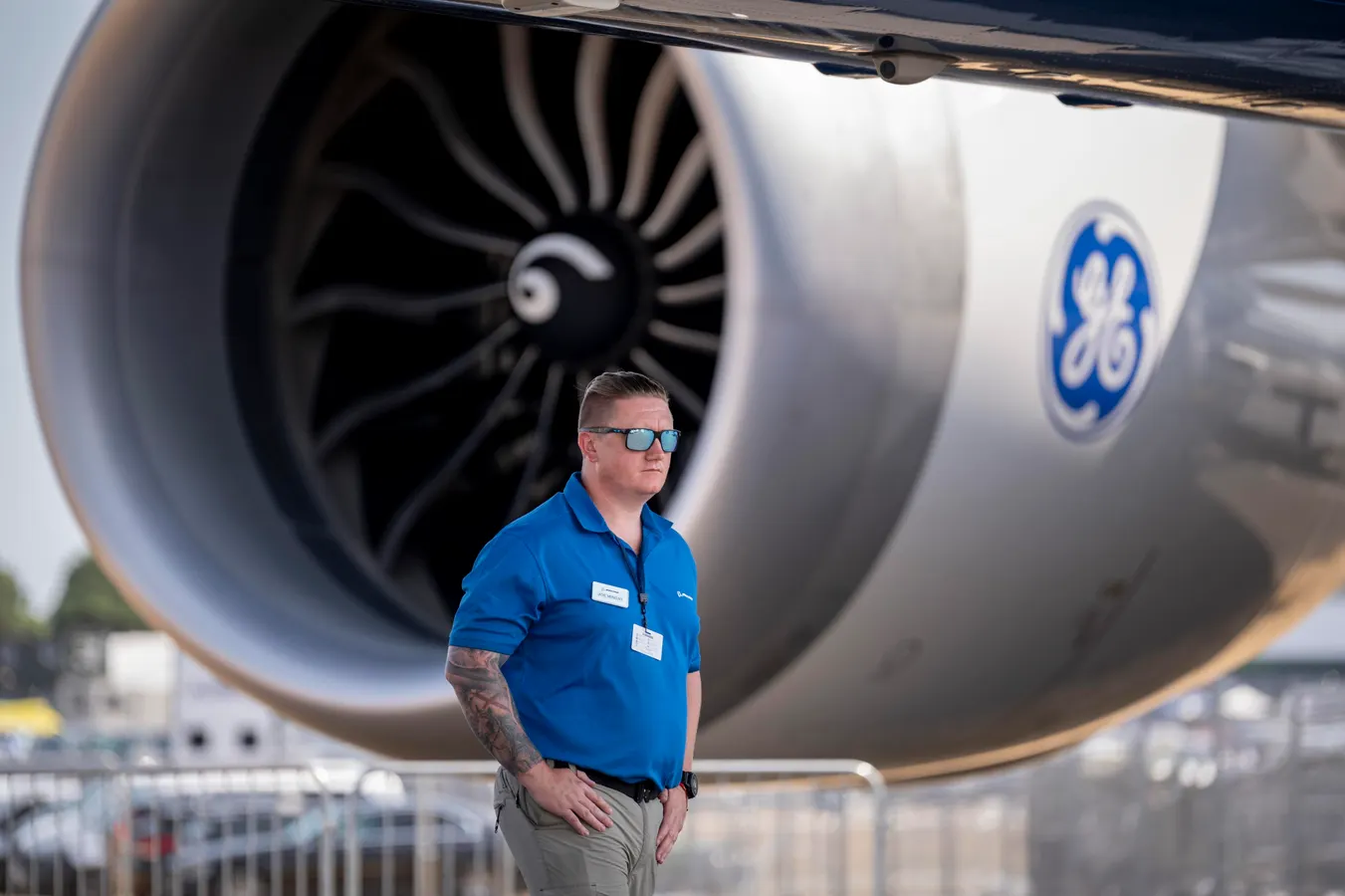

A Boeing employee stands beneath the fuselage of the company’s 777X jet airliner and a GE engine at the Farnborough Airshow, at Farnborough, England.
In Pictures via Getty Images
GE Aerospace’s agreement to acquire Consolidated Precision Products for $11.75 billion is a smart strategic move. It gives GE greater control over one of aerospace’s hardest production constraints: complex, flight-critical castings. What is good for GE Aerospace, however, may not be good for every other engine maker or aircraft OEM.
CPP belongs to a small group of companies with the equipment, qualified processes, technical knowledge, and workforce needed to produce advanced castings at scale. Jefferies estimates CPP already supplies about a quarter of GE Aerospace’s casting needs. Moving that capacity under one of the world’s largest engine manufacturers could strengthen GE Aerospace’s supply position while leaving competitors more exposed in a market that is already tight.
That is the larger issue. Aerospace and defense do not merely have a supply chain problem. The industry has a structural capacity problem. The federal government should treat advanced castings as a strategic industrial capability and help incentivize investment in domestic facilities, equipment, technology, and workforce development.
GE Aerospace Is Buying Assured Supply
CPP manufactures highly engineered investment and precision sand castings for commercial aircraft, military platforms, weapon systems, helicopters, and industrial gas turbines. The Cleveland based company has about 6,600 employees across more than 20 facilities. It supports major GE Aerospace programs, including LEAP, GEnx, T700, and F110, and has supplied GE Aerospace for more than 15 years. About 70 percent of CPP’s revenue comes from commercial and defense engines. GE Aerospace expects CPP to generate roughly $2 billion in revenue in 2027.
The demand case is straightforward. GE Aerospace expects airfoil demand to rise more than 30 percent by 2030 from 2026 levels as new-engine production, aftermarket demand, and defense requirements hit the same foundries at the same time. From GE’s perspective, the logic is clear. Own the bottleneck instead of managing it entirely through purchase orders.
GE Aerospace says it will apply FLIGHT DECK to raise yields, improve quality, increase machine utilization, and cut scrap and rework. The company also wants design and manufacturing closer together so enhanced airfoil technology can move into current engines and next-generation platforms faster.
This is not a conventional company acquisition. It is a vertical integration and assured supply play.
GE Aerospace is not alone. Pratt & Whitney opened a 1.2 million-square-foot airfoil facility in Asheville, North Carolina, in 2022 after an investment of about $1 billion and is now adding an advanced casting foundry there. Rolls Royce is expanding casting capacity in Britain. Engine makers increasingly treat control of airfoil production as central to delivery, durability, and cash conversion and not as a commodity buy.
A Tight Market Could Become Even Tighter
The concern is what GE Aerospace’s ownership of CPP means for everyone else. CPP produces castings for nearly every major current-generation commercial aircraft program and also serves defense and power customers, including other engine and airframe programs. Those customers will now depend on capacity owned by a major OEM with rapidly growing requirements of its own.
GE Aerospace has said CPP is only part of the solution, that it will keep working with other suppliers, and that it plans additional capital investment in CPP. Those commitments matter. Ownership change, by itself, does not create more capacity. If anything, an $11.75 billion price is about 26 times expected 2027 EBITDA before synergies, and about 18 times including them. This confirms how valuable and limited casting capacity has become.
Advanced castings are not parts that can be moved quickly to another source. Production requires specialized tooling, wax patterns, ceramic shells, controlled melting and pouring, heat treatment, machining, coatings, nondestructive inspection, and rigorous quality control. New designs often scrap a large share of early output. New suppliers must prove repeatability and complete long customer qualifications before a single part can fly.
Demand is also widening beyond traditional aerospace. Industrial gas turbines use similar highly engineered castings, and the buildout of artificial-intelligence data centers is raising demand for turbine power. Commercial aviation, defense, and energy are increasingly competing for the same specialized industrial base.
This is why execution, not the press release, will decide whether the deal helps the industry or merely reallocates a bottleneck. Buying CPP does not automatically produce more castings. GE Aerospace must integrate more than 20 plants, retain specialized talent, raise first-time yield, manage tooling, honor commitments to non-GE customers, and turn installed assets into reliable output. If FLIGHT DECK actually increases industry supply, the deal strengthens the base. If it primarily reserves capacity for GE aerospace, the rest of the market gets tighter.
Government Should Help Build New Capacity
The U.S. Government (USG) has a legitimate role because the market does not fully price the national security value of surplus and redundant capacity. Decades of offshoring and short term cost pressure left the United States with fewer foundries, thinner process knowledge, and too much dependence on a handful of sources for parts essential to commercial aviation and defense readiness.
A new casting operation takes significant capital and years. Companies must install specialized equipment, build facilities with demanding power and environmental requirements, develop proprietary processes, train a technical workforce, and complete customer qualifications. Returns come slowly. Demand moves with aircraft rates and defense budgets. That is a poor fit for purely private capital when the output is a strategic chokepoint.
The Department of War already has tools. Its Industrial Base Analysis and Sustainment program identifies castings and forgings as a priority sector. Defense Production Act Title III, manufacturing technology programs, and long term procurement commitments can reduce investment risk. Those tools should be used to add qualified domestic capacity.
The Factory Is Becoming Strategy Again
For GE Aerospace, acquiring CPP is a rational move to control its own future. For other OEMs, it is a warning that access to critical capacity can no longer be assumed. For policymakers, it is evidence that the United States allowed a strategically important manufacturing capability to become too concentrated and too constrained.
America does not have a shortage of engine orders. It has a shortage of mission critical process capacity. The country needs more qualified producers, modern facilities, and skilled workers who can manufacture the parts on which the aerospace and defense markets depend on. GE aerospace just paid $11.75 billion to own more of that process. The test for industry and USG is whether the next $12 billion goes into creating capacity or into bidding for the remaining casting capacity that is left.
















Leave a comment