


Current Climate brings you the latest news about the business of sustainability every Monday. Sign up to get it in your inbox.
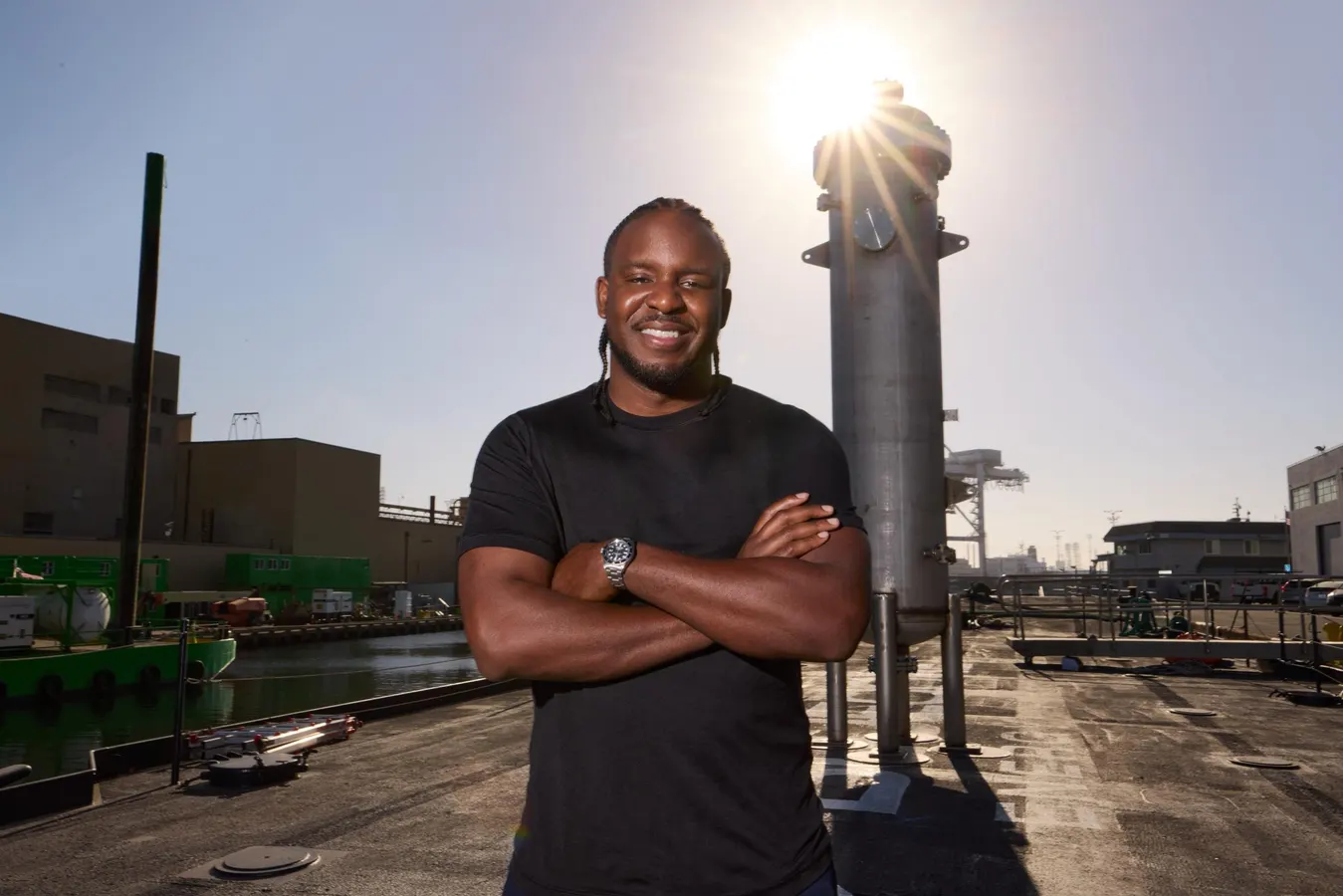
Welcome back to Current Climate. Billions of dollars have poured into nuclear power startups over the past few years, especially for would-be makers of small modular reactors (SMRs) promising carbon-free energy at lower cost than massive, conventional nuclear plants, and with few safety risks. Bluecore Energy is playing in that space as well, but with the added twist of putting its SMRs on barges and sending electricity back to shore to power cities, ports and other industrial operations.
Given that its reactors will float, there would be additional cost savings since the company doesn’t have to acquire large amounts of land for them. That means they can also be set up faster. The Long Beach, California, startup, based at the city’s sprawling container port, just raised $50 million to help build a 10-megawatt system there. If all goes well, it will be providing electricity for cranes and other port operations before the end of the decade.
“The Navy figured this out before we even had computers, that it’s great for propulsion in submarines and ships,” founder and CEO Kofi Asante told Forbes. So he turned to nuclear engineers to see if the concept of an offshore SMR made sense. Learning that it did, he hired experts, including several former military engineers, to turn it into a reality. Initial production of reactors will take place at its Long Beach headquarters.
“We’re building a light water reactor, which we’re not the first to do,” he said. “We just made it smaller and put it on a barge, because a barge acts as extra real estate and two-thirds of the world is pretty unused. It’s water.”
The other benefit of putting the system on the sea: It can use that water as a backup for more cooling if needed. “You have an infinite amount of cooling around you,” said Asante, who previously worked on electric boats and aircraft for Arc and Elroy Air.
When it’s activated, the system could be placed miles offshore, sending power back via a subsea cable. Because of their size, SMRs pose less danger in the event of an accident. In the case of Bluecore’s system, if the barge flipped over in rough seas, it’s designed to automatically shut down.
“The safest place for it is in the water, and it’s providing 15,000 homes’ worth of electricity. You power it once every couple of years, and it’s zero-emission,” he said. “Our whole mission is to democratize access to clean energy.”
The Big Read
Want To Buy A Tesla Cybercab? The Economics Should Scare You
Tesla began a pilot demonstration project of its two-seat, no-steering-wheel Cybercab recently with a fleet of 45 cars operating in Austin, with no employee in the car. In concert, they put out an “interest form” where people can add their name to a list of individuals and fleet operators who might wish to purchase these vehicles and put them to work. While Elon Musk has frequently presented this as a highly lucrative business opportunity, the reality is it won’t likely be lucrative—if it works at all.
If Tesla does sell you a Cybercab—in theory for just $30,000—one must be clear that Tesla will still operate it. They will not only provide and maintain all the software; all use of it will go through them. Riders will need to book rides through the Tesla app, access the car and pay for it through that app. Tesla will control everything, set the prices, and pick which car serves a rider. While you may have the opportunity to clean it and perform minor service, it’s more likely it will also be cleaned, serviced and charged by Tesla. You will only decide when to take it in and out of service, and where to store it when it’s not in service. You won’t be able to “put it into Uber” or run your own private service.
Tesla will have its own large fleet. When a rider request comes in, they are probably motivated to use one of their own vehicles, unless yours is much closer to the rider. You might find yours is only used during the peak “rush hour” times, including late-night bar-hopping time on the weekend.
Tesla controls the billing and customer, and they alone decide how to allocate the money. As such, it’s easy to calculate what portion of the money they will share with you, and the answer is “barely enough.” They will pay you enough to make it marginally valuable to do this, because they will (if it makes sense at all) want people to decide to do it. It’s hard to see why they would pay you more than “barely enough.” Why give people more money than they need rather than keep it for Tesla?
Hot Topic
Sriram Vasantharajan, CEO of Mazama Energy, On The Benefits Of Super-Hot-Rock Geothermal Power
There are lots of new geothermal companies out there. What distinguishes your approach?
The space is nascent, and it is broad. We need many voices around the table, but what is very different about Mazama is our central thesis. And that is, what would it take for geothermal to become scalable and cost-competitive with fossil fuels so that it can be transported and done where it’s needed? That’s super-hot-rock geothermal, which is going down to much higher temperatures, much more powerful energy densities, but then creating the complete toolkit for it, from drilling to reservoir creation to heat harvesting. So the whole toolkit integrated to unlock and scale super hot rock geothermal is what distinguishes Mazama.
And what is driving this quest is to drive down the cost of geothermal. Reduce the number of wells compared to conventional geothermal by 18%; lower the amount of water being used by 75%; and create the highest power capacity resource when compared with anything, including nuclear, per acre of land. Create the most energy density.
On a sort of per well basis, what’s your expectation of how much energy you’re going to get out compared to other players in the geothermal space?
When you compare conventional geothermal versus super hot rock geothermal, on an apples-to-apples comparison, we expect anywhere from six- to 10X the power density that is possible with conventional geothermal, which means more power per well, more power capacity. That means you end up drilling far fewer wells and using less water to deliver the same. It’s unleashing that higher temperature, enormous power density that’s beneath our feet.
How deep are you drilling?
It’s as deep as needed to access super-hot rock. For example, at our field in Newberry, [Oregon], last year we created an engineered geothermal well, the hottest ever engineered, by drilling down to about three kilometers, 10,000 feet, to access 331 degrees Celsius. This year, our second well, project Athena, drilled that same depth 80% faster than last year and is now drilled 50% deeper. We’re now at 15,000 feet, reaching temperatures of 750 degrees Fahrenheit or more.
How does that compare with competing geothermal startups?
I don’t know what they will target, but if you look at what’s been called conventional geothermal, and I’m using Celsius, it’s been around 200 to 230 degrees Celsius. Mazama’s first engineered geothermal system, which we demonstrated last year at Newberry, is almost 100 degrees Celsius more than that.
You just raised $135 million. How much is that to date?
Total funds raised as of today are almost $200 million. But the more interesting facet or evolution with the current race is the people, the investor trifecta that we have managed to get. If you look at the people who are now investing in Mazama, it is legendary tech investors, [Vinod] Khosla, [Bill] Gates, John Doerr, but then you also have energy-savvy builders like John Arnold. The other pillar is major oil and gas. It’s a belief or validation in the proof we have shown that super hot rock geothermal is viable. And now what they are doing is accelerating the pathway for us to commercially scale and deploy engineered geothermal.
What Else We’re Reading
EPA immediately sued over plans to repeal climate rules for power plants (Ars Technica)
Trump’s climate rule rollbacks are adding a gigaton of carbon pollution (Bloomberg)
Republicans and Democrats are unified on concerns about AI’s impacts on the environment (Associated Press)















Leave a comment