


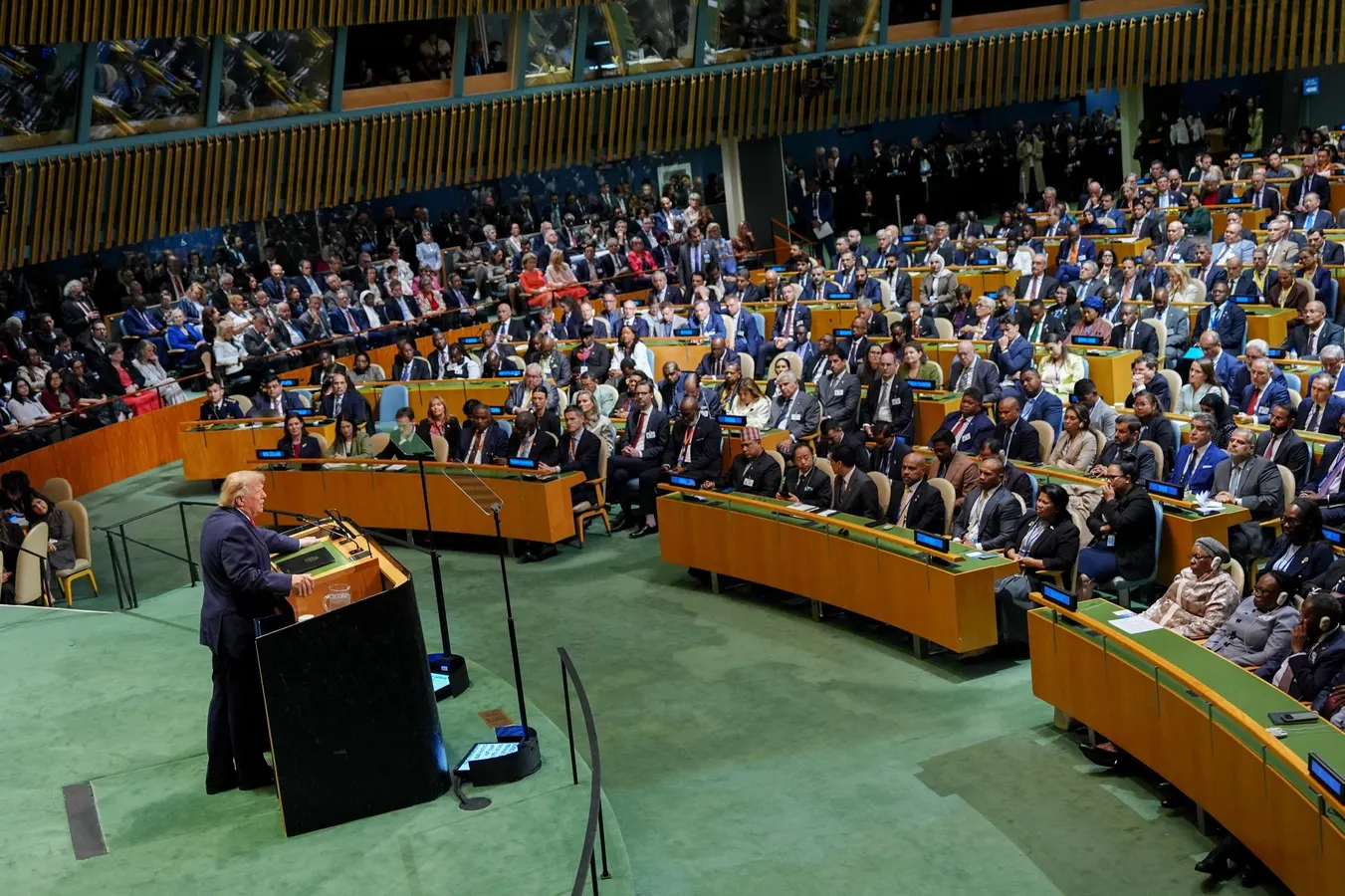

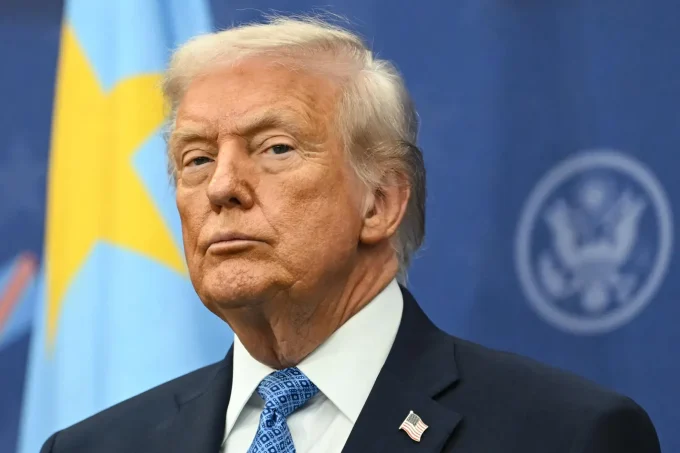
US President Donald Trump speaks during the United Nations General Assembly (UNGA) in New York, US, on Tuesday, Sept. 22, 2026. The theme of the 81st session of the United Nations General Assembly is “Restoring trust, managing transformation: A United Nations that delivers for all.” Photographer: John Lamparski/Bloomberg
© 2026 Bloomberg Finance LP
As world leaders continue their meeting in New York in the United Nations General Assembly, the organization created to prevent another world war is confronting an uncomfortable question: Are the principles that preserved relative peace among the major powers for eight decades beginning to unravel?
UN Secretary-General António Guterres opened this week’s debate with an ominous assessment: “The faultlines in our world are widening. Cracks have become canyons.” General Assembly President Khalilur Rahman was equally direct: “People are not asking whether the United Nations still exists. They are asking whether it works.”
The same question might be asked about American leadership.
President Donald Trump arrived at the UN proclaiming that America is “stronger today than ever before” and emphasizing national sovereignty, American power and a willingness to confront enemies.
Yet in Washington, another conversation is taking place—about whether the United States still sees the international security system it created after 1945 as something worth leading.
Vasily Nebenzya, Permanent Representative of Russia to the UN, speaks during a UN Security Council meeting on Ukraine at the UN Headquarters in New York City, November 20, 2025. (Photo by kena betancur / AFP via Getty Images)
AFP via Getty Images
Russia Is The Immediate Test
Whatever the longer-term challenge from China, NATO’s own assessment could hardly be clearer. The alliance currently describes Russia as “the most significant and direct threat to Allies’ security.” It cites Russia’s military expansion, nuclear intimidation, sabotage, cyberattacks, disinformation and continuing war against Ukraine. Frequent Russian incursions into NATO airspace have not gone unnoticed. That makes the transformation of American policy toward Europe particularly consequential. For nearly 80 years, Washington’s basic assumption was that preventing a hostile power from dominating Europe was in America’s national interest—not just a charitable concern about Europeans.
That lesson emerged from World War II, the Berlin blockade, the creation of NATO and four decades of confrontation with the Soviet Union. America maintained troops, nuclear forces and alliances in Europe because deterrence was considered cheaper and safer than discovering too late that aggression had escaped containment.
Today, however, the burden is shifting.
At NATO’s Ankara summit in July, the alliance acknowledged that European allies and Canada now finance the vast majority of military assistance to Ukraine. NATO Secretary General Mark Rutte said this month that more than $10 billion had been allocated through the Prioritized Ukraine Requirements List (PURL) and U.S. Foreign Military Sales. Under PURL, the weapons are American, but NATO allies and partners increasingly pay the bill. Rutte called this Europe “stepping up.”
There is another way to view it: Washington is reducing its direct financial commitment to the defense of a European order the United States originally did more than any other country to construct.
President Clinton signing the Budapest Memorandum in 1994 with Russia and Ukraine, securing Ukraine’s sovereignty
Sygma via Getty Images
What Happened To The Budapest Commitment?
Ukraine makes that question particularly awkward. In 1994, Ukraine agreed to surrender the nuclear arsenal it inherited from the Soviet Union. In the Budapest Memorandum, Russia, the United States and Britain reaffirmed their commitment to Ukraine’s sovereignty and existing borders and pledged to refrain from threatening or using force against its territorial integrity. True, the memorandum was not an Article 5 military guarantee. Washington did not promise automatically to go to war for Ukraine. But the political issue cannot be dismissed so easily. Ukraine gave up nuclear weapons as the major powers assured it that its sovereignty would be respected.
When Russia invaded Ukraine it flagrantly broke that understanding. The question for Washington is what America’s assurances mean if, when they are most severely tested, increasingly someone else is expected to finance the response. That has implications far beyond Ukraine. Nuclear non-proliferation depends partly upon countries believing they can survive without nuclear weapons of their own.
Europe Is Already Drawing Conclusions
Foreign-policy experts increasingly describe a profound change in the transatlantic relationship. Fiona Hill, the former National Security Council Russia expert now at Brookings, argues that “diminished U.S. leadership and strained alliances” are forcing Europe and Ukraine to seek new security arrangements. Her conclusion is striking: “Both Ukraine and Europe are already entering a post-American world.”
At Chatham House, international security director Marion Messmer wrote before this summer’s NATO summit that the Trump administration had become serious about reducing U.S. involvement in European security. She said Europe had become “much more wary about Washington’s intentions” and questioned whether deterrence can remain credible if adversaries see America disengaging.
That concern is no longer academic.
General Sir Richard Barrons, a co-author of Britain’s Strategic Defence Review, told a Chatham House conference in July that European NATO countries need to rebuild deterrence against Russia “with far less reliance on the US, inside four years.”
Those are extraordinary words from the allies of the country that created NATO.
The Danger Is Miscalculation
None of this means a third world war is inevitable. But history suggests that major wars often become possible when deterrence becomes uncertain—when one side begins to wonder whether the other actually means what it says. A recent Chatham House study warns that an inadequately secured ceasefire in Ukraine could allow Russia to regroup, rearm and continue pressure through sabotage, cyberattacks and political interference. That is why Ukraine cannot be viewed simply as a dispute over where to draw a ceasefire line. It is a test of whether military force can once again become an accepted means of changing Europe’s borders.
The UN Has The Same Problem
And that brings the argument directly back to New York. Article 2 of the UN Charter prohibits the threat or use of force against another state’s territorial integrity or political independence. Yet Russia remains a permanent member of the Security Council. When the Council considered a resolution condemning Russia’s invasion in February 2022, 11 members voted for it. Russia vetoed it.
That contradiction goes to the heart of the UN’s present crisis. Russia is entrusted with special responsibility for maintaining international peace while possessing the power to block action concerning its own war.
The United Nations is now searching for a successor to António Guterres. Selecting an effective Secretary-General matters. But changing the person at the top is not enough. As Rahman told the General Assembly this week, reform must go deeper because the organization’s problems are “chronic and fundamental.” He specifically called for Security Council reform.
The larger challenge is whether the institutions created after World War II can still enforce the principles upon which they were built. America once understood why that mattered. It helped write the UN Charter. It stood firm in Berlin. It created NATO. It spent decades convincing Moscow that aggression against Western Europe would meet a united response.
World leaders assembled at the UN this week should ask Washington whether it still sees that system as central to American security—or increasingly as a burden that others should carry. More importantly, if deterrence protecting Europe and North America fails, will America be ready to help shoulder the extra burden that creates? Further, what are the implications of America’s position for nations elsewhere, such as Taiwan and South Korea for example? History once taught us that rebuilding deterrence can be vastly more expensive than maintaining it. Have we forgotten that lesson?












Leave a comment