


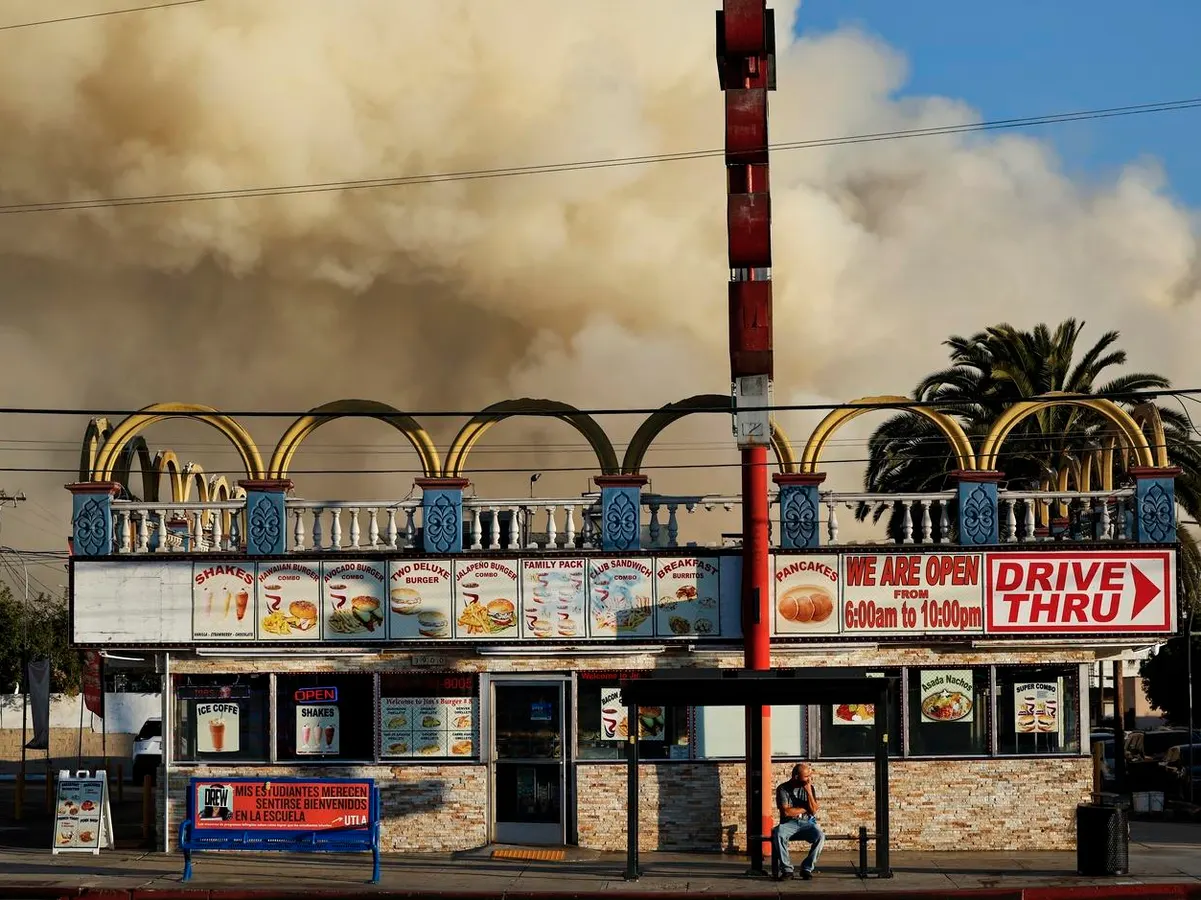

A person sits at a bus stop as a massive warehouse fire at a Lineage cold storage facility continues to burn and spread smoke around Los Angeles, California on June 20, 2026. California Governor Gavin Newsom declared a state of emergency in response to the fire which began June 17 in the Boyle Heights neighborhood. (Photo by Mario Tama)
Getty Images
California Governor Gavin Newsom signed two bills on September 27 after a fire at a Los Angeles cold-storage warehouse left millions of pounds of food to spoil near homes and businesses, with the effects on the surrounding community dragging on for months.
The laws raise penalties for certain safety violations and require some refrigerated facilities to have funds or coverage available to help communities during an emergency. The fire has also drawn attention to the challenges of protecting cold-storage warehouses from fire.
The June 17 fire at a Boyle Heights warehouse operated by Lineage, the world’s largest temperature-controlled logistics company, burned for eight days. Known as Big Bear, the facility stored seafood, pork, beef, and poultry before shipment to grocery stores and restaurants across the U.S. West Coast.
The nearly 500,000-square-foot facility held an estimated 85 million pounds of frozen food. Once refrigeration failed, removing the food became a prolonged operation inside the damaged building. Residents reported odors, flies, and rats in the weeks after the flames were extinguished.
Lineage, which operates more than 500 warehouses worldwide, said it completed the food-waste cleanup on September 5 and spent more than $100 million on its response. The cause of the fire remains undetermined. Lineage has since sued a rooftop solar operator and a contractor, alleging they were responsible.
New penalties and emergency funding
The laws aim to protect communities when an emergency at a large facility affects the people living nearby. Senate Bill 716 allows fines of up to $50,000 per violation for certain health and safety violations that lead to a declared emergency.
Assembly Bill 817 requires qualifying cold-storage facilities seeking building permits to have a fund, bond, or insurance coverage that can help affected communities under specified emergency conditions. The requirements initially apply in parts of Los Angeles and will extend to other eligible areas of California in 2028.
Senator María Elena Durazo, one of the authors of the new legislation, said the fire’s effects on nearby families showed why the laws were needed.
“Families in Boyle Heights and East LA were exposed to toxic smoke and lived with the stench of millions of pounds of rotting food for months,” she said. “They could not open their windows and could not let their kids play outside.”
California Senator María Elena Durazo authored SB 716, while Assemblymember Mark González authored AB 817, in response to the devastating fire at the Lineage cold-storage facility in Boyle Heights.
Senator María Elena Durazo
The Global Cold Chain Alliance opposed the bills, saying they would raise costs for “growers, processors, distributors, manufacturers, and retailers alike,” without doing enough to improve emergency preparedness.
“Cold storage is a critical link in the food supply chain, and the cold chain industry has continually invested in facilities, equipment, and safety measures to prevent incidents,” the alliance said.
Newsom said the Boyle Heights fire showed how long a major facility emergency can affect a community.
Fires that are difficult to reach
Beyond its impact on the community, the Boyle Heights fire has raised questions about how well refrigerated warehouses are protected against fire. Packaging, pallets, and some types of insulation can feed a fire. Tightly packed racks can prevent sprinkler water from reaching a fire. How well a warehouse is protected depends on what it stores, how high and densely the goods are stacked, and whether its sprinkler system is designed for that layout.
Those questions extend across a sizable industry. In 2025, the United States had 931 refrigerated warehouses with nearly 4 billion cubic feet of gross capacity, according to the Department of Agriculture.
National figures specific to cold-storage fires are scarce. In an analysis provided to FactCheck.org, the National Fire Protection Association estimated that U.S. fire departments responded to an average of 35 fires a year at refrigerated-storage properties from 2015 to 2019.
Noah Navarro, a retired firefighter and CEO of The Fast Fire Watch Company, a national provider of OSHA-certified fire watch security solutions, said taller warehouses, denser storage, and greater reliance on automated equipment can complicate fire prevention and response. Batteries, wiring, and combustible insulation can add hazards, while insulated walls and ceilings can make a fire harder to locate and extinguish.
“Cold-storage warehouses are getting larger and more automated, which can make fires harder to detect and control,” he said. “If a sprinkler or fire alarm is out of service, is undergoing an upgrade, or encounters code violations, operators need a plan for someone to watch for fire, call emergency services, and get the system working again. A fire watch can cover that gap while repairs are made.”
Noah Navarro, a retired firefighter and CEO of The Fast Fire Watch Company, says dense storage, automated equipment and insulated walls can make warehouse fires harder to prevent, locate and extinguish.
Noah Navarro
A study published in the journal Fire described the danger of fires developing unseen within insulated walls and roofs, including those of cold-storage buildings.
“Concealed fires within the insulation layers of buildings, such as cold storage facilities … present a serious fire hazard because heat generated by electrical faults can accumulate behind protective panels before ignition and then spread rapidly once combustion begins,” researchers said.
Other fires, other hazards
A CBS News investigation found at least 63 fires over the past decade in or around cold storage properties operated by Lineage. The company acknowledged 34 building fires, including a 2024 blaze at its Finley, Washington, warehouse that burned for nearly two months.
That fire was first reported in a freezer where racks held frozen vegetables on plastic pallets. Sprinklers initially contained the flames, but the shelving and stacked goods made the burning material difficult for water and firefighters to reach. The blaze was described at the time as one of the Northwest’s largest. Frozen potatoes, corn, peas, carrots, and other vegetables were destroyed, leaving an estimated 90,000 tons of debris, much of it rotting produce.
The Finley warehouse used anhydrous ammonia as a refrigerant. Approximately 14,000 pounds of it were lost during the fire, according to the Washington Department of Ecology. Similarly, after the Boyle Heights fire, Lineage found elevated ammonia levels around its Los Angeles warehouse. California environmental records show the facility stored between 10,000 and 24,999 pounds of anhydrous ammonia daily.
A firefighter from Williams Fire and Hazard Control of Texas walks towards the side of Lineage cold storage facility which was destroyed by fire in Los Angeles, CA. (Gina Ferazzi/ Los Angeles Times)
Los Angeles Times via Getty Images
Dr. Jill Johnston, an environmental health scientist at the University of California, Irvine, told CBS that the ammonia refrigeration systems used by many cold-storage warehouses can pose a danger during a fire.
“What they use for cooling are very toxic chemicals,” Johnston said. “They can explode. If something goes wrong, these facilities have the potential to release massive amounts of toxic chemicals.”
Damage beyond the warehouse
The Boyle Heights fire stood out for its scale and the disruption it caused nearby residents. Other cold-storage fires across the United States have destroyed food inventories, forced neighborhood evacuations, and, in some cases, claimed lives.
On September 12, 2026, firefighters responding to a frozen-fish warehouse near the Port of Bellingham in Washington found flames breaking through the roof. All the frozen fish inside was destroyed, but no injuries were reported, and the fire did not spread to adjacent buildings.
In Puyallup, Washington, a fire on August 21, 2021, destroyed a Washington Cold Storage warehouse and forced nearby residents to evacuate over concerns about toxic smoke and potential explosions. The facility contained about 1,000 pounds of anhydrous ammonia refrigerant, complicating firefighting efforts.
In Worcester, Massachusetts, six firefighters died at a vacant Worcester Cold Storage and Warehouse building on December 3, 1999. A federal investigation found that two firefighters became lost while searching the six-story building for occupants. Four others became lost during subsequent rescue efforts.
Flames engulf the vacant Worcester Cold Storage and Warehouse building in Massachusetts on December 3, 1999. Six firefighters died battling the blaze. (Photo by MediaNews Group/Boston Herald)
MediaNews Group via Getty Images
“Cold-storage fires can be difficult to control,” Navarro said. “Materials and insulation can burn, and tightly packed stock can make it hard for firefighters to reach the flames. If ammonia escapes, people nearby could be at risk. If the alarm or sprinklers are out of service, you need someone there to spot a fire, call for help, and get people out. In an urban area, a lot of people can be affected.”
In Boyle Heights, that impact extended well beyond Lineage’s property. Smoke affected nearby residents during the fire. As the stored food spoiled, foul odors and pests prolonged the disruption for months.
California’s new laws address those wider costs, allowing higher fines for certain serious safety violations and requiring qualifying cold-storage projects to have funds or coverage available for affected communities. The Boyle Heights fire burned for eight days. For neighbors, its aftermath lasted months.












Leave a comment