



U.S. Air Force Senior Airman Brian Baker, 60th Civil Engineer Squadron explosive ordnance disposal operations team member, ties a trip wire in a simulated hostage scenario during Exercise Sourdough in San Francisco, California, Dec. 10, 2025.
(U.S. Air Force photo by Airman 1st Class Ashley Rowell)
Members of the United States military unofficially began wearing berets during World War II, with the 509th Parachute Infantry Battalion donning British maroon berets as honorary members of the British Parachute Regiment. The United States Army Special Force officially adopted the “Green Beret” in 1961, and the United States Air Force Security Police began wearing dark blue berets in February 1976.
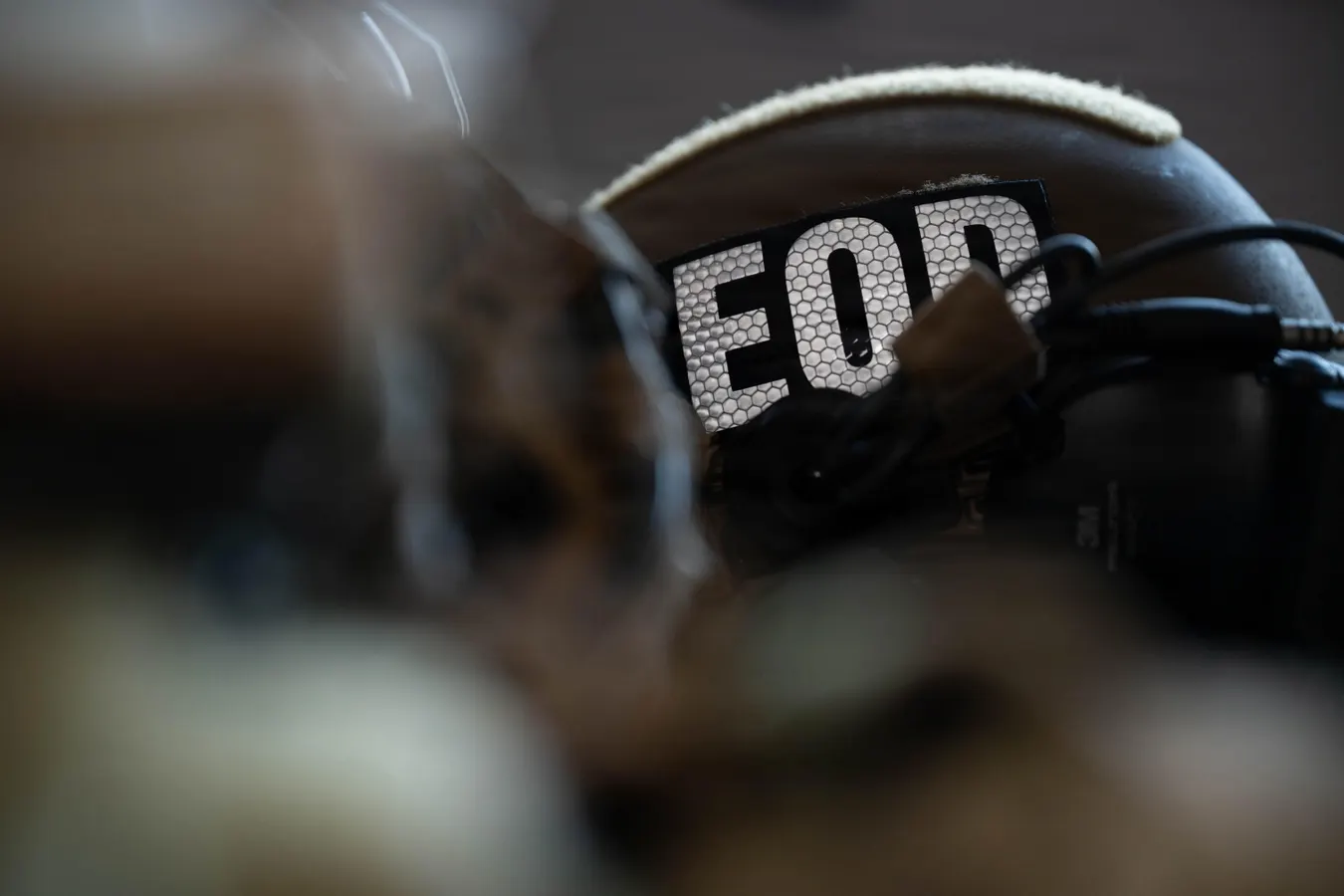
Now, another beret is being adopted within the U.S. Air Force, a “rust-colored” one that will be worn by its “explosive ordnance disposal” airmen.
On Friday, Chief Master Sergeant of the Air Force David R. Wolfe announced the official adoption of the new berets as a way to recognize the EOD airmen’s specialized combat arms mission and contributions to the joint force. The announcement was made virtually at the graduation of the inaugural Project MAMBA course at Tyndall Air Force Base’s Silver Flag training site.
The Multi-domain Airmen for Modern Battlefield Application, or MAMBA, is the U.S. Air Force’s EOD redesigned pre-deployment training pipeline. Its course incorporates recent combat lessons and is meant to prepare EOD airmen for operations in complex, contested environments alongside joint and coalition forces.
“Today’s graduates represent the capability, professionalism and warrior ethos that define our explosive ordnance disposal force,” Wolfe said. “As you prepare to deploy and take on one of the Air Force’s most demanding missions, carry forward the pride and combat identity you have earned. The EOD beret will stand as a visible recognition of that identity and your service to the joint force.”
According to the U.S. Air Force, the EOD mission is to detect, identify, evaluate, render safe, recover, exploit and dispose of explosive ordnance and hazardous materials. The personnel conduct specialized render-safe procedures and post-blast exploitation while supporting maneuver forces and protecting personnel, equipment and operations.
Why Rust Colored?
Across the United States Armed Forces, military beret colors signify specific branches, job specialties, or elite unit qualifications. That includes colors that are meant to visually separate special operations, airborne, or armored units from the general forces. In addition, a beret’s colors can honor past units or specific historical campaigns.
With the British Army, which adopted berets earlier than the United States, early colors like black were chosen for armored crews because the dark fabric hid grease and oil stains. Yet today, black berets are worn as the standard service uniform headgear across the rest of the United States Army.
Maroon is still worn by airborne forces and paratroopers who are on jump status due to the historic ties to the British Airbourne units of the Second World War. Likewise, the 75th Ranger Regiment wears a tan beret to pay tribute to World War II’s Merrill’s Marauders, the legendary, all-volunteer U.S. Army jungle-warfare unit that fought behind Japanese lines in Burma and who worn such distinct headgear.
The rust color was chosen for its own distinct reasons.
“The rust beret reflects the EOD mission and the color historically associated with explosive hazards. Its metallic flash incorporates EOD and Air Force symbolism, representing the community’s global mission, technical expertise and legacy of sacrifice,” the Air Force explained, adding that the beret authorization also aligns the EOD’s uniform distinction with its designation as a specialized conventional combat-arms career field and recognizes the community’s role in delivering combat capability at the tactical edge.
“EOD Airmen bring disciplined expertise, courage and resolve to the joint force’s most complex and hazardous missions,” said Chief Master Sgt. Steven Harris, EOD career field manager. “The rust beret recognizes their combat-arms identity, honors the community they represent and reflects the capability they will continue to deliver wherever the mission demands.”
The U.S. Air Force didn’t announce when the EOD rust-colored beret will begin to be issued.
French Or Scottish Headgear?
A soldier with the French Army’s Chasseurs Alpins (alpine troops) wears the unit’s signature beret at a media event held during Exercise Trident Juncture 2018.
(Photo by Rob Kunzig, NATO Channel)
The French Chasseurs Alpins, a type of mountain infantry, were the first modern military unit to adopt a large, wide beret as part of their standard uniform. Nearly 140 years later, the elite mountain troops still wear a similar beret as part of their walking out uniform.
The British Army’s Royal Tank Regiment unofficially adopted the aforementioned black beret in 1918, because its traditional service caps were too stiff and impractical inside of cramped tanks, and the beret was officially approved in the uniform regulations in 1924.
However, the cap’s origins go back much further.
Although the modern beret is associated with the French, the earliest form of flat round caps can be traced back to the Bronze Age Minoan Crete around 1750 BC. Its direct link to the modern beret is a matter of debate, but what is known is that a wool cap was crafted by local farmers and shepherds in the Béarn and Basque regions of the Pyrenees to protect against rain and cold. The word “beret” is thought to have entered the lexicon around 1835, and mass production began in the 1840s in towns such as Oloron-Sainte-Marie and its use spread beyond the Béarn region of France.
As it had no brim, it could be squashed or rolled into a pocket, and kept its shape after being packed away, and that made it an ideal form of headgear for mountain personnel. That led to the Chasseurs Alpins adopting the beret, which earned the nickname “la tarte” (the pie). By the late 19th and early 20th centuries, the beret had become fashionable with artists, notably painters such as Claude Monet, Paul Cézanne, and later Pablo Picasso, who often wore berets in Paris. The simple headgear reached high fashion, where it was donned by women in the 1930s, which cemented the beret’s status as an international symbol of French style.
Yet, another version of beret originated in Scotland as flat wool “bonnets” (originally “bonaid” in Gaelic), which served as practical Highland wear and clan identifiers adorned with feathers or badges.
Beyond its use as military headgear and fashion accessory, berets also became a revolutionary symbol, notably worn by Argentine revolutionary Che Guevara, and a distinct had for activist groups, such as the Black Panther Party and the Guardian Angels. A “Raspberry Beret” even got its moment in the pop cultural musical spotlight thanks to Prince and the Revolution!
















Leave a comment