


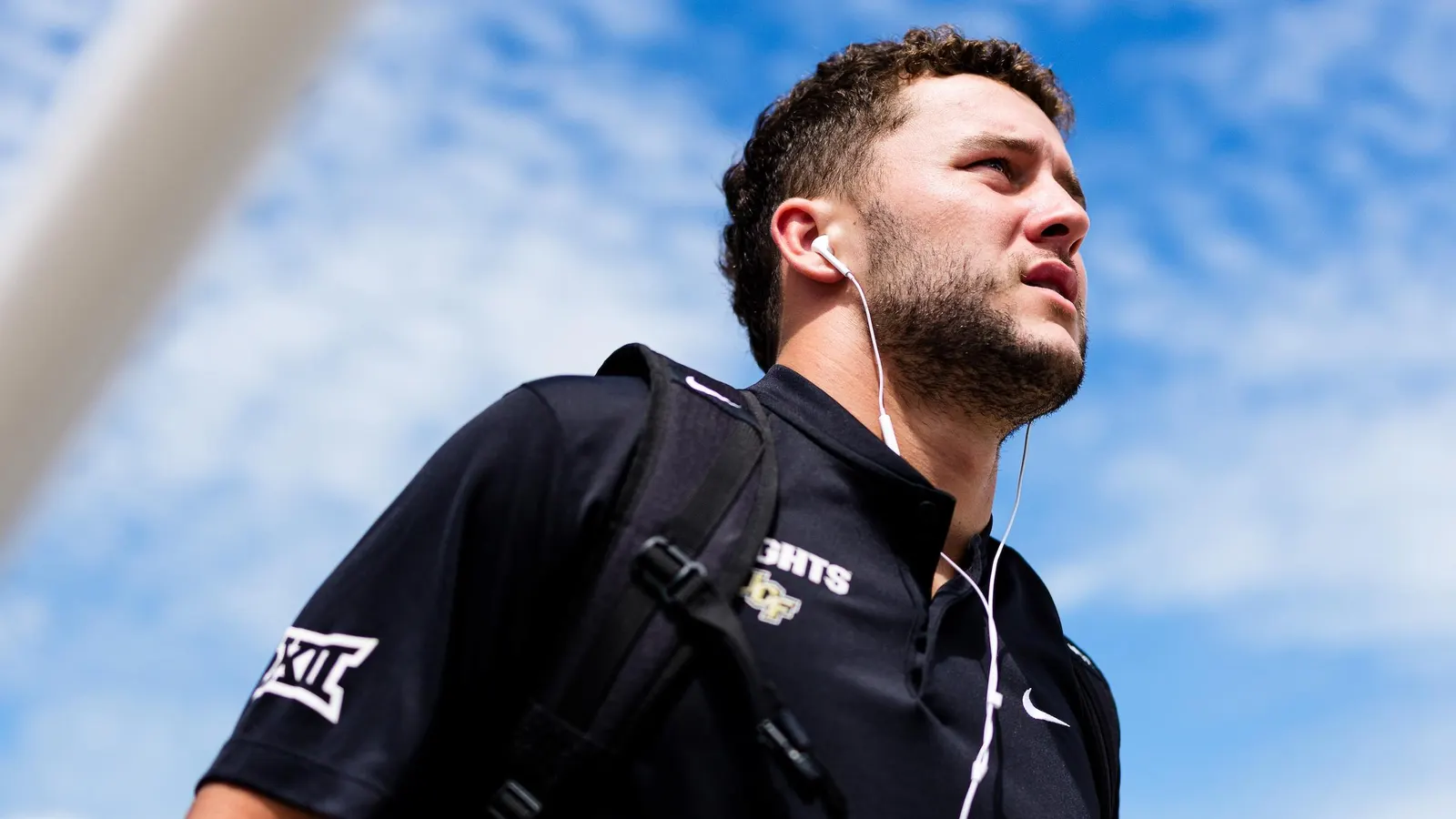

UCF defensive back, Ty Bartrum, played four seasons at Dartmouth where he received his undergraduate degree. He is spending his final season of eligibility at UCF and is enrolled in a master’s program.
Conor Kvatek/UCF Athletics
When Ty Bartrum took the field with the UCF defense for the first series of the Knights’ matchup with visiting TCU on September 26, the safety lined up across from a familiar face in quarterback Jaden Craig. They were teammates and roommates at Harvard before transferring to their current schools in January. Here they were on the Big Twelve gridiron in Orlando attempting to throttle one another.
“I think we kept the smack talk to a minimum, but we still had fun with it,” said Bartum, an Ohio native who was a finalist last season for the Buck Buchanon Award given to the FCS defensive player of the year, when asked about the lead up to the encounter with his buddy. “Over the past three and a half years we were as close as you can get in terms of being friends, roommates, traveling together and always being together. It was a different feeling being on opposite sides, but we both had a good time. It was pretty special.”
For the record, Bartum did not intercept Craig while recording a pair of tackles in UCF’s 21-13 victory in the conference opener for both teams. Fellow safety Antoine Jackson picked off Craig at the Knights’ seven-yard line with less the two minutes remaining to seal the victory.
It was kind of ironic their first conference game as FBS players was against each other.
“That’s my best friend,” said Craig, following the encounter in which he threw for 310 yards, two interceptions and was sacked four times. “It was good seeing a familiar face and I’m glad he’s doing well (at UCF). Nothing but love for him and I hope the best for him in the future.”
The 6-foot-3 and 225-pound Craig, a northern New Jersey native and two-time (2024, 2025) Walter Payton Award finalist for the most outstanding offensive player in the FCS, is Harvard’s all-time leader with 6,074 passing yards and 52 touchdown passes. He often connected during the 2023 and 2024 seasons with a receiver whose current team has designs on going far in the College Football Playoff a second straight year.
“Funny enough, our other roommate was Cooper Barkate,” said Bartrum, referring to the Miami receiver, who left Harvard following the 2024 season to attend Duke where he and quarterback Derian Mensah were an impressive combination. The combo remains intact as Barkate and Mensah left for Coral Gables to play for the Miami Hurricanes.
What has allowed such talent to flow from the Ivy League to the FBS is a combination of factors that illuminate recent change in college athletics as well as a group of universities maintaining a long-held standard. Specifically, freedom of movement through the transfer portal and the 70-year-old Ancient Eight to this day not permitting graduate students to participate in athletics.
Hence, after redshirting as a freshman at Harvard, Craig played three seasons with the Crimson, earned his undergraduate degree (economics) and wanted to play a fourth and final season of football. As a graduate student, he could not continue to compete in the Ivy League. So, Craig took his game to TCU to complete his athletic eligibility.
Looking at the broader picture as it pertains to Ivy League transfers, according to a league communications director, 44 players entered the portal after the 2025 season. Forty-two were graduate students, including Bartrum and Craig.
The fact the Ivy League prohibits graduate students from the taking the field provides an opportunity for an athlete to get the best of both worlds when it comes to education and athletics during the course of a collegiate career.
“Nerds Can Ball a Little Bit”
Given the number of Ivy Leaguers making their way to FBS programs, perhaps a “Nerds Can Ball a Little Bit” line of athletic attire will soon make its way to college locker rooms.
The slogan is courtesy USF receiver, Mudia Reuben, who was asked about his previous college football address and that of teammate D.J. Crowther during a recent mid-week presser. Reuben did not attend an Ivy League institution, though he received his undergrad degree in three years at Stanford before transferring to USF where he is on the verge on completing his master’s in biomedical engineering. Crowther played four seasons at Dartmouth, though only four games as a freshman to maintain a redshirt, and is carrying the load for the Bulls’ ground game while in a master’s (entrepreneurship) program.
TAMPA, FLORIDA – D.J. Crowther of the South Florida Bulls runs against the Delaware State Hornets during the first half of the game at Raymond James Stadium on September 19, 2026 in Tampa, Florida. (Photo by Mike Carlson/Getty Images)
Getty Images
“The Ivy League is an avenue for those who want to focus on academics,” said Crowther, a San Francisco Bay Area native who when to high school in Sacramento. “There is definitely a lot of talent in the Ivy League, and at the end of the day, it’s football. There are ballers everywhere.”
Indeed, there are no secrets at any level of college football. There is no lack of exposure with scouts spread throughout the country, seemingly countless games broadcast each week and highlights from every corner of the map available on social media platforms.
Bartrum was certainly on the radar at Harvard, a place where he knew he had it good.
“I hosted recruits before my senior year and I spoke about my experience at Harvard and where I was in (my college career),” he said. “As I was talking to them, I was thinking, ‘Wow, this sounds really good. I love my experience here.’”
Bartrum also understood there was an opportunity to compete at the highest level of college football after receiving an Ivy League degree. Like his Crimson pal, Craig, a redshirt season (2022) and Ivy League rules meant one thing when it came to completing his athletic career: The portal door was wide open to the world of big-time college football, live broadcast exposure like never before, NIL, etc. Again, it also provided an option to experience the best of both worlds during his collegiate career, an Ivy League education and FBS playing experience.
“I have had many conversations about the college football space and the Ivy League experience,” said Bartrum. “You can have a year, maybe two, after transferring (from the Ivies) to take advantage of NIL. You need to trust your judgement.”
Crowther trusted his judgement and is going about his final season of eligibility much like that of Bartrum’s, and in the Sunshine State, after four years at an Ivy League campus in New England.
“Coming out of high school, (players) can go to the Ivy League, get their degree and then transfer,” he said. “It is something that definitely could put more eyes on the Ivy League. Over the past few years there have been a lot of Ivy League players that have gone to the FBS level and are doing well.”
There sure are. Included in the transfer class of 2026 are a trio Penn Quakers: Pitt left tackle Netinho Olivieri, Duke receiver Jared Richardson and Purdue receiver Bisi Owens. Also, Oregon offensive lineman Michael Bennett (Yale) and Georgia Tech tight end Chris Corbo (Dartmouth), who was a teammate of Crowther’s, are among others who made the move.








Leave a comment