


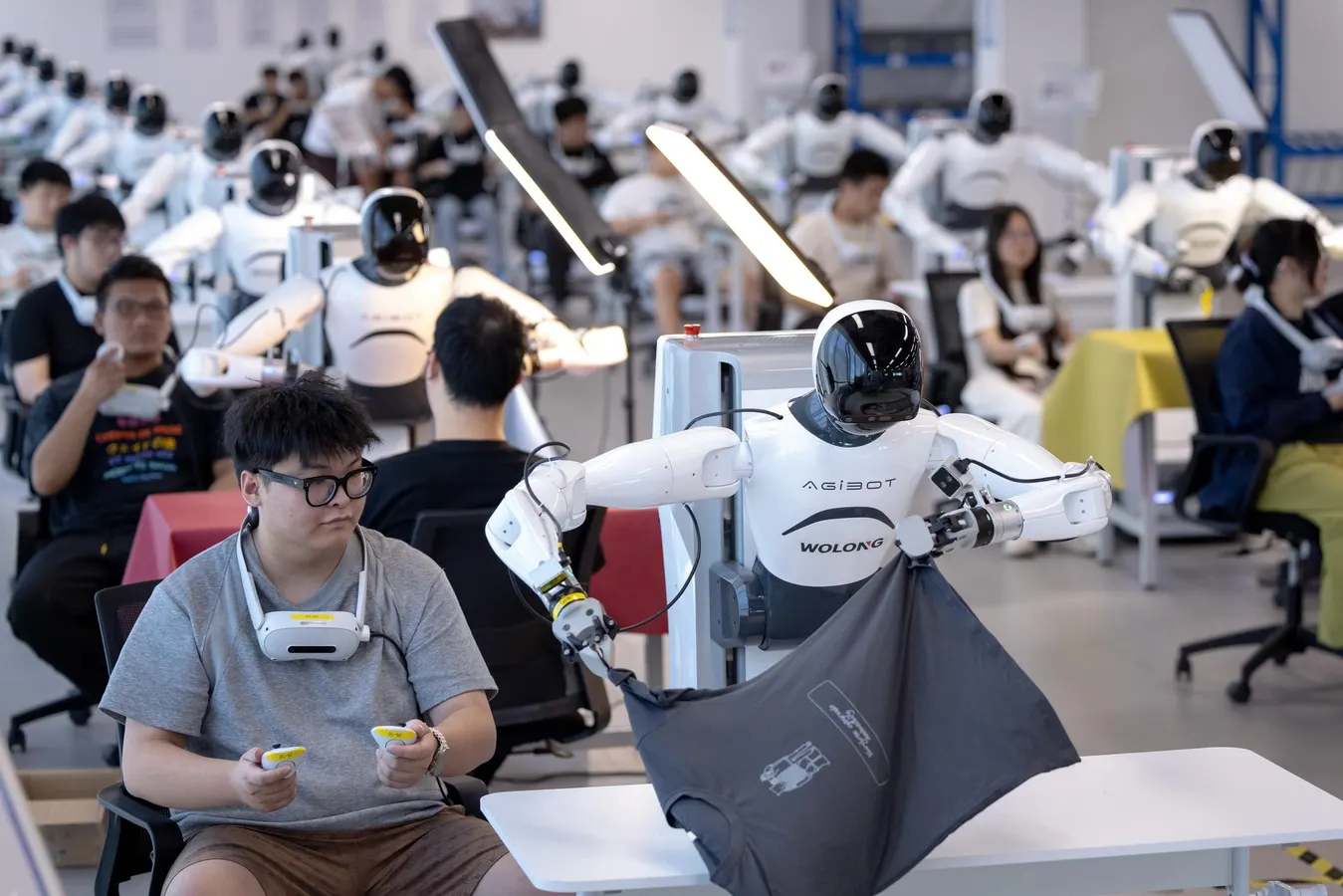

SHAOXING, CHINA – SEPTEMBER 14: Humanoid robots follow technicians to learn job skills at the data collection area of an embodied AI robot innovation center on September 14, 2025 in Shaoxing, Zhejiang Province of China. Staff members use controllers to “guide” the humanoid robots step-by-step in performing tasks such as folding clothes, sorting files, and tightening screws, thereby accumulating training data for different operational scenarios. (Photo by Ni Yanqiang, Wang Jianlong/Zhejiang Daily Press Group/VCG via Getty Images)
VCG via Getty Images
President Trump says, “We’re leading China in AI.” The latest Carnegie China report confirms Trump’s assessment: “Every few months, a leading American AI lab releases a state-of-the-art frontier model, only to be followed by a Chinese open-weight model that nips at the heels of the U.S. frontier.”
The U.S. leads in AI, China follows. The narrative is surely encouraging, but also quite a bit more nuanced than is commonly understood.
That’s because AI, like any other technological endeavor, is people driven. Which is where the AI race between the U.S. and China becomes more encouraging and troubling at the same time. It’s written here routinely that the only “closed economy” is the world economy, and the U.S.-based AI economy benefits substantially from what has long been a largely one-way flow of AI talent from China to the U.S.
Without these inflows, it’s easy to speculate that the U.S. lead described by President Trump in the AI race wouldn’t be as substantial, assuming a lead. Again, it’s all about people, and according to the Carnegie China report, “China has established a commanding lead as the largest originating source of elite AI talent globally.” Which, at first glance, is an encouraging analysis for the U.S.
Since the migration of human capital in the AI sector largely remains a one-way flow from China into the U.S., it remains true that the U.S. AI sector benefits no matter where the AI talent originates. As the Carnegie China report further indicated, “When it comes to brain gain vs. brain drain, the United States saw a net gain of +2,145 researchers in 2025 while China registered a net loss of -1,729 researchers.”
Reading all this, it would be easy for Americans to be more than encouraged about the AI present and future. The best and brightest of the AI crop in the U.S. are largely keeping their skills in the United States, while the U.S. remains a magnet for top Chinese AI talent. See above. Hence the U.S.’s lead.
Which is where the story takes a discouraging turn. Yes, a second glance. While the battle for human capital continues to favor the United States, President Trump has employed a contradictory stance on the AI race. Though he contends that “whoever wins AI wins,” he’s not matching his rhetoric with openness to the global pool of AI talent necessary for the U.S. to keep winning.
In particular, more challenging visa restrictions have made it quite a bit more difficult for talented technology workers to reach the United States for work. Consider the latter relative to the country origin of the best AI minds.
In 2022, 46% of the world’s top undergraduate AI talent came out of China. Three years later, the China share is 57%. The U.S.’s? It’s down to 13%. Only for the story to become yet more troubling.
While the U.S. is in the AI lead, the Chinese are plainly catching up. Combine the narrowing AI divide between the U.S. and China with tighter U.S. visa restrictions and the AI talent race is slowly moving in China’s direction. As explained in Carnegie China, “The share of Chinese-origin researchers who end up working in China increased from 57 percent in 2022 to 69 percent in 2025.”
It can’t be said enough that the AI race is about people, first and foremost. The previous truth favors the U.S., but only insofar as President Trump aligns his desire to win with an embrace of the very people, including Chinese people, necessary for the U.S. to win.














Leave a comment