


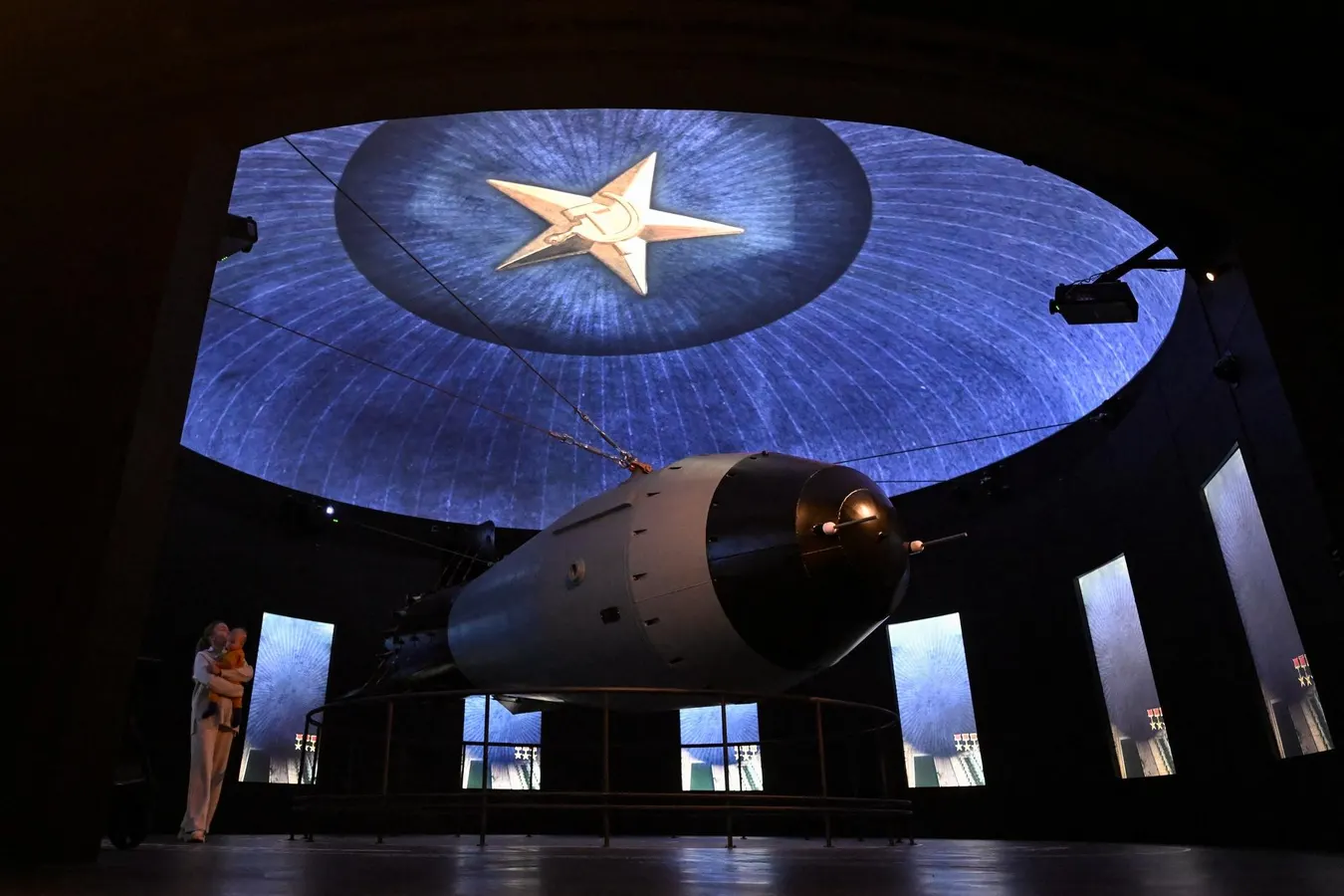

Putin’s new ramped-up threats to target the European democracies with his arsenal of nuclear super-bombs could foreshadow an armed attack by Russian troops on a NATO nation. Shown here is the Soviet-designed Tsar Bomb, the most powerful thermonuclear weapon ever created. (Photo by NATALIA KOLESNIKOVA/AFP via Getty Images)
AFP via Getty Images
Vladimir Putin’s new ramped-up threats to target the European democracies with his arsenal of nuclear super-bombs could foreshadow an armed attack by Russian troops on a NATO nation, says a leading expert on the Kremlin’s leadership, intelligence operations and military.
Just days ago, Putin issued his most direct warning ever that he could launch nuclear missiles against European nations helping Ukraine repel its Russian invaders, in a provocative call to arms posted on the President of Russia website.
His new nuclear invective could be a precursor to launching a lightning incursion on one of the nations that regained its independence and freedom upon the break-up of the USSR, the Soviet empire that Putin now dreams of recreating, says Elena Grossfeld, an eminent scholar at King’s College London.
Based at the prestigious King’s Centre for the Study of Intelligence, Grossfeld told me in an interview that Putin’s just-issued warnings of using doomsday weapons against the West are adding to a crescendo of nuclear threats ricocheting across the Kremlin and Russian legislature.
These days, she says, “so many Russian propagandists and Duma [legislature] members have been explicitly threatening nuclear attacks.”
Nikolai Patrushev, the premier aide-de-camp to Putin, with an alliance between the two militarists that dates back to their parallel strongholds in the KGB, the Soviet state security and intelligence agency, just weeks ago admonished the Polish foreign minister that Moscow could wipe out Warsaw almost overnight.
After Poland’s top diplomat, Radosław Sikorski, mused during a high-level security conference in the Ukrainian capital that NATO could easily overcome the Russian military, Patrushev launched an apocalyptic message to Sikorski and all his compatriots.
“By claiming Poland holds military superiority over Russia, Sikorski fails to realize that in the event of hostilities against Moscow, Warsaw would vanish within two or three days,” Patrushev said in a threat published worldwide by the Russian government-controlled propaganda outlet TASS.
Putin’s top lieutenant recently threatened Poland’s foreign minister that Russia could raze Warsaw in 2 or 3 days. Shown here is the Polish presidential palace and the iconic prince who led an earlier defense against invading Russian troops. (Photo by LTL/Heritage Images via Getty Images)
Getty Images
Patrushev, says King’s College expert Elena Grossfeld, “joins a loud chorus of others.”
“Sergei Lavrov, head of [Russia’s] Ministry of Foreign affairs, has also been issuing threatening statements against NATO,” she told me.
In his torrent of taunts of a nuclear face-off with the West, Putin said escalation via atomic arms “is a path towards a precipice, especially today when the world’s leading powers have weapons in their arsenals that are capable of destroying all life or at least reducing the Earth to a catastrophic state.”
Like the Soviets, Russia retains the world’s biggest stockpile of strategic and tactical nuclear weapons, the last remnant of its superpower status forged by the one-time communist tzars of the Union of Soviet Socialist Republics.
“Can we guarantee that these weapons will never be used? We cannot, of course.”
“Yes, of course, France and the UK are nuclear powers,” said Russia’s Supreme Commander-in-Chief. “We understand that perfectly well and are fully aware of it.”
“But no one else possesses the kinds of strike capabilities that Russia has today. And these are our competitive advantages.”
Nuclear bombs are hailed as icons of military might across Russia. Shown here is the Soviet RDS-4 nuclear weapon, which decorates a park, the first atomic bomb to be mass produced in Soviet Russia as the Cold War heated up. (Photo by Alexander NEMENOV / AFP via Getty Images)
AFP via Getty Images
After the veiled and open threats on deploying weapons of mass destruction issued by his lieutenants, Putin said Europeans “will now seize on it and exploit this argument that Russia is threatening them with nuclear weapons.”
In sync with the Kremlin commissar’s barrage of predictions of all-out atomic warfare, Moscow has been escalating its killer drone attacks while targeting routes and regions of Ukraine traversed by top-level Western statesmen.
Russian military pilots guided twin kamikaze exploding drones to hit a Ukrainian rail line that Britain’s onetime Prime Minister Boris Johnson was traveling on in mid-September, in what might have been a failed assassination attempt.
Then, right after Moscow warned foreign diplomats to leave Ukraine’s capital, or face “mortal danger,” Russian drone commanders launched a massive fleet of compact jet fighters to bombard Kyiv as German Chancellor Friedrich Merz touched down in the blitzed city to summit with President Volodymyr Zelensky, reported Le Monde, France’s leading broadsheet newspaper.
While Zelensky escorted him on a tour of Ukraine’s National Academy of Sciences, just decimated in a Russian airstrike, Chancellor Merz lashed out at the Kremlin war machine, and at the killing of citizens and scientists, Le Monde reported.
“These barbarous attacks on the civilian population of Ukraine must stop,” Merz declared. “These are war crimes that are being committed daily here.”
Moscow’s threats of impending nuclear clashes, fired off in a campaign that some scholars call “cognitive warfare,” might be aimed at terrorizing the heads of NATO states in advance of a small-scale, lightning Russian invasion of a former Soviet vassal state like Lithuania, Grossfeld predicts.
She points to a fascinating, just-released prediction of Russia’s alternative war strategies by high-level officers at the Danish Defense Intelligence Service, who warn: “Russia believes that Europe will gradually develop an autonomous military capability which, by 2030, will pose an increasing threat to Russia.”
“For Russia, the coming years [in the run-up to 2030] therefore present a window of opportunity, during which President Putin could conclude that it is worth the risk attempting to drastically change the security order in Europe.”
There is “a growing risk that Russia will launch a limited military attack against one or several NATO countries bordering Russia,” the Copenhagen-based intelligence officers predict.
“A limited military attack,” they add, “could potentially take place in the coming months.”
On the same day that the UK’s Boris Johnson just avoided being hit by a jet-powered Russian drone near a Ukrainian border crossing with Poland, “a Russian frigate in the waters off Gedser fired flares at a Danish military helicopter,” the Danish defense scholars reported.
Gedser, in southern Denmark, is a port on the Baltic Sea, where ”Russian forces are increasingly acting aggressively towards NATO military units.”
Officers at the Danish Defense Intelligence Service report that “a Russian frigate in the waters off Gedser fired flares at a Danish military helicopter” recently. Gedser is a picturesque Baltic Sea port in southern Denmark, shown here. (Photo by Jens Büttner/picture alliance via Getty Images)
dpa/picture alliance via Getty Images
War-gamers at the Danish Defense Intelligence Service, one of Europe’s leading intel organizations, outlined three potential scenarios for Russia to launch military operations against one or more NATO states.
In a series of simulated conflicts, they assumed that “Russia’s conventional military capabilities continue to grow while the West fails to simultaneously build up its military capabilities at the same speed.”
“Within approximately six months,” they projected, “Russia will be able to wage a local war in a country bordering Russia.”
“Within approximately two years, Russia will pose a credible threat to one or several NATO countries and thus be ready for a regional war against several countries in the Baltic Sea region.”
“Within approximately five years,” they forecast, “Russia will be ready for a large-scale war on the European continent.”
Military intelligence expert Grossfeld says she agrees Russia could invade one of the countries once forcibly annexed by the Soviet Union by sending plainclothes troops in an operation mirroring Moscow’s takeover of the Crimea region of Ukraine in 2014.
Grossfeld likewise seconds the forecast that Putin could speed up a military build-up, aimed at fighting a continental war in Europe, but adds the timeline for this arms race is still uncertain.
To lay the groundwork for an early, limited incursion of a NATO state, she predicts, Putin, the KGB-trained mastermind of strategic deception and psychological warfare, might direct a “false flag” attack on Russian territory, and then claim Moscow was justified in counter-attacking this set-up “aggressor.”
Finland, invaded by Soviet Russian troops in 1939, quickly joined NATO and stepped up military patrols along its borders after Russian troops and tanks invaded Ukraine. (Photo by Sean Gallup/Getty Images)
Getty Images
This strategy would be an intriguing case of history repeating itself, she says.
After signing a world-shaking Non-Aggression Treaty in 1939, when they secretly agreed to carve up vast sections of Europe between them, Nazi Germany and the Soviet Union almost simultaneously invaded and occupied Poland, with Adolph Hitler staging a false flag Polish attack on Germany to explain his “counter-invasion.”
Weeks later, to expand his empire-building conquests, Joseph Stalin mimicked Hitler’s stratagem by orchestrating a false flag attack on a Russian village just across the border with Finland, setting the stage for the “Winter War” that would see Soviet troops occupy the Finnish borderlands.
Putin, who appears to have closely studied the expansionist military campaigns of Hitler and of Stalin, could be preparing to spark a new Winter War with a targeted NATO nation, Grossfeld says.
During his nuclear Armageddon talk, Putin went to great lengths to sketch out the Kremlin’s potential use of Earth-threatening warheads to counter a NATO attack on Russia’s exclave of Kaliningrad.
“If it comes to a direct attack on the Russian Federation – in this case, Kaliningrad, although it could potentially involve other territories as well – the question of Russia using all the weapons at its disposal would inevitably and immediately arise. That is inevitable,” Putin proclaimed.
Yet there is absolutely no evidence that NATO has ever mapped out an aggressive, preemptive attack on Kaliningrad or any other territory of the Russian Federation.
Grossfeld, an expert on Putin’s military strategies, including his stepped-up testing of NATO defenses to undermine the entire Western alliance, predicts the Kremlin commander might be planning a false flag assault on Kaliningrad in order to “counterattack” one or both of its NATO neighbors, Lithuania and Poland.
If the NATO allies failed to rapidly unite to mount a collective defense to Russia’s invasion, required under the NATO Treaty’s pivotal Article 5, that could spell the beginning of the end of the North Atlantic Treaty Organization.
Yet the King’s College London scholar predicts that despite NATO’s limited pushback to Russia’s skyrocketing aggression so far, even a limited invasion of a NATO state would spark a speedy response by NATO Allies.
“I think NATO is training, and arming, but it doesn’t look like it’s going to forcefully respond against Russian provocation,” she forecasts, “unless and until Russia does a ground incursion into one of Baltic states” or other NATO nation.
NATO member states are likely to quickly unite in the collective defense of any NATO Ally invaded by Russia (Photo by Omar Havana/Getty Images)
Getty Images
And if Russian and NATO troops and jet fighters and drones do face off in this long-simmering clash of civilizations, Grossfeld says, despite all of Vladimir Putin’s nuclear doomsaying, “I still consider the likelihood of nuclear weapons use to be low.”












Leave a comment