


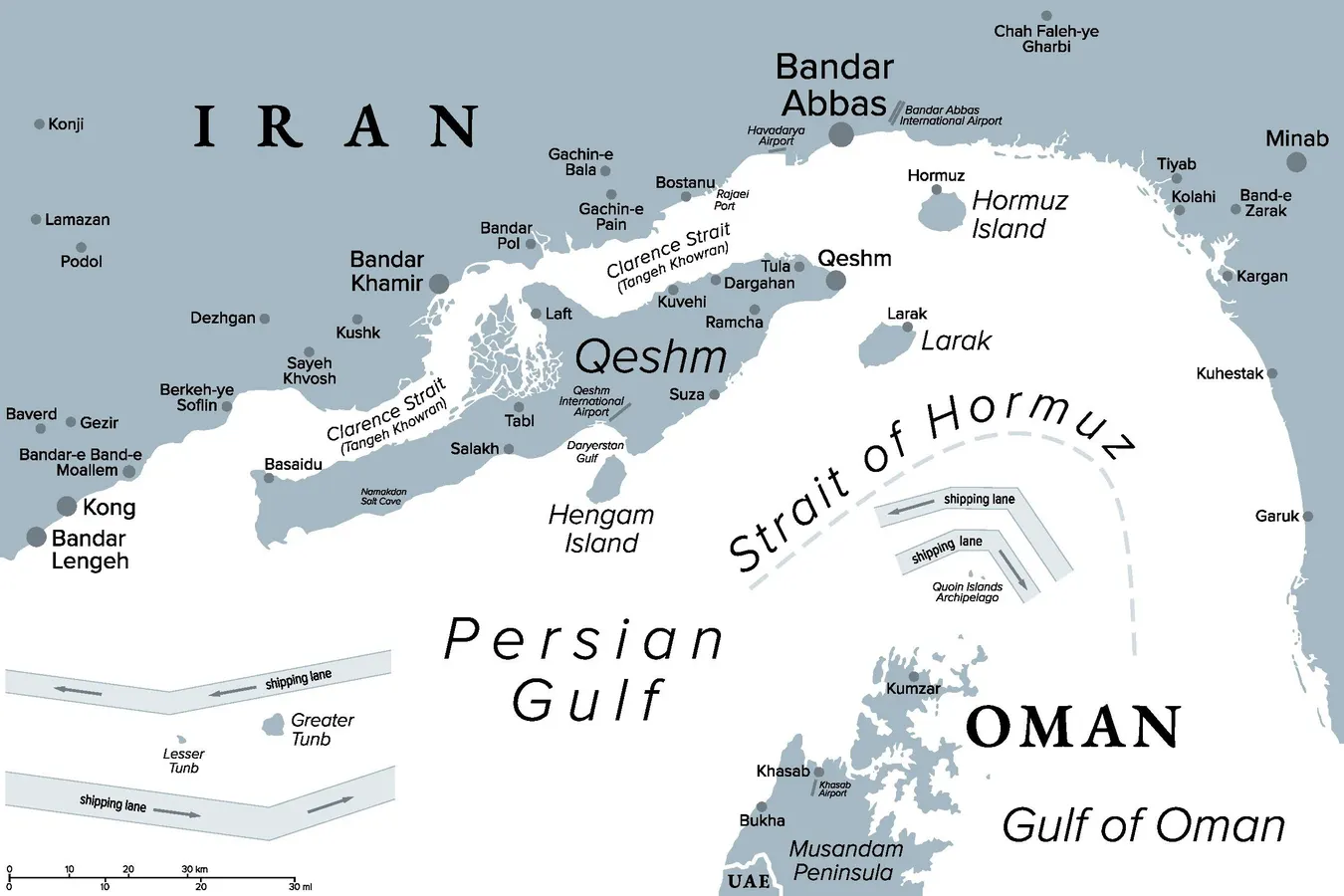

Qeshm, largest island of Iran, gray political map. Located in the Strait of Hormuz of the Persian Gulf, separated from mainland by the Clarence Strait, opposite the port city Bandar Abbas.
getty
Washington can reopen the strait by force. Only a settlement can leave it carrying less of the region’s security burden.
Seven months after the United States and Israel launched strikes on Iran, the conflict has settled into a dangerous limbo of low-intensity warfare, and Americans are paying for it at the pump. Diesel first topped $6 a gallon in September and averaged $6.32 on October 6, according to AAA; gasoline averages $4.37; and Brown University researchers estimated the war had cost the average household more than $770 by early September. The political bill is coming due: the Cook Political Report now rates Senate races in Alaska, Iowa, Ohio and Texas, all Republican-held seats, as toss-ups.
The June 17 Islamabad memorandum, which briefly lifted the dual blockade, unraveled in early July, and no formal ceasefire has replaced it. Normal traffic through the Strait of Hormuz remains disrupted, and a U.S. naval blockade, reimposed in mid-July, continues to choke Iranian trade.
Qatari and Pakistani mediators are still shuttling proposals, but on September 26 President Trump rejected Tehran’s seven-day plan to reopen the strait and resume nuclear talks in exchange for lifting the blockade, waiving oil sanctions and a regional ceasefire, including Lebanon. The Wall Street Journal reported that he has told aides he expects to resume bombing after the midterms.
Understandably, a Republican priority is ending the disruption of commerce through the strait and in the Red Sea, where the Houthis, Iran’s Yemeni allies, are attacking Saudi ports and shipping. The deeper issue is what this war reveals about a changing regional and global security order, one in which energy infrastructure has become a front line and regional powers are hedging and building their own arrangements. The real test is not whether America can reopen a waterway, but whether it can turn military advantage into a settlement that leaves it carrying less of the region’s security burden, not more.
Hormuz Is the Symptom
Hormuz is about more than oil. About a fifth of the world’s LNG moved through the strait last year, and the International Energy Agency calls the disruption the largest supply shock in the history of the global oil market. Iranian missile strikes in March on Qatar’s Ras Laffan LNG complex also knocked out 17% of the country’s LNG export capacity, damage QatarEnergy says will take three to five years to repair. In September, gas prices in Asia and Europe hit their highest levels since the 2022-23 energy crisis, and the costs have rippled into shipping, insurance, fertilizer and food. A regional security crisis has become a global inflation problem.
The pattern matters more than any single strike. Russia’s assaults on Ukraine’s power grid, Ukrainian strikes on Russian refineries, and Iran’s strikes across the Gulf have made energy and trade networks deliberate targets of war. The Red Sea shows how quickly a workaround becomes a target. Saudi Arabia routed most of its exports through the East-West pipeline to Yanbu to bypass Hormuz. Then Houthi attacks on Yanbu and Saudi shipping, the Houthi capture of Mocha and the Hanish islands near Bab el-Mandeb, and Iraq-launched drones that shut the pipeline for about two weeks made the bypass itself contested. No single power, including the United States, can guarantee all of it alone.
Power Is Leverage, Not an End State
American military power in this war is best understood as leverage, not an end state. U.S. Central Command says its forces have cleared Iranian mines from the strait’s main shipping lanes, though maritime authorities do not yet treat the wider waterway as mine-free. Strikes have badly degraded Iran’s military, and the blockade has sharply cut Tehran’s oil revenue. But leverage depreciates if it is not converted into a political settlement. Tehran’s likely calculation, and this is analysis rather than a stated Iranian position, is that it can outlast Washington by letting energy-driven inflation pressure the White House ahead of the midterms, and perhaps beyond. The objective, then, is to cash in military advantage while it is near its peak, rather than wasting it over time.
What a Settlement Must Solve
A durable settlement has to solve the problems that both started the war and were created by it: ending the fighting and ending the disruption of Hormuz, restoring verifiable limits on Iran’s nuclear trajectory, and denying Tehran the means to rebuild the proxy network it has used to destabilize the region, from Lebanon to Yemen. A deal that only restores pre-war traffic through the strait would reset the clock on the next crisis.
Sequencing is where talks have stalled, and it is a trap. Tehran wants the blockade resolved before it addresses nuclear demands; Washington says there will be no agreement unless the nuclear program is addressed. The June memorandum broke that deadlock by putting nuclear talks after reopening, and it remains the workable template, provided relief is phased and tied strictly to verified steps. Tehran has reason to engage. Inflation is running near 70%; the rial, at roughly 2.7 million to the dollar on the open market, has lost more than half its value in a year; and the Statistical Center of Iran reported last month that GDP shrank 10.1% year on year in the quarter ending June 20, with oil and gas output down 26%.
Can the Iranian System Enforce a Deal?
Diplomacy has been so difficult largely because it is no longer clear who in Tehran can deliver a deal. Former Supreme Leader Ayatollah Ali Khamenei, who for decades arbitrated among Iran’s rival power centers, was killed on the war’s first day, and his son and successor, Mojtaba, has not appeared in public, in audio or on video since being appointed to the office in March. Foreign Minister Abbas Araghchi has said he has never spoken with him, while real influence has drifted toward the Supreme National Security Council, now led by Mohsen Rezaei, and IRGC leaders such as its commander, Ahmad Vahidi.
The July 7 episode shows the stakes. The New York Times reported in September that a hard-line faction opposed to the deal attacked three commercial ships, setting a Qatari LNG tanker ablaze, without the knowledge of Vahidi, President Masoud Pezeshkian or the Supreme National Security Council. The attack unraveled the June agreement. A deal can be sabotaged by a faction the negotiators do not control, and the absence of a visible supreme leader helped it succeed.
Iran’s “mosaic defense“ doctrine compounds the problem. Designed to keep the military fighting after commanders are killed, it disperses operational authority across 31 provincial Revolutionary Guard commands and, in practice, allied groups. That makes Iran resilient against decapitation, but it also means the ability to keep fighting is spread more widely than the authority to stop.
Shifting the Burden
The settlement must also enable burden-shifting. If the war ends with American warships as the only guarantee that Hormuz stays open, Washington will have won the battle and inherited a permanent mission at odds with its new geostrategy. A smarter deal would build in multiple channels to Iran’s power centers, through Qatar, Pakistan and Oman, and a concrete mechanism: a Gulf-led maritime coalition with formal Omani and Qatari roles, backed by U.S. intelligence and air cover. If diplomacy delivers, Trump can declare victory and begin drawing down.
A Different Regional Balance
The strategic end state is a different regional balance, not a permanent American protectorate: Gulf states defending their own infrastructure and sea lanes, Turkey and Pakistan in larger diplomatic and security roles, and the United States as strategic backstop, retaining the bases, airlift and intelligence reach to intervene when a threat genuinely requires it.
Power That Reduces the Need for Power
None of this means Washington should stop using power. The ability to reopen Hormuz, enforce a blockade and strike decisively is what gives it leverage and credibility with partners. But the measure of success is how little force America needs to apply once the war is over.
American power should create the conditions under which Washington needs to use less of it, by settling the war on terms that hold and leaving regional actors more capable and more responsible. Qatar and Pakistan have shown that they can mediate. Now Iran must come to terms, and Washington must show that it can negotiate its way out of the war and establish an order that does not require it to continue to do the heavy lifting.













Leave a comment