



The vessel traversed from Singapore to Ghana using hydrogen and diesel.
Newlight
For 8,500 nautical miles, a 650-foot bulk carrier sailed from Singapore to Ghana burning a fuel blend no cargo ship had used commercially before. Roughly a quarter of what powered its 10-megawatt engine wasn’t diesel at all—it was hydrogen, metered in by a control system deciding in real time how much to inject and when.
Rerouted around the Cape of Good Hope rather than through the Suez Canal—where Houthi attacks have weaponized regional chokepoints and driven up war-risk insurance—the voyage cost its owner an extra two weeks and roughly $600,000, underscoring how vulnerability to petrostate supply shocks and maritime bottlenecks makes fuel-hedging technologies a matter of corporate and national energy security.
Newlight, a San Francisco-based maritime energy startup, retrofits existing diesel engines rather than waiting for the industry to build new ones. Measured across that Singapore-to-Ghana run aboard a Lomar Shipping vessel, the system cut fuel consumption 24%, CO2 emissions 28%, and carbon monoxide 22%—results Newlight projects will save comparable ships $500,000 a year, with the retrofit paying for itself in under 18 months.
“We are building a new energy layer for the diesel engines already powering the global economy, making them materially more efficient and cleaner without requiring them to be replaced,” Haran Hillel, Newlight’s co-founder and CEO, told me in an interview. “The vessel didn’t need to change how it operated. We simply gave its existing engine a way to do more, and it did so successfully across thousands of miles at sea.”
That timing argument matters because shipping’s own decarbonization clock is running on two tracks at once. Global shipping moves more than 80% of world trade by volume and burns an estimated 250 million to 300 million tons of fuel a year, at a cost north of $150 billion—the single largest line item in a vessel’s operating budget.
The International Maritime Organization, the United Nations’ shipping regulator, has set a target of net-zero emissions by 2050, with intermediate cuts arriving in stages. Its binding carbon-pricing framework will be put to a vote by IMO member countries on December 4.
Regionally, the pressure is already law: the European Union’s Emission Trading System and FuelEU Maritime rules, both now fully in force, tax ships separately for the carbon they emit and the diesel they burn. Newlight says a vessel the size of the one it retrofitted would otherwise owe roughly $1.3 million a year in EU carbon costs—about 30% on top of its fuel bill.
A Retrofit, Not a Replacement
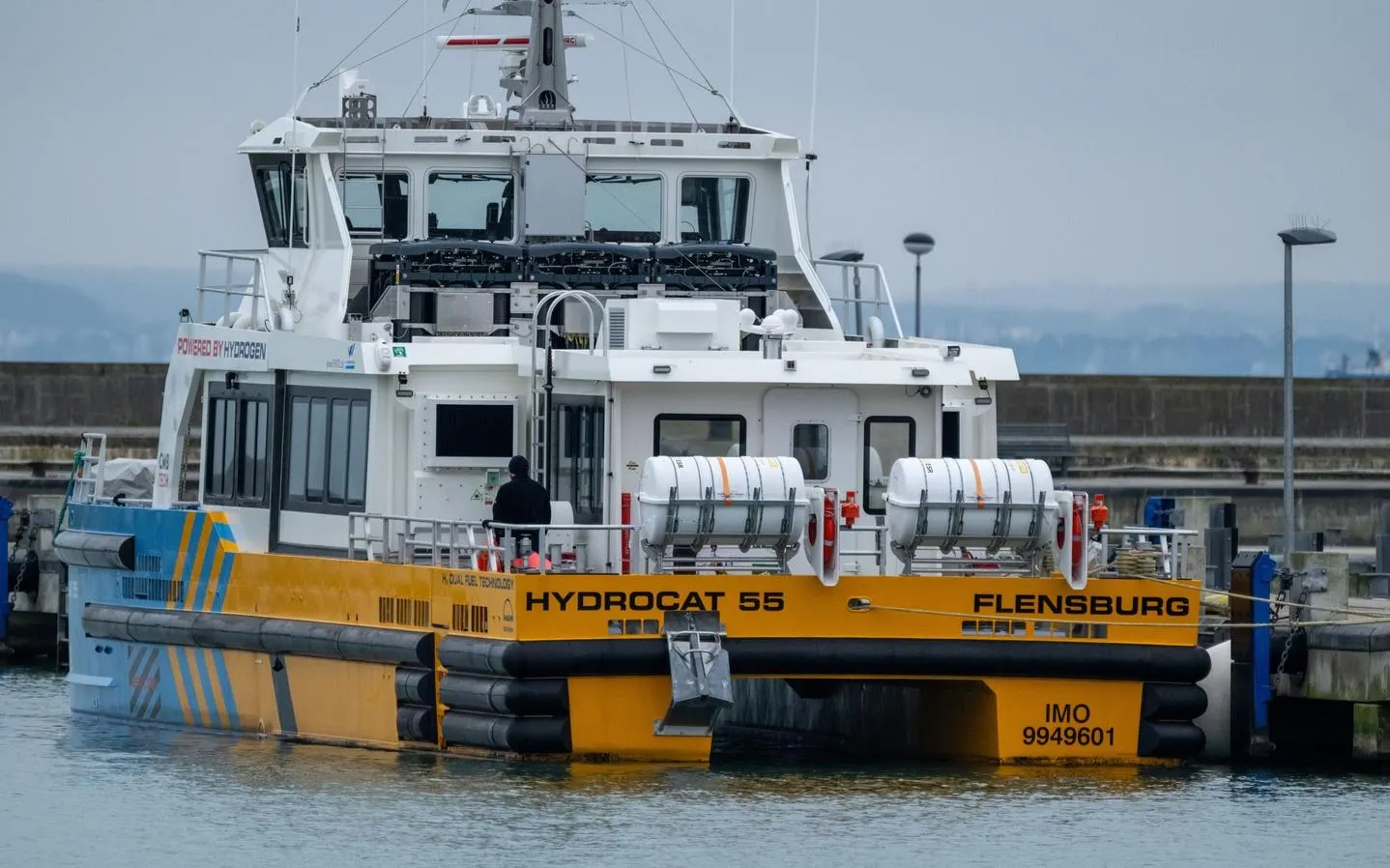
PRODUCTION – 10 January 2024, Mecklenburg-Western Pomerania, Sassnitz-Mukran: The ship “Hydrocat 55” is moored in the city harbor of Sassnitz. The ship has a diesel engine with a special hydrogen injection system. At high speeds, the proportion of hydrogen can be around 30 percent. Photo: Stefan Sauer/dpa (Photo by Stefan Sauer/picture alliance via Getty Images)
dpa/picture alliance via Getty Images
The technology itself is a hybrid, not a replacement. A real-time controller reads combustion data from the engine and continuously adjusts hydrogen and bunker-fuel injection, replacing about 20% to 25% of the diesel a ship would otherwise burn—a share Newlight expects to grow toward 40% to 50% as hydrogen supply infrastructure matures. Installation takes two weeks with the vessel still in the water, and ships can run on diesel alone if hydrogen isn’t available at a given port.
“You can think about it like making a Toyota Prius out of every ship in the world,” Evyatar Cohen, Newlight’s co-founder and COO, told me. “We use the hydrogen, and it’s controlled by an algorithm that decides the right moment to inject it—because if you miss that timing, you can break the engine instead of saving fuel.”
Newlight doesn’t sell the system; it leases it, sources the hydrogen, and reports the savings back to the customer. One fleet operator that signed for 10 vessels spends about $100 million a year on fuel; under the Newlight arrangement, it now pays $80 million for fuel and about $10 million to Newlight, netting $10 million in annual savings. Across three customers, Newlight now has 12 vessels under contract—worth an estimated $110 million a year to the company—against a market it sizes at roughly 60,000 ships large enough to be worth retrofitting.
The journey: Newlight’s path ran through a small test engine, then a larger one, then a yacht engine and an attack-boat engine, before Lomarlabs—the venture arm of UK-based shipping group Lomar—offered a Lomar Shipping vessel as its first commercial test bed.
“It took us roughly a year from when we started working with them to the point where they began testing on our ship,” Stylianos Papageorgiou, Lomarlabs’ managing director, told me. He described his firm’s role as investing “primarily sweat equity” by giving hardware startups a real ship to prove novel technology at sea. It required more than engineering: regulatory approvals, a full retrofit, and the logistics of fueling a ship with hydrogen, which, unlike diesel, isn’t yet available at ports worldwide.
Newlight’s customers aren’t only giants like Maersk. Its contracts run with mid-sized operators. “It’s wrong to assume that only large fleets are compliant,” Papageorgiou says. “There are plenty of smaller companies that have few ships but are very sensitive to this, for good business reasons of their own.” Even within the biggest fleets, he adds, compliance is uneven: a few flagship vessels at the leading edge don’t mean the rest of the fleet has caught up.
Beyond The Megacarriers: Compliance At The Middle Tier
03 July 2025, North Rhine-Westphalia, Duisburg: A hydrogen pipeline is marked at the “Enerport” energy center in the Duisburg Gateway Terminal. The energy center contains fuel cells, combined heat and power units and battery storage. Climate-neutral operation with hydrogen as an energy supplier is being tested at the terminal. Photo: Oliver Berg/dpa (Photo by Oliver Berg/picture alliance via Getty Images)
dpa/picture alliance via Getty Images
Newlight isn’t the only bet on a cleaner-burning ship. Ammonia-fueled engines and full hydrogen conversions promise to eliminate fossil fuel from shipping entirely, and electric propulsion is advancing for shorter routes. Nevertheless—by Newlight’s own account— all three are years from being commercially viable at fleet scale.
“The world is not ready,” Cohen says, noting that a full ammonia or hydrogen conversion can cost three times what a ship pays for fuel today—bearable for one or two showcase vessels, not across a fleet that wants to remain competitive. Newlight’s plans to grow with the market: replace what’s economical today, and expand that share as hydrogen infrastructure and pricing improve.
That’s also, in Papageorgiou’s telling, exactly why the IMO’s delay doesn’t hurt Newlight’s case—it sharpens it. He’s optimistic that IMO’s strategy to achieve net zero will prevail, noting that every major IMO rule has faced years of political resistance before eventually taking effect. In the meantime, he says, operators face a widening gap between where regulation is headed and what their fleets can currently do—a gap that favors whoever already has a workable answer.
“There is real value in anything that can be retrofitted without disrupting the operation of the ship,” he says.
Back aboard the ship that made the run from Singapore to Ghana, none of that regulatory maneuvering changed what happened at sea: an existing bulk carrier, no different from thousands like it still in service, burned a quarter less diesel and emitted substantially less carbon. By insulating fleets against maritime chokepoints and volatile petrostate supply lines, the technology offers a hedge that goes far beyond simple compliance. As CEO Hillel put it simply: “That is exactly where Newlight fits.”
SEE ALSO:
Samsung Heavy Industries Is Advancing Ships Powered By Ammonia
Decarbonizing The Shipping Sector Is A Long Trip But Within Reach















Leave a comment