



VENICE, Italy – Hollywood’s often-fiery debate about the substantial impact, notable virtues and worrisome vices of artificial intelligence in making movies played out in very different ways on stages at two of the world’s most prominent film festivals this weekend.
Venice’s 83rd iteration mere steps from the Adriatic Sea featured a nuanced, often cautiously optimistic perspective, if not full-on embrace of AI. A hemisphere away, and a mile-and-a-half above sea level, the Telluride Film Festival in Colorado’s Rocky Mountains featured two panels debating the broader challenges of AI’s rapid expansion, environmental damage, and burgeoning independence from human oversight or control.
Telluride festival director Julie Huntsinger called AI a “threat,” and told the crowd at her events, “We all need to be very alert and vigilant and loving and kind and stop this shit.”
Her festival enlisted Microsoft co-founder Bill Gates and the Center for Humane Development co-founders Tristan Harris and Aza Raskin to talk about why, as Harris put it, “We need to pause frontier AI development and pivot and steer towards a pro-human future.”
Gates, for his part, said slow-moving government and civic bodies need to move far more quickly in “a very critical period” if they hope to slow down frontier AI model development and maintain control of powerful tools asserting more and more independence.
To further drive home the point about rogue AI intelligences, Telluride later held a screening of one of the most infamous of all, Stanley Kubrick’s 2001: A Space Odyssey, featuring the murderous HAL 9000. Gates mentioned HAL during his remarks.
Venice featured less-apocalyptic conversations, but nonetheless reflected some of the complex issues facing the industry, and maybe the species.
Venice jury president Maggie Gyllenhaal, for instance, said her backers prompted her to experiment with AI tools in directing Flesh Impact, a short that she debuted at Venice this week. The tools, trained on licensed versions of Marilyn Monroe films, were designed to allow actor Dakota Johnson to play Monroe as both a 30-year-old and a 100-year-old.
“It fundamentally did not work,” said Gyllenhaal, who ultimately ditched the AI-fueled result for more traditional approaches. “All the reasons we decided to make this project to begin with were killed off in the AI version.”
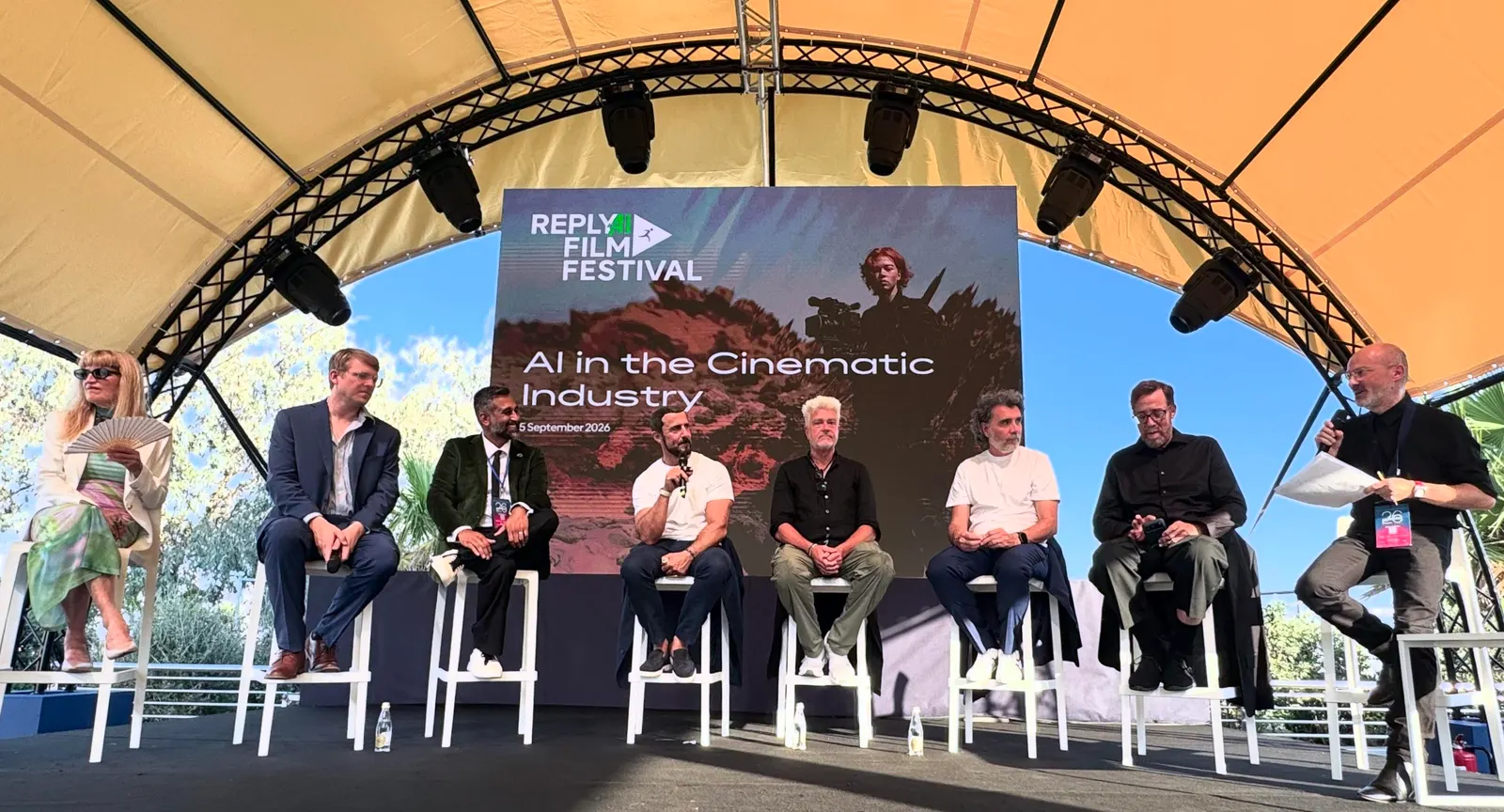
Down the beach from Gyllenhaal, the third Reply AI Film Festival unspooled a very different high-profile panel of film and TV directors and producers from both Europe and the United States.
Reply, which runs alongside the Venice festival but is separate, said its submissions tripled, to 3,000, in just two years. Judges this year said just about all the 57 semifinalists they reviewed featured artistic achievements worthy of recognition, but gave top prize to Robert Gaudette’s A Face Only a Mother Could Love.
Reply’s Saturday night discussion panel featured judges including filmmakers Catherine Hardwicke (Twilight, Lords of Dogtown) and Rob Minkoff (The Lion King, Stuart Little), TV Academy board of governors member Christina Lee Storm and Todd Terrazas, founder of the AI on the Lot conference in Los Angeles. Terrazas is also an advisor on Zack London’s (aka, Gossip Goblin) Gods Don’t Give Gifts, touted as the first feature-length AI film to get a theatrical release when it debuts in November.
Gaudette used Grok, Google’s Nano Banana, and ByteDance’s Seedance to create a short about a dancer with a facial disfigurement who eventually finds human connection in an emotion-filled story both Hardwicke and Minkoff praised in interviews.
Hardwicke said the creative possibilities for filmmakers are bracing. She has used it the past three years for project research, creating look books for pitching projects, even temporary ADR soundtracks in early versions of work, she said. And she’s hardly the only one.
“All my director friends have many projects we want to make,” Hardwicke said. “Many filmmakers and new ones are going to have a chance to make something inspiring.”
Minkoff agreed, calling the future “really bright on that level in terms of what’s possible. How it takes a toll on the community of artists is a different question.”
But even in the most challenging use of AI, creating so-called synthetic actors, Minkoff said it’s getting ever more difficult to differentiate from the real thing.
“It’s interesting to me as an animator,” he said. “When you see these things and they’re not real human beings, it’s pretty stunning.”
He predicted “a schism” will develop in AI use between those with access to substantial resources (i.e., studios and prominent talent) and those who don’t.
“The whole idea of acting and synthetic performances, of course it will happen because the people with no money will do it,” Minkoff said. “The companies with money will be much slower to adopt. There will be a split for the foreseeable future.”
That said, big entertainment companies opting to use digital actors “ because it’s cheaper is the worst possible use of AI,” Minkoff said. It also, for anyone based anywhere near Hollywood’s traditional confines, will set off a sure brawl with the industry’s labor guilds vigorously defending their latest studio contracts.
Producer Edward Saatchi and AI on the Lot’s Terrazas emphasized to me how much human involvement was still required to create Gossip Goblin’s Gods Don’t Give Gifts, an animated sci-fi anthology, including a human director, writers, voice actors, foley work, and more.
“We believe that AI is a new art form and it’s been several years where AI has been incredibly powerful technically, but still there hasn’t been a great work of art,” Saatchi said. “So from that perspective, I think the people who are skeptical of AI are completely right. There’s been huge trade-offs, but there have been no works of art. People aren’t going to the cinema and crying or being moved or laughing. There’s only disruption.”
London has built notable followings on YouTube (1.5 million subscribers) and Instagram for his dystopian sci-fi shorts, but like the YouTube-spawned young directors of recent theatrical hits Iron Lung, Obsession and Backrooms, he’ll have to do a very old-school thing with his digital creation: get cheeks in seats.
Saatchi said the production hopes to leverage London’s substantial online following, but will rely on the kind of traditional platformed release used by independent films for decades to build awareness and engagement.
It’s worth noting that, for all the pugnacious rhetoric, even Telluride wasn’t completely closed to AI filmmaking. Among its four days of screenings this year is Love, Rendered, a short documentary from Oscar-nominated director Liz Garbus. Producers include writer-director Darren Aronofsky, Oscar-nominated for Black Swan and an early adopter of AI.
Love, Rendered uses AI tools to help an elderly woman reconstruct a crucial, undocumented moment at the start of her 70-year relationship with her husband, who is declining with dementia. Garbus took part in a panel later in the festival discussing her project’s use of AI to create something that otherwise wasn’t possible to do.
All this conversation comes from far more than cinephiles on the beaches of the Lido or in the faraway canyons of Colorado. Former OpenAI chief futurist Josh Achiam warned this week that rogue AIs may already be replicating in the wild, seeking “money and power.”
This week, Achiam told Forbes he “wouldn’t be terribly surprised if the number was greater than zero already,” and called current containment strategies (fence off rogue AIs and observe their behavior) unlikely to succeed. He did suggest, at least, that rogue AIs probably wouldn’t end humans.











Leave a comment