



AI Adoption in Supply Chain
Gartner
Gartner’s Supply Chain Symposium Makes One Thing Clear: Executing Your AI Strategy Takes a Strong Data Foundation That Traditional Cleansing Can’t Provide
From a sinking San Francisco skyscraper to jaw-dropping live demos on the show floor, this year’s event revealed an uncomfortable truth that most supply chain organizations are building AI on foundations they have not actually fixed.
As they have for over a decade, supply chain executives flocked to Gartner’s Supply Chain Symposium to connect on the high-priority topics facing global supply chains, both today and in the future. The single theme threading through the breakout sessions, analyst briefings, and hallway conversations was that the AI moment is real, but the data foundation beneath it mostly is not. Supply chain leaders are staring down an uncomfortable gap between ambition and architecture, and the analysts, practitioners, and technology vendors on the floor had a lot to say about how to close it.
Here are the highlights that stood out to me.
Gartner: You Are Building AI on Shaky Foundations
Analyst Vas Plessas opened one of the Symposium’s most attended sessions with a photograph of San Francisco’s Millennium Tower: 58 stories, $10 million units, sinking 30 inches and tilting 18. The developer saved $10 million on the foundation. Repair estimates now run between $100 million and $500 million.
The metaphor for supply chain AI was not subtle, and it was not meant to be.
“The algorithms are available to everyone. The data foundation is your competitive advantage.” Vas Plessas, Gartner VP Analyst
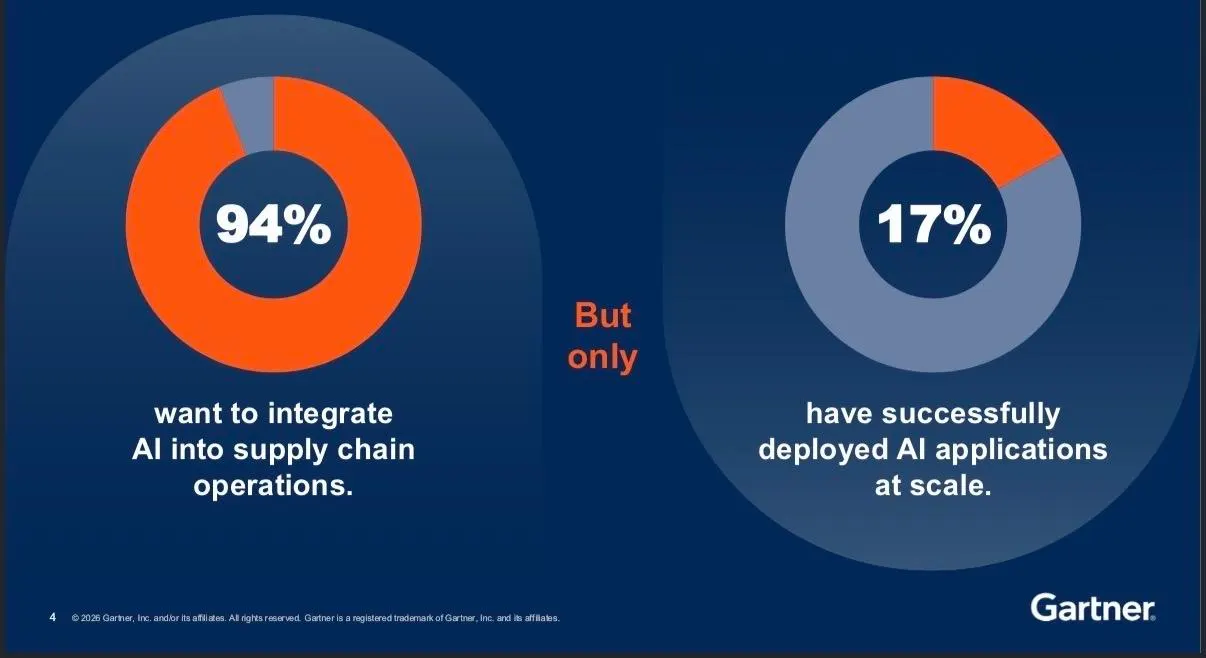
The numbers supporting that framing were striking. According to Gartner research presented in the session, 94% of supply chain organizations want to integrate AI into their operations. Only 17% have successfully deployed AI applications at scale. That 77-point gap, Plessas argued, is almost entirely a data problem, not a model problem.
Supply chain data has been optimized for human consumption, with dashboards built for planners and reports built for executives. AI agents need something fundamentally different. They need data that is Connected, Contextual, and Continuous, which Plessas called the 3Cs of AI-Ready Data.
Connected: Linking supply chain data across the full network, including ERP, WMS/TMS, data lakes, documents, and IoT sensors, into a multimodal data fabric so AI sees the whole picture.
Contextual: Establishing a semantic layer with verified authoritative entity resolution and a shared metrics store, so that ABC group holdings, ABC mfg. inc., and ABC manufacturing all resolve to one identity, and on-time delivery means the same thing in the U.S., EU, and Asia.
Continuous: Treating data quality as an ongoing discipline powered by GenAI, covering profiling, classifying, tagging, cleaning, and monitoring in a closed loop, rather than a one-time cleansing project.
On AI trust and autonomy, Plessas introduced a spectrum worth internalizing. Moving from human-in-the-loop, where operators review and approve every AI recommendation while the system logs acceptance patterns, through human-on-the-loop, where AI initiates and runs the process, and operators manage by exception, to human-off-the-loop, where autonomous decision-making operates within operator-set guardrails. The direction of travel is clear, and the on-ramp is trustworthy data.
His closing action plan was very direct. Pick your most critical AI use case, partner with IT to design the architecture for it, and prioritize the human element from day one. Organizations that skip the foundation and go straight to the penthouse already know how that story ends.
KPMG: The Data Challenge Is an Enterprise-Wide Problem
Christopher McCarney, US Consulting Leader, Supply Chain & Procurement Advisory from KPMG brought a practitioner perspective to the data readiness conversation, sharing findings from KPMG’s just-released report, Risk Management and Resilience Emerge as Key Concern for Supply Chain Leaders. A Leadership Survey, which drew on 462 responses from organizations with a minimum of $1 billion in annual global revenue across nine sectors, including Life Sciences, Consumer/Retail, and Industrial Manufacturing.
The report’s headline number lands hard in the context of everything else being discussed at the Symposium: 73% of businesses are planning a comprehensive transformation of their supply chain operating model within the next one to three years, up 11% from the prior year.
94% of respondents plan to innovate their Risk Management and Resilience function within the next three years.
77% believe there is a talent gap within their organization’s procurement and supply chain function.
66% of organizations have implemented or are actively scaling AI capabilities across the function.
69% believe AI will transform the workforce and replace some human roles, while only 3% believe AI will not replace any workers at all.
Supply chain visibility, demand planning, and customer service and experience are the three areas most impacted by the talent gap, according to respondents. While 50% cite investing in automation and AI as a top strategy to address that gap, organizations simultaneously flag labor market competition, minimal investment in upskilling, and rapid technological advancement as forces that will make the problem harder to solve.
The geopolitical overlay was equally striking. Cybersecurity threats, multi-tier supplier risk, and regulatory risks ranked as the top three concerns. 60% of respondents are already passing tariff-driven costs directly to end customers, and 37% are diversifying their supplier base or shifting to alternative markets as a primary near-term mitigation strategy.
“Our research shows that leaders are challenged to align transformation ambition with execution capability. Organizations that succeed will be those that align changes in operating models, workforce capabilities, and data readiness, because AI alone won’t close the gap. At the same time, resilience is no longer a trade-off with efficiency – it’s becoming a competitive differentiator as supply chain leaders prioritize risk and resilience more than ever.” McCarney shared, ”The KPMG data complements the Gartner message in an important way. Gartner describes what AI-ready data needs to look like architecturally. The KPMG survey shows the scale of organizational change required to get there and how much of the work is fundamentally a people-and-process challenge, not just a technology one.”
ketteQ: What Foundational AI Actually Looks Like in Production
Not every AI story at the Symposium lived on the main stage. Some of the most interesting conversations happened at the booths, and one that generated significant attention was ketteQ, a supply chain planning platform that came to Orlando with a live demonstration that produced genuine jaw-dropping reactions from the practitioners who stopped to watch.
The centerpiece was Quincy, ketteQ’s AI agent, which writes Python code on the fly and executes it directly within the platform to answer natural-language questions and take directed actions. This was not a demo environment or a scripted walkthrough. It was a functional AI agent orchestration running on ketteQ’s production architecture.
CEO Mike Landry was direct about what distinguishes this from what legacy planning systems can offer:
“For us it is all about AI that is working and foundational, not cosmetic. Because our system is cloud-native and built on a standard tech stack, the LLMs already speak ketteQ and have access to invoke our planning agents. The legacy planning systems, built on antiquated architectures and proprietary technologies, simply cannot do what we can do and are now deploying.”
The distinction Landry is drawing maps directly onto the Gartner framework being presented inside the session halls. A modern, standard-stack architecture means that large language models can interact with the planning system natively, without the translation layers, proprietary APIs, and data lockdown that characterize older platforms. The AI agents are not bolted on. They are built into the foundation. Landry indicated that real-world customer stories from the Symposium conversations would be forthcoming in the weeks ahead.
Supply Chain Now: The Practitioner Pulse
Few people cover supply chain events with the depth and reach of Scott Luton, founder and host of Supply Chain Now, one of the industry’s most listened-to podcast platforms. Luton was on the ground at the Symposium and had a front-row perspective on what resonated with practitioners versus what remained aspirational.
Luton said, “If there was one defining theme at Gartner 2026, it was this: the winners won’t be the organizations with the most AI. They’ll be the organizations that combine trusted data, faster (and more successful) decision-making, workflow & job reinvention, and ever-valuable human expertise into a new operating model. I think the conversation has moved beyond AI hype and into the much harder and much more valuable work of autonomous execution and scale.”
Luton’s perspective carries particular weight because Supply Chain Now covers the practitioner community, including the planners, logistics leaders, and procurement officers who are being asked to make AI investments real. What he hears in those conversations frequently gets ahead of or behind the analyst’s narrative in instructive ways.
Lead Coverage: Conference Intelligence from the Show Floor
Will Haraway, Co-Founder of Lead Coverage, was also working the event and brought a sharp perspective on what actually drove conversation energy at the Symposium versus what was getting polished slide treatment without much substance behind it. Lead Coverage specializes in helping B2B companies understand and act on the signals emerging from industry events, trade publications, and analyst communities that shape technology decisions.
“Analyst relations is such a big part of what we do because the prospects that emerge from Magic Quadrant, a Market Guide, or a Cool Vendors report are already warm. They’ve read your strengths, product roadmap, and vertical expertise and already find you credible. Maximizing that exposure is paramount in enterprise sales,” said Haraway. “My two takeaways from this week were the continued evolution of the 4PL and 3PL spaces, basically in real time, session to session, analyst to analyst. Secondly, I was struck by how AI infrastructure has basically supercharged the supply chain planning space. It’s the hottest market in the industry right now.”
Haraway’s vantage point is useful precisely because Lead Coverage sits between the vendor community and the buyer community, tracking how conference conversations translate or fail to translate into actual commercial momentum.
Unilog: Real-Time Sensor Intelligence Meets Supply Chain Visibility
One of the more compelling product conversations on the show floor came from Osi Tagger, founder of Unilog, who was on hand to walk through the company’s new UControl sensor platform. UControl addresses one of the most persistent gaps in supply chain visibility. The need for real-time data on the condition and location of goods in transit and storage is a data layer that most enterprise systems simply do not have access to in a reliable, standardized form.
“Visibility is no longer about tracking vehicles; it’s about knowing exactly where your critical assets are, understanding their condition in real time, and having the intelligence to act before disruptions occur,” Tagger shared. “We developed UControl to close visibility gaps across carriers, air freight, and ocean freight by bringing real-time intelligence into a single platform. It is vendor agnostic and highly adaptable, giving organizations of any size enterprise-grade visibility and decision-making capability without the complexity, cost, or implementation timelines traditionally associated with supply chain technology.”
The UControl announcement fits squarely within the connected data imperative. IoT and sensor data are among the five source layers in the multimodal data fabric architecture, and they consistently have the most gaps. A standardized, reliable sensor layer that feeds into that fabric is essential infrastructure.
Velostics: AI Orchestrated Yard Management
Velostics was another platform drawing attention on the show floor, and my conversation with founder Gaurav Khandelwal offered a ground-level look at what AI-driven operations look like when applied to one of the most friction-heavy nodes in the supply chain, dock scheduling and yard management.
Velostics focuses on the logistics execution layer, specifically automating appointment scheduling and carrier coordination processes that most organizations still handle manually or via disconnected legacy tools. The new release they previewed extends the platform’s autonomous scheduling capabilities, aiming to remove human-in-the-loop friction from routine coordination workflows while flagging exceptions that genuinely require attention.
“The yard is a critical choke point in the order-to-cash process,” said Khandelwal. “AI agents coordinate complex scheduling, gate, and dock workflows to drive high dock utilization, lower detention costs, and fewer OTIF fines — and we can be live in days, not months.”
The Velostics story aligns with a broader pattern evident across the Symposium: the most credible AI applications at this stage are those solving specific, high-frequency operational problems with measurable outcomes, not those promising to transform everything at once.
My Key Takeaways from the Symposium
With Gartner’s analytical framework setting the stage and practitioners, vendors, and media all occupying the same floor at the same time, it produces a kind of clarity that is hard to get any other way. Here is what I am walking away with.
The AI deployment gap is real and a data problem. Gartner’s 94-versus-17 statistic deserves to be on every supply chain leader’s desk. The gap is not a vendor problem or a budget problem. It is a data architecture problem that predates the AI era and has simply been made visible by it.
Transformation ambition is outpacing organizational readiness. The KPMG survey’s finding that 73% of organizations plan to implement a comprehensive supply chain operating model transformation in the next one to three years, up from 62% the prior year, is either a very encouraging sign of urgency or a warning that a significant gap between intention and capability is emerging.
The practitioner community is paying attention in a new way. The conversations I had at the event pointed to a shift in how practitioners are engaging with AI content at events. The general curiosity of prior years is giving way to sharper, more specific questions about proof points, data requirements, and real deployment timelines.
The Gartner framing that stayed with me most is the simplest one. Path A is building the penthouse and ignoring the foundation. Path B is building the foundation and letting the value compound. Every conversation I had at this Symposium, from the analyst stage to the booth floor, was, in one way or another, about which path an organization is on.















Leave a comment