


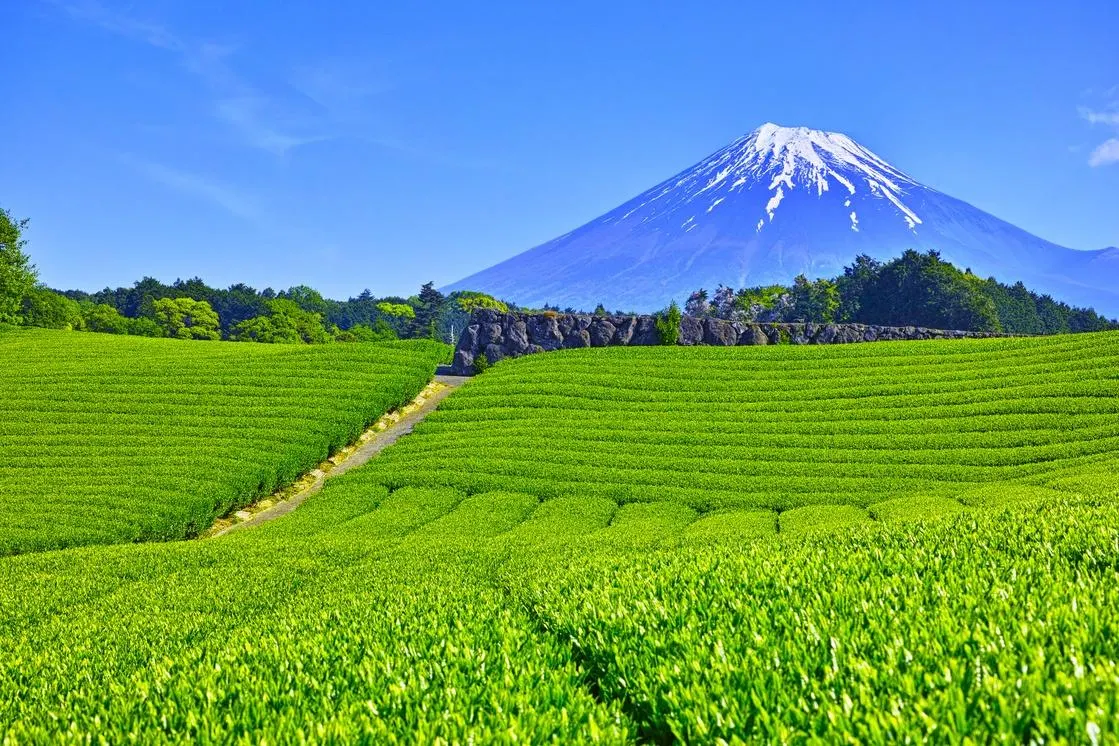

A view of the tea plantations and Mt. Fuji seen from Fuji City, Shizuoka Prefecture
getty
America can’t get enough Matcha. But the boom is creating an unexpected problem in Japan: the country may not have enough tea, farmers, or processing capacity to keep up with global demand.
Matcha lattes have become a major gateway for American consumers. Japan’s tea exports reached a record ¥72.1 billion ($6.25 million) in 2025, up 98% from the previous year and roughly triple their level a decade ago. The U.S. accounted for 35% of Japan’s total tea exports and Matcha made up about 85% of those exports.
The surge is a windfall for Matcha producers. But for Japan’s tea industry as a whole, it is creating a supply-chain squeeze.
Overseas buyers are bidding aggressively for high-quality Tencha, the tea leaves used to make Matcha. According to the Japan Food Journal and NHK, the price of Tencha rose for the fifth consecutive year, jumping from ¥5,678 per kilogram in 2024 to ¥14,681 in 2025, nearly a threefold increase in a single year.
At the same time, high-quality Matcha is increasingly being directed toward lucrative export markets, contributing to tighter domestic supplies. More farmers are also converting fields from Sencha, Japan’s traditional loose-leaf green tea, to Tencha production because of the higher returns. That shift could put upward pressure on prices of other types of Japanese tea as well.
The problem is that Japan cannot simply plant more tea overnight.
For generations, Sencha has been at the center of Japan’s tea industry. Producing Tencha, however, requires different cultivation and processing methods. Farmers need materials to shade the tea plants from sunlight, as well as specialized drying equipment and other machinery that can require investments of tens of millions of yen. For smaller producers that lack the capital to make such investments, the industry’s shift toward Matcha can become an additional pressure to exit the business.
Even producing Tencha does not solve the entire problem. The leaves must still be ground into the fine powder known as Matcha, a process that typically requires specialized milling facilities. High-speed grinding using cooled metal mills is common, but such facilities remain limited in number across Japan and are expensive to build.
As a result, demand for the country’s limited milling capacity has surged, creating waiting lists for processing slots.
There is another structural problem. Japan’s tea-growing area cannot be expanded quickly. When existing farmland is converted to Tencha production, less land remains available for Sencha and other varieties. If the shift continues, today’s Matcha boom could eventually contribute to higher prices and tighter supplies across Japan’s broader green-tea market.
Matcha’s unique flavor, ease of use and stunning color attract consumers.
getty
One Farm’s Unusual Response
One tea producer in Shizuoka Prefecture is taking a different approach. Rather than simply expanding production, Hattori Tea Farm is trying to make its farming operation more productive, energy-independent and resilient to climate change.
The company is led by Yoshiaki Hattori, the fourth generation of a family that has been in the tea business for roughly 120 years. Working in the family business, Hattori became increasingly aware of the complexity of Japan’s tea distribution system and questioned why consumers often had little connection to the people who actually grew their tea. He wanted to simplify the supply chain and deliver better, safer tea directly to consumers.
Today, Hattori Tea Farm handles the production, processing and sale of organic, pesticide-free Matcha and other types of tea from its own operation and exports tea products to roughly 50 countries.
“We have been increasing production by about 150% year over year in recent years, but we still cannot keep up with demand,” Hattori says.
Hattori began looking overseas long before Matcha became a global trend. As a student, he traveled abroad as a backpacker and later began visiting European markets to sell Japanese tea.
He soon encountered a problem. Sencha required consumers to understand how to use a teapot and how to brew the tea properly. Matcha was different: It was powdered, easy to transport and could be incorporated into familiar drinks.
But Hattori knew little about making Matcha himself. He spent roughly six years traveling to Nishio in Aichi Prefecture and Uji in Kyoto, two of Japan’s best-known tea-producing regions, learning the craft from scratch. About 15 years ago, he began seriously targeting overseas markets with Matcha.
Turning Solar Power Into Farm Infrastructure
At the heart of Hattori’s model is an unusual idea: use solar power not just to generate electricity, but as part of the farm’s production infrastructure.
Since 2014, the company has installed solar panels above its tea fields through agrivoltaics, also known in Japan as solar sharing. The electricity generated is used to power its tea-processing factory, offices and other operations, such as company electric vehicles. The factory is now 100% off-grid, according to the company.
Hattori also generates revenue by selling electricity through Japan’s feed-in tariff program and to contracted corporate customers. Reducing its dependence on electricity purchased from utilities has cut the company’s electricity costs to roughly one-third of their previous level, according to Hattori.
Hattori Tea Farm grows tea under solar panels.
Hattori Tea Farm
But the solar panels serve another important purpose.
Tencha is normally shaded for about a month before harvest. The reduction in sunlight increases amino acids in the leaves and can improve their flavor and color. Traditionally, farmers install structures made from steel pipes or bamboo to support the shading material. Those structures require both labor and materials.
Hattori uses the solar-panel mounting structures for the same purpose.
“The solar-panel structures can also serve as supports for the shading sheets, making the process much more efficient,” Hattori says. “We also developed an automated system for moving the shading sheets and obtained a patent for it.”
The panels may provide additional benefits during colder months. According to Hattori, they reduce radiative cooling from the ground and make frost less likely to form around the tea plants.
Frost damage is a major threat to Tencha production. Many tea farms use large frost-prevention fans to protect their crops, consuming additional electricity. Hattori says his solar-equipped fields have reduced the need for those fans and further lowered energy costs.
The company is also testing whether the panels can make the fields more resilient to increasingly severe heat and drought.
“Solar panels can provide a degree of shade and reduce the evaporation of water from the soil,” Hattori says. “Last year, 60% of the newly planted Tencha seedlings died because of extreme heat and drought. The seedlings in the fields with solar panels, however, grew successfully.”
Can the Model Scale?
The success of Hattori’s operation raises a bigger question: can this model work beyond a single farm?
The answer is not straightforward. Upfront investment in solar installations, local climate and growing conditions, land-use regulations and Japan’s electricity market can all affect the economics of agrivoltaics. Nor is every tea field necessarily suitable for the same system.
Hattori is nevertheless trying to move beyond his own farm.
In 2025, he established the Solar Matcha Cooperative to share his experience in Matcha production and agrivoltaics with other tea farmers. The goal is to spread what Hattori describes as a more sustainable approach to Matcha production across the region.
In April 2025, Norinchukin Bank and JA Mitsui Energy Solutions established a special-purpose company, Tea Field Solar LLC, with Hattori as a partner, as part of an effort to preserve and expand Shizuoka’s tea industry.
According to Hattori, 17 agricultural corporations have joined the initiative, with plans underway to install solar panels across more than 40 tea fields.
If those projects move forward, Hattori’s experiment will become something larger than a single company’s sustainability strategy. It could become a test of whether renewable energy can help solve some of the economic and environmental pressures facing traditional agriculture.
Hattori’s farm is also pursuing other approaches to sustainability. Its fields benefit from abundant spring water from the Southern Alps, and the company conducts annual soil analyses and adjusts its use of organic fertilizer according to soil conditions, aiming to maintain a diverse and healthy ecosystem.
The approach appears to have another commercial benefit. Overseas buyers are increasingly looking for traceability and sustainable sourcing.
“Many buyers who contact us tell us they found our farm while searching for terms such as ‘sustainable Matcha,'” Hattori says. “Being able to trace the tea back to a single farm and using organic cultivation can make it easier to meet pesticide-residue standards in overseas markets. Our use of self-generated electricity and our efforts to reduce CO2 emissions also seem to be viewed positively.”
That demand is important because Hattori is not competing solely on price. The company’s proposition is increasingly based on provenance, traceability and sustainability. These attributes can command a premium in some overseas markets.
From Matcha Lattes To Matcha Itself
Japan’s tea industry has a history stretching back more than 1,200 years. Tea production is not simply agriculture; it represents the transmission of cultural knowledge and specialized skills across generations.
Yet global demand is forcing an industry built over centuries to rethink how it grows, processes and sells tea.
Much of Hattori’s overseas Matcha currently goes into Matcha lattes and other beverages. But Hattori believes international consumers are beginning to move beyond Matcha as an ingredient and develop an appreciation for the tea itself.
“The overseas market has changed dramatically over the past 15 years,” he says. “When we hold seminars in Europe, where people have historically enjoyed sitting down with tea or coffee, we are seeing more people who have a genuine interest in and understanding of the flavor of Matcha itself.”
For instance, he recently encountered what he describes as highly knowledgeable Japanese-tea enthusiasts in Germany and Slovakia—consumers who were already familiar with Japanese tea culture despite having no connection to Japan.
For Hattori, that shift could mark the next stage of the global Matcha market.
But for Japan’s tea industry, the larger question is not simply how much Matcha the world wants to drink.
It is whether Japan can meet that demand without undermining the agricultural system that produces it.
The challenge facing Japan’s tea industry is ultimately bigger than Matcha. As global demand reshapes traditional agricultural supply chains, producers will need to find ways to increase output without simply consuming more land, energy and resources.
Hattori’s model offers one possible answer: make the farming operation itself more productive, more energy-independent and more resilient to climate change.
Whether that model can scale across Japan’s tea fields remains to be seen. But as America’s appetite for Matcha continues to grow, Japan’s centuries-old tea industry may have little choice but to reinvent how it grows, processes and sells tea.
















Leave a comment