


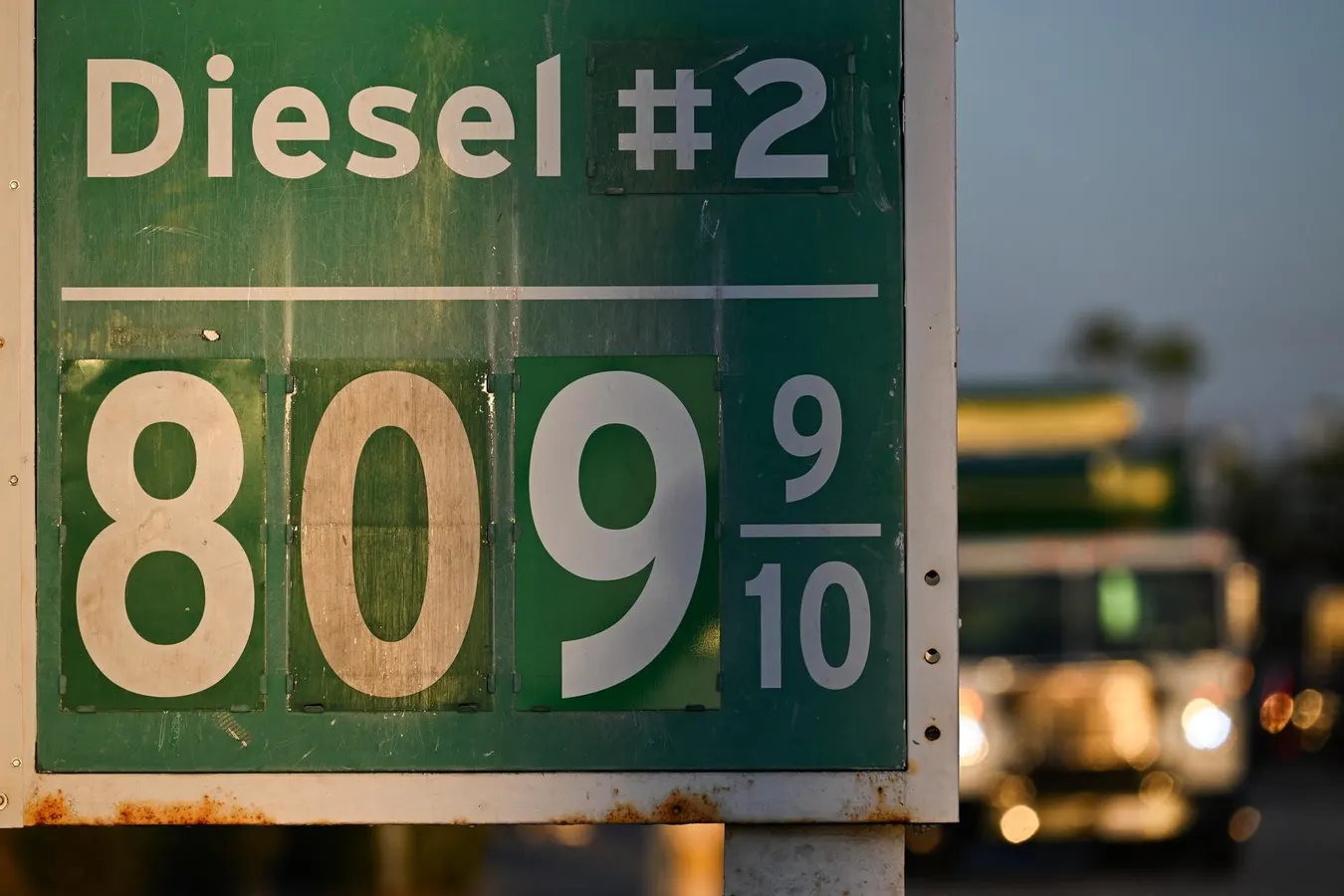

The price of diesel fuel above $8 a gallon is displayed outside of a Shell gas station in Carson, California on September 22, 2026. On September 22, US President Donald Trump expressed support for a diesel export ban, with fuel prices having surged on the back of the Middle East war. (Photo by Patrick T. Fallon / AFP via Getty Images)
AFP via Getty Images
The United States is producing more crude oil than ever. According to the Energy Information Administration, U.S. crude production is on track to average a record 13.8 million barrels per day in 2026, surpassing the previous record set last year.
Yet diesel prices recently climbed to record highs, while distillate inventories remain unusually low. The EIA expects those inventories to stay below the five-year range through much of 2027, with stocks falling below 100 million barrels for the first time in more than two decades. At first glance, that seems contradictory. If the United States has more oil than ever, why can’t refiners simply make more diesel?
The answer is that crude oil and diesel are not interchangeable commodities. Oil has to pass through a refinery before it becomes diesel, gasoline, jet fuel, heating oil, or one of the many other petroleum products consumers actually use. A record amount of crude oil can be produced while refined-product markets remain tight, because the bottleneck may occur after the oil comes out of the ground. Right now, that is increasingly the case.
A Barrel Of Oil Is Not A Barrel Of Diesel
One of the most persistent misconceptions about petroleum markets is the assumption that refiners can decide how much gasoline or diesel they want to make and simply adjust production accordingly. They do have a small degree of flexibility, but it is limited by chemistry, crude quality, refinery configuration, and the equipment installed at each facility.
A typical 42-gallon barrel of crude processed in a U.S. refinery produces roughly 19 to 20 gallons of gasoline and 11 to 13 gallons of ultra-low-sulfur distillate, most of which becomes diesel or heating oil. The remainder becomes jet fuel, petrochemical feedstocks, asphalt, petroleum coke, and other products.
In 2025, distillate accounted for about 30% of total U.S. refinery yield, while finished gasoline accounted for nearly 46%. Those proportions can shift somewhat as refiners alter operating conditions, process different crude oils, and respond to market prices, but a refinery designed to produce roughly 30% distillate cannot simply double that share because diesel prices are high.
Modern refineries are enormously complicated systems of distillation towers, catalytic crackers, hydrocrackers, cokers, hydrotreaters, and other processing units. Each was designed around particular crude slates and product markets, and while operators can optimize within those constraints, there are limits to how much the product mix can be changed. That is why a shortage of diesel cannot be solved simply by pointing to record crude production and telling refiners to make more.
Refiners Are Already Running Hard
There is also a practical limit to how much additional diesel U.S. refineries can produce when utilization is already high. During the third quarter, U.S. refineries reportedly operated at an average of roughly 96% of capacity as companies responded to very strong refining margins. Diesel crack spreads, which measure the difference between the value of diesel and the crude oil used to produce it, reached extraordinary levels as global product supplies tightened.
When refineries are running in the mid-90% range, there is very little idle capacity available to bring online. Plants also cannot operate indefinitely at maximum rates because maintenance is unavoidable, and fall is traditionally a heavy refinery turnaround season. Operators can postpone some maintenance when margins are attractive, but eventually units have to come down for inspections and repairs.
Total U.S. refining capacity has also slipped modestly. The EIA reports that operable atmospheric crude-distillation capacity stood at about 18.2 million barrels per day at the beginning of 2026, down roughly 250,000 barrels per day from a year earlier, with 130 operable petroleum refineries remaining in the country. That is not evidence of a catastrophic collapse in U.S. refining, because existing refineries have expanded considerably over time, but it does mean there is no enormous reserve of idle capacity waiting to replace lost global supply.
Building additional capacity is also very different from drilling another oil well. A major refinery expansion can require billions of dollars, years of engineering and construction, lengthy permitting, and confidence that the investment will remain profitable for decades. That is a difficult commitment to make in an industry where demand growth, environmental policy, electrification, and fuel-efficiency standards all introduce uncertainty about long-term returns.
The Shortage Is Global
The current diesel problem also cannot be understood by looking only at the United States. The EIA says U.S. distillate inventories fell below their five-year range in April as significant supplies disappeared from the Middle East, Russia, and China. U.S. refiners responded by exporting more fuel into a global market willing to pay high prices, and net distillate exports have been at or near five-year highs for much of 2026.
Russia has restricted fuel exports because Ukrainian attacks have damaged parts of its refining system. Middle Eastern refinery production and shipping have been disrupted by the Iran conflict, while China suspended most fuel exports for October as domestic refiners work to rebuild depleted inventories. Taken together, those developments have tightened diesel availability across several major regions at the same time.
Europe is particularly exposed because the continent has steadily reduced refining capacity over the past decade and a half. European and neighboring refining capacity has fallen from roughly 17.5 million barrels per day in 2009 to about 14.4 million barrels per day today, increasing dependence on imported refined products. When several traditional suppliers are simultaneously constrained, buyers compete more aggressively for available barrels, and those prices feed back into the U.S. market.
That is why high U.S. crude production does not automatically translate into cheap U.S. diesel. The United States participates in a global refined-product market, and domestic prices reflect both local supply conditions and what buyers elsewhere are willing to pay.
Why Not Just Stop Exports?
That naturally raises another question: If American diesel inventories are so low, why allow refiners to export it?
The Trump administration considered restricting diesel exports before President Trump said this week that he would not impose a ban. Such a restriction could potentially leave more diesel in the United States and lower domestic prices in the short term, but there would be trade-offs that complicate the picture.
Refiners optimize the entire barrel, not one product in isolation. If export restrictions reduce the value of producing diesel, refiners may alter operating rates or product yields, while foreign buyers would have to replace those U.S. barrels from somewhere else. Because gasoline and diesel emerge from the same refining system, policies designed to reduce the price of one product can also affect the economics and availability of the other. Petroleum markets are interconnected enough that a policy that appears simple in isolation can create second-order effects elsewhere in the system.
The United States can therefore be the world’s largest crude oil producer, a major exporter of refined products, and a country experiencing extremely high diesel prices at the same time. Those conditions are not contradictory; they reflect different stages of the petroleum supply chain.
Inventories Are Important
The most important near-term issue is inventory. Diesel markets normally carry stored product that provides a cushion when refineries shut down unexpectedly, demand rises, or foreign supplies are interrupted. That cushion has been substantially depleted, leaving the market much more vulnerable to disruptions that would have been easier to absorb under normal conditions.
The EIA expects U.S. distillate inventories to remain unusually low into 2027, while seasonal factors could add pressure in the coming months. Refineries typically undergo maintenance in the fall, agricultural demand rises during harvest season, and heating-oil demand begins to pick up as colder weather approaches. When inventories are already thin, those routine seasonal shifts can have an outsized impact on prices.
Even an end to the Iran conflict would not immediately restore the market to normal. Oil and diesel prices could certainly fall sharply if geopolitical tensions ease and disrupted refinery output returns, but the world would still need to rebuild inventories that have been drawn down during the crisis.
The EIA estimates global petroleum inventories have already fallen by roughly 400 million barrels this year and expects additional declines through the end of 2026. Replacing those stocks requires production to exceed consumption for an extended period, which could keep the market tighter than many expect even after the immediate geopolitical premium fades.
The Real Bottleneck
For much of the past decade, discussions about U.S. energy security focused heavily on crude oil production. The shale revolution largely solved that problem by allowing American producers to supply enormous quantities of oil, but crude production is only one link in a much longer chain.
The present diesel crunch is a reminder that energy security also depends on refining capacity, inventories, pipelines, storage terminals, shipping routes, and a global network of refineries capable of turning crude oil into the products consumers actually need. When any of those links become constrained, record oil production alone cannot compensate for the shortage.
America does not have a shortage of crude oil. It has a shortage of available diesel. Until global refining output recovers and inventories are rebuilt, those two conditions can continue to coexist.














Leave a comment