


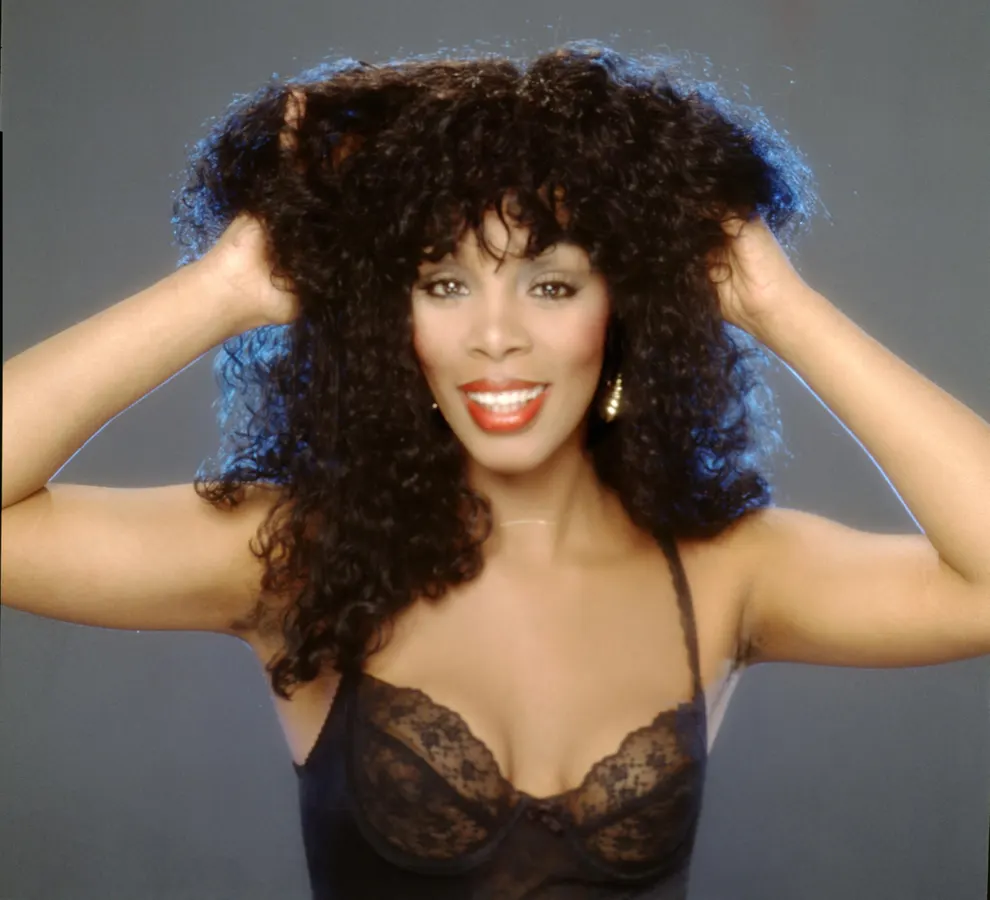

LOS ANGELES – 1979: Singer Donna Summer poses for a portrait in 1979 in Los Angeles, California. (Photo by Harry Langdon/Getty Images)
Getty Images
A good indicator of a musician’s popularity is how much music they released during a certain period in their careers. In Donna Summer’s case, her output for Casablanca Records between 1975 and 1979 is Beatles-level astounding: six studio albums (two of which were two-record sets) and one live double LP. It speaks to how prolific the late Summer was during her reign as the Queen of Disco. Like the Bee Gees in that same era, Summer’s music dominated radio and the clubs with a string of smash hits such as “Love to Love You Baby,” “Last Dance,” ‘MacArthur Park,” “Heaven Knows,” “Hot Stuff,” “Bad Girls” and “Dim All the Lights.”
Summer’s hugely successful tenure with Casablanca Records is now being celebrated with the release of The Casablanca Studio Albums Collector’s Edition, a 7-CD or 10-multicolored LP box containing the albums Love to Love You Baby (1975); A Love Trilogy (1976); Four Seasons of Love (1976); I Remember Yesterday (1977); Once Upon a Time (1977); Live and More (1978); and Bad Girls (1979).
“They didn’t take long,” the British songwriter and producer Pete Bellotte, who collaborated with electronic disco mastermind Giorgio Moroder and Summer during the Casablanca years, says today about the staggering amount of music they made. “They were all done very, very quickly, and there was never a song left over. We only ever went in for the amount of songs we were recording it for.”
Packshot of ‘Donna Summer: The Casablanca Studio Albums Collector’s Edition Box Set.’
credit: Demon Music
“She approached her songs—and especially these albums, which were very based around concepts—as characters,” the writer Christian John Wikane, who contributed an essay to this new collection, says. “Once Upon a Time is a great example of that because that is a complete four-act story, like the first disco opera, if you want to call it that.
“You can hear it in her voice,” Wikane continues. “You hear that fragility and the vulnerability, especially on side one and side two. “Like “Working the Midnight Shift,” you can hear the loneliness, and then the elation with ”I Love You” and “Happily Ever After” on side four. That’s unique for that time to have a singer that really can tell a story outside of a Broadway theater context or a more standard theatrical context.”
Summer was working in Germany as a backing singer when she met Bellotte and Moroder in the early 1970s. Her breakthrough hit was the sultry and controversial “Love to Love You Baby.” “The reason it turned out like it did,” Bellotte recalls, “was she went in when the backing track was ready, and she started messing around and doing the moaning and groaning because “Je t’aime moi non plus” had been around that song by [Serge] Gainsbourg.”
The single version of “Love to Love You Baby” was first released in the U.K. but didn’t gain much traction. But when Neil Bogart, the founder of American label Casablanca Records, first heard the song, he wanted to extend the length of the track; it would later appear on the 1975 album of the same name.
“He was having a party at his house,” Bellotte says of Bogart. “He phoned us on a Friday night. He said, ‘We’re playing your song all the time. And I’ve got a guy here sitting at the record player, and all he does is lift the needle and put the needle back on. That has given me the idea for doing the whole side of the album, like “In-a-Gadda-Da-Vida” by Iron Butterfly. And we need it quickly. Get on with it.’”
“It wasn’t the first song to take up the full side of an album,” adds Wikane. “However, I do feel like as sort of a song that had basically its first life was a three-minute pop single for it to kind of then just really be expanded into this sensual orchestral masterpiece.”
1977’s I Remember Yesterday, a concept album that paid homage to different musical styles from the past, contained the futuristic and pioneering disco song “I Feel Love.” Not only did it become another hit for Summer, but it also influenced a generation of British electronic pop acts.
“She came in [the studio in Munich], and she sang it in head voice, the first take,” Bellotte recalls. “We hadn’t written it for her head. But the moment she sang it in head voice, it was beautiful because it was so far away and up below what we called the ‘machine.’ She was raining this kind of confetti of music in triplets down onto this machine. And it was just it was the heart above and the machine below. It was just such a juxtaposition that we hadn’t intended. So it was a really spooky song, how it all came together.”
“Groups like Kraftwerk were exploring very much around the same time with synthesized music, but they weren’t really doing it for a pop market the way that Donna was,” Wikane says. ““I Feel Love” just kind of was able to take it into a pop form and bring listeners to a whole other dimension, both on the radio and in the clubs…”I Feel Love” definitely deserves its place on the mantle in terms of groundbreaking records.”
The majority of Summer’s 2-LP Live and More consisted of stage performances of her hits, but it featured a new studio track, “MacArthur Park” (part of the “MacArthur Park Suite”). Written by Jimmy Webb and previously recorded by the actor Richard Harris, the song became Summer’s first Billboard Number One. It was Bellotte’s suggestion to cover the song.
“At the very beginning, I wanted to say “MacArthur Park” because it’s my favourite song from Richard Harris and my favourite song altogether,” Bellotte says. “But every time I’ve spoken about it, people have laughed at me: ‘It’s a really cheesy, crummy song.’ So I said, ‘Okay. Here we go. I’m going to say this, and you’re all going to laugh: “MacArthur Park.”‘ And they kind of looked strangely.
“But Bogart, who is such a music man, his head started nodding. He said, ‘Okay, get that record’ So they brought the record in. It started off slow, and it built up. And everyone knew immediately this was the song. Greg Matheson, the arranger, didn’t go to bed that night. He wrote the whole score. It was pages and pages and pages, as you can imagine.”
“I feel like that was a great record to sort of show that she’s more than “Love to Love You Baby” and “I Feel Love,” Wikane says. “She has so much in her voice that a lot of people hadn’t even really appreciated, even though “”Last Dance” had been released before that.” But I feel like “MacArthur Park” just showcased it in a way that Donna is — forget a pop singer — a singer that can stand with any sort of gospel or opera singer in terms of just how technically perfect she was as a vocalist as well.”
Released in 1979, Bad Girls, which became Summer’s last album for Casablanca, was another smash for the singer, peaking at number one on the chart. As heard on the hits “Hot Stuff” and the title song, Bad Girls showed Summer incorporating rock music into her disco sound.
“That’s Pete Bellotte, [drummer] Keith Forsey and [keyboardist] Harold Faltermeyer collaborating,” says Wikane. “They all were sort of rock-oriented guys. I think Giorgio was a little more unsure if that would work. And it certainly did. I think it’s part of her career, especially this period that we’re talking about, that’s fascinating how you have “Love to Love You Baby,” and you have “MacArthur Park” and “Hot Stuff.” And it’s like a totally different singer on each of those songs — yet they’re all Donna Summer. There’s an edge in her voice on “Hot Stuff” that you don’t hear on a lot of other records that she recorded during the ’70s.”
Bellotte remembers his joy on having the Doobie Brothers’ Jeff “Skunk” Baxter add some blistering rock guitar to “Hot Stuff.” “Skunk came in, and he was all in the tight blue jeans and the hair down here and the mustache. He was fantastic. So I said, ‘Okay. Do you want to hear it?’ He said, ‘Yeah, just play it through once.’ So he heard it. That solo is the first solo you played and the only thing he played. It was just perfect for the song.”
Summer was also coming into her own as a songwriter on the Bad Girls album, particularly on the sublime and exuberant “Dim All the Lights.” “I feel like Bad Girls really does show her strength as a songwriter,” says Wikane. “She was always part of the songwriting process on the other albums, but there’s just something about Bad Girls where I feel like she’s coming into her own. And you even hear it just as a vocalist as well, being able to kind of get into the character of what the song is about. “My Baby Understands,” I think, is another great example of her as a rock singer, a song that she wrote. So she had that in her, for sure.”
Bad Girls marked the end of an era for Summer when she jumped ship to the newly formed Geffen Records for 1980’s The Wanderer album. The music from the box shows the special creative chemistry among Summer, Moroder and Bellotte during that magical four-year run at Casablanca. “The whole thing was we were the happiest team that you can imagine,” Bellotte fondly recalls. “There was never, ever, any friction in any way whatsoever. We were all such great friends, and with all the musicians as well. So it was a really wonderful period.”
Wikane says the albums as a whole offer a more well-rounded overview of Summer’s music during her Casablanca tenure than any single or double-disc compilation, especially the way the tracks were sequenced for a seamless listening experience.
1978: ‘Queen of Disco’ Donna Summer performs onstage in 1978. (Photo by Michael Ochs Archives/Getty Images)
Getty Images
“There isn’t really a rest from song to song,” he says. “It kind of segues right into the next track, like on Once Upon a Time and Bad Girls as well. That’s genius to take a song, and you don’t know when you’re writing it that it’s going to end up having the same beat as this other song and that it’s going to work together. Like “Bad Girls” and “Hot Stuff” were not written at the same time. They weren’t conceived as the same song, yet they work really well together one after the other. And that’s a constant throughout her albums, like “Spring Affair” going into “Summer Fever” on Four Seasons of Love.
“Just the way that was conceived, it’s easy to take it for granted because it works so well,” he continues. “It’s easy to just lose sight of that when a lot of these tracks now exist just sort of out there in the ether on their own. But this is how they were originally presented to the public through these albums. And in the context of the albums, that’s my favorite way to listen to them.”













Leave a comment