


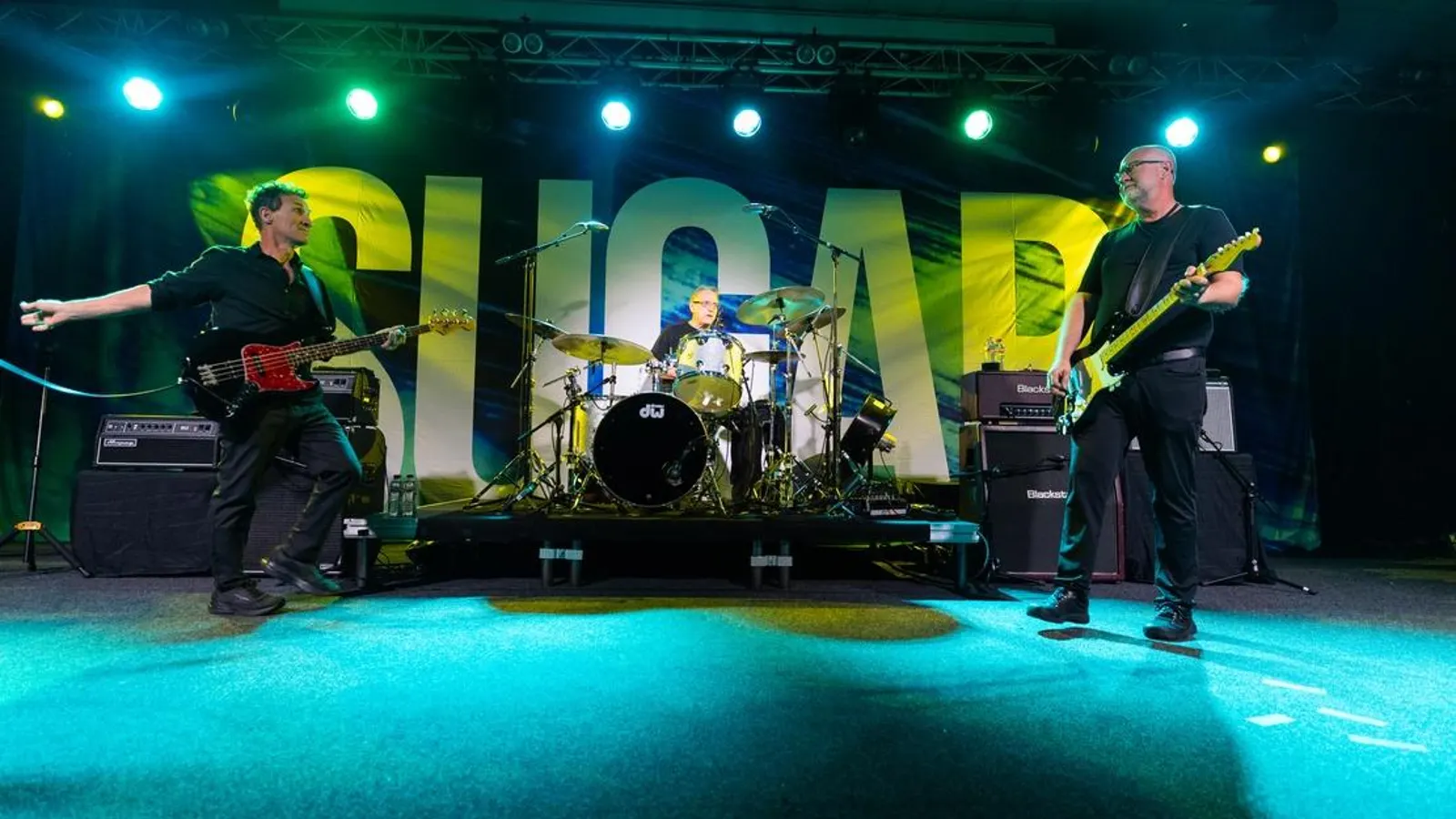

DUBLIN, IRELAND – MAY 27: (L-R) David Barbe, Malcolm Travis and Bob Mould of Sugar perform at National Stadium, Dublin on May 27, 2026 in Dublin, Ireland. (Photo by Kieran Frost/Redferns)
Redferns
Following a trio of sold out shows last week at First Avenue in Minneapolis, Bob Mould continues a rare look back as the reunited SUGAR enters the final leg of a surprising reunion tour, one which resumes this Thursday, September 17 at Metro in Chicago ahead of a Saturday afternoon performance on stage at Riot Fest.
While the group’s initial run from 1992 to ‘95 was quick, for Mould, SUGAR nevertheless stands as a commercial highpoint, especially in the U.K., where the group’s two studio albums and EP all charted in the top 10. In America, word of mouth spread so strongly following the group’s 1992 debut Copper Blue that the 1995 follow-up File Under: Easy Listening nearly cracked the top 40 of the Billboard 200 album chart.
That success was the byproduct of a perfect storm which would find punk and alternative sounds crossing over to the mainstream in America, guiding musical tastes thanks to the success of albums like Nirvana’s Nevermind the year before, with SUGAR selling out venues in America, like Chicago’s Metro in July 0f 1992 almost two months before their debut album had even been released.
But even during a reunion, Mould refuses to seize solely upon nostalgia, teaming up with original rhythm section David Barbe (bass) and Malcolm Travis (drums) on a trio of terrific new songs (“House of Dead Memories,” “Long Live Love” and “Keep Looping”) and a 21 minute mini-documentary (the new Changes: The Story of SUGAR) streaming free on YouTube.
I spoke with Bob Mould about capturing the zeitgeist in 1992, his work within rock trios and a SUGAR reunion set to take the group across America into late October. A transcript of our phone conversation, lightly edited for length and clarity follows below.
Jim Ryan: How would you sum up the sort of perfect storm that was everything happening musically in 1991 that made Copper Blue the right album at the right time for you a year later?
Bob Mould: Oh gosh. You know, the year 1991 was pretty important for me. I had just come out of a deal with Virgin Records. Did a couple of records with them – great records – and they did what they could. But it was time to move on. Spent the whole year doing solo acoustic and electric touring, writing songs, trying out new songs. It was, I guess, the well-documented summer – Dave Markey’s movie The Year Punk Broke – with Nirvana, of course, being sort of the band that skyrocketed (amongst many bands). But it felt like the musical landscape changed that year.
I had been writing a lot of stuff, got David and Malcolm together and we started rehearsing in early ‘92. We made a couple of records in the spring of ‘92. And it was sort of weird, you know? After most of the 80s with Hüsker Dü, and a couple of solo records, to either be ahead of the mainstream tastes, or a little askew from the mainstream taste, to have something like SUGAR, especially in the U.K., land so serendipitously, I suppose, was pretty great. And this year, decades later to be coming out with three new songs with the original band, going back to the U.K. and sort of celebrating the history of the band and the current state of the band and, now, getting pretty deep into America? It’s been really great.
I sort of recognized what those records meant to people – what those songs meant. I’ve never been a big on nostalgia kind of guy. I remember writing my autobiography. Three years of looking back on the first 50 years of my life was… not torturous (laughs) but it was like, “Wow. Did I have to look back at all of that?” But to look back at the three years that SUGAR existed in the first iteration, and to look at just the response of people at these shows, it’s been pretty great.
The one thing that’s super noticeable to me from the stage is, I don’t see people filming the shows or holding their phones up a lot. I see the phones come out for the new songs. (Laughing) But everything else? People are incredibly attentive and present. If there’s any nostalgia in it, that’s the nostalgia that I love: looking out and seeing very few phones pointed at me!
Ryan: Well, riffing off of that, you are always looking for ways to push this stuff forward. And, even during a reunion run, there are new songs, “Keep Looping” being the most recent. Did I detect a reference to doomscrolling there? What can you tell me about that one?
Mould: Oh yeah, all of that – doomscrolling, AI. I live in San Francisco and I’m watching the city I live in change yet again. There’s politics. And it’s this perfect storm of a lack of attention to civility – or law. People are ignoring a lot of things right now. They’re just sort of rolling their fingers across a piece of glass. I mean, I’m guilty of it. I try to be cognizant of it and mindful of it. But we’re in a new day and age. And I don’t think people are going to put these things down.
I just pray that critical thinking and honest, true journalism survives this next two years and three months of whatever the hell we’re doing right now.
Ryan: Fingers crossed. You’ve obviously done some terrific work within trios. And I’ve watched some videos of the reunion shows and there’s still something awfully unique about the magic the three of you conjure up on stage each night. What makes this particular trio so unique?
Mould: I think if I run through the different trios that I’ve been fortunate to be part of in the past… Hüsker Dü? We were all so young. And trying to find a sound. And, when we did, it was the sound of three fighter jets racing to be ahead of each other. And we did that for a long time.
Then I went onto work with Tony Maimone and the late Anton Fier on the two solo records Workbook and Black Sheets of Rain. And they’re a very different, locked in, water tight, air tight, immovable rhythm section. And that taught me a lot about pacing and a different kind of dynamics.
SUGAR, working with David and Malcolm, it’s a little bit more of just a constant motor. I think there’s an economy to the rhythm section that’s a little bit different than what I came out of with Anton and Tony or Hüsker Dü. It’s more of a four to the floor, stripped back beat with a lot of nice color.
If I go to Jon Wurster and Jason Narducy, we’ve played together for 15 years. But 15 years with the same rhythm section, and writing songs for the strong suits of that rhythm section, and the way the three of us play and the amount of improvisation that I think me, Jon and Jason are capable of, is different than SUGAR and different than Tony and Anton – and different than Hüsker Dü.
With SUGAR, I don’t know if mechanical is the word, but it’s a little more motoric. Malcolm really comes to the song straightforward and really holds everything in place. Which is super cool. It’s definitely a different vibe. I noticed it as soon as we started rehearsing in April for all of this work. Boy, within 15 minutes I was like, “Oops! OK! I’ve got to listen a little bit harder, be a little less freewheeling and think about the records we made and think about the way we recorded the songs.” It was a cool challenge. And I was glad that I personally recognized the differences right away. And, I think, for the band, I would say that maybe by the 10th show we had found the center of what SUGAR is and how we play together. I think we all came back with a little bit of rust and a little too much adrenaline here and there – just sort of attacking it instead of putting it all back together the way it used to sound. So, it’s been fun. And now everything feels pretty centered.
The work days are pretty regular now. I think everybody is used to when do we eat, when does anyone nap, how long do we need to get ready to go out and do the thing? The stuff people don’t see, you know?
(Left to right) Malcolm Travis, Bob Mould and David Barbe of the reunited SUGAR, who performs Saturday, September 19, 2026 as part of Riot Fest in Chicago, IL
Photo courtesy of Big Hassle
Ryan: Did you ever cross paths with Dolly Parton by chance?
Mould: I saw Dolly once in concert in Washington D.C. It was an incredible experience. What a loss all around for America. What a loss for the world – and the music world. What an amazing life. And what an amazing story – such an inspiring American story. It’s just unique. It’s sort of like, “What would Dolly do?” right? She was that kind of spirit. And just a role model for all of us at whatever level we choose to identify. So, a real terrible loss.
Ryan: We’ve spoken about art addressing the world previously. And you touched on it earlier in terms of “Keep Looping.” But never has that concept seemed more important to me than it is right now. And, finally, we’re seeing some songs. But, personally, I feel like I’m also still hearing words like “stick to music” pretty often. So, I feel compelled to ask you again, what’s the role of the artist when it comes to addressing times like these?
Mould: I think artists oftentimes can be prescient. I think artists have a different way of looking at history – whether it’s through decades or centuries or cultures. I think when people do the stick to the music thing, it’s like, well the art is a reflection of society. It can be a predictor for where society is going. And we’re supposed to bring messages to people.
With my audience, I’m very fortunate. I’ve got a lot of teachers, a lot of writers, a lot of artists – I’ve got a lot of creative people that work with other people, and understand community and politics, and try to do the right things. For people who maybe come casually to my work because the guitars are loud or something like that, it’s like, you know, all these songs have lyric sheets. And if you didn’t take the time to look at what the message was…
And I sort of bolster that message. Whether it’s being involved with The Trevor Project on this tour – we’re trying to raise money to help them out. If people don’t get my politics or where I come from socially by now, it’s like, “Well, there’s other bands over there. Don’t let me take your time!”







Leave a comment