


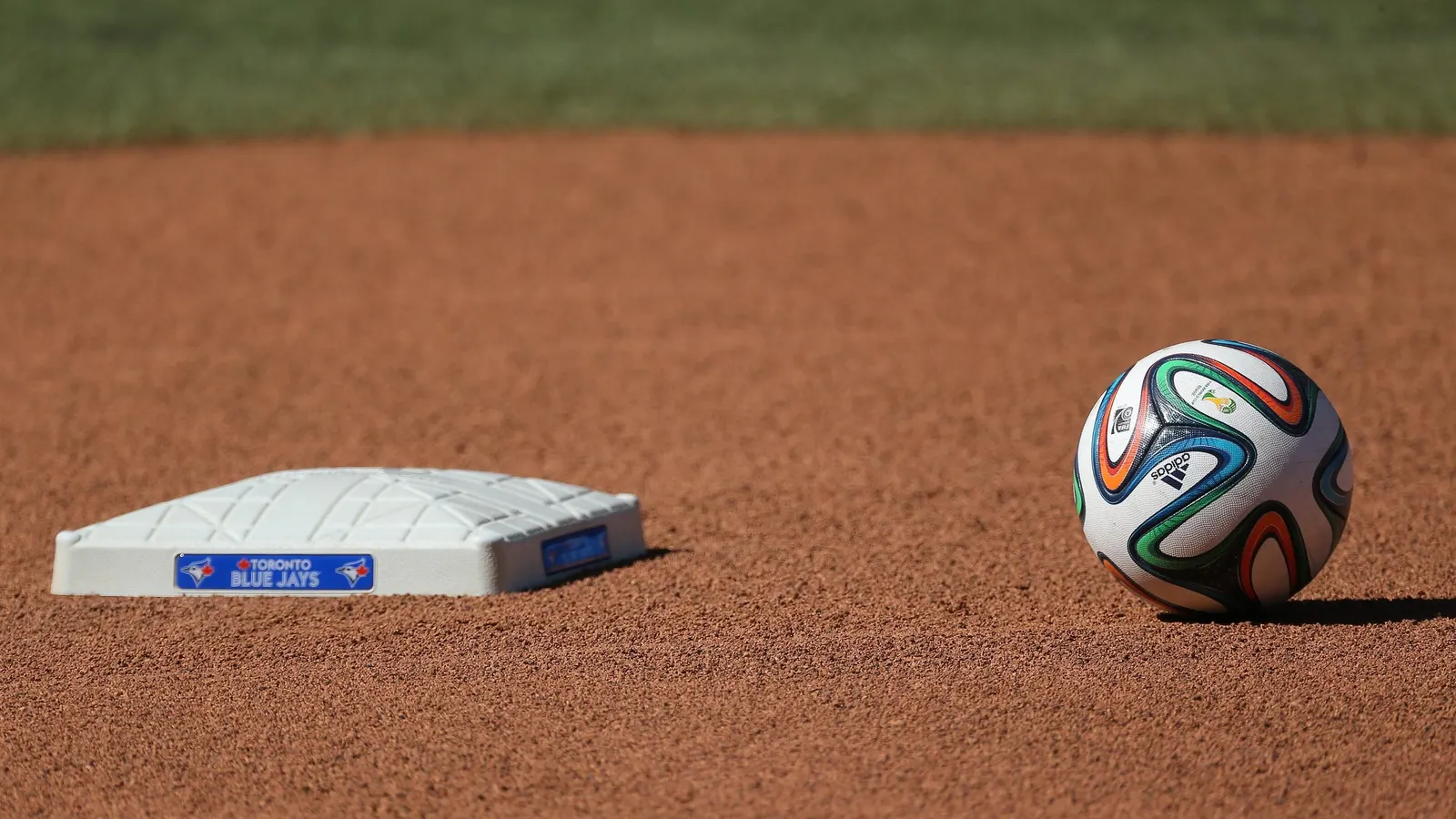

TORONTO: A soccer ball on the field near third base during batting practice before the Toronto Blue Jays’ MLB game against the Chicago White Sox on June 27, 2014 at Rogers Centre. (Photo by Tom Szczerbowski/Getty Images)
Getty Images
Baseball fans, pay attention to the 2026 World Cup if you want the inside scoop on who is going to win the World Series this fall.
Many will argue it is utterly impossible and simply ridiculous to consider. Just as many may look at numbers from these two seemingly unrelated and dissimilar events and say wait a minute, is that really true?
A coin flip will give you a 50-50 chance. A look at World Cup winners improves those odds – even if it is sheer coincidence. If history holds, should a team from South America lift the FIFA World Cup Trophy on July 19, bank on the American League champ this fall. If a European team triumphs, take the National League.
Looking at World Series results in years when the World Cup has been played since the first great soccer tournament was staged in 1930:
- When a South American team wins, the American League is 8-1.
- When a European team prevails, the National League is 8-4.
- The NL also is 2-0 when World Cups were cancelled in 1942 and 1946 due to World War II.
- South America is 1-0 when the World Series was cancelled in 1994 due to the players’ strike.
No team from the continents of Africa, Asia, Australia or North America has won soccer’s quadrennial festival.
The Early Years
The St. Louis Cardinals, New York Yankees, Uruguay and Italy were big winners early. So were the Allies in winning World War II that canceled two World Cups.
The AL went 2-0 in years Uruguay won and 1-2 when European soccer clubs won.
The biggest Yank win during this time was not by the Bronx Bombers, but by the USA men’s team. Their 1-0 win over England on June 29, 1950, in Brazil is considered the biggest upset in World Cup history.
The American team was a bunch of part-time players. Charlie (Gloves) Columbo got his nickname because he wore gloves even in the summer heat of Brazil. Goalie Frank Borghi drove a hearse. Other players included a mailman, machinist, dishwasher and an accounting student from Haiti who never became an American.
RIO DE JANEIRO, BRAZIL: The 1950 USA World Cup Team: (back row, l-r) manager Chubby Lyons, Joe Maca, Charlie Colombo, Frank Borghi, Harry Keough, Walter Bahr, coach Bill Jeffrey; (front row, l-r) Frank Wallace, Ed McIlvenny, Gino Pariani, Joe Gaetjens, John Souza, Ed Souza (Photo by EMPICS Sport/EMPICS via Getty Images)
PA Images via Getty Images
That 26-year-old Haitian, Joe Gaetjens, scored the winning goal, heading in a pass from Walter Bahr and shocking the sports world. Bahr became a legendary coach at Penn State. His sons Casey, Chris and Matt played in the North American Soccer League. Chris and Matt also were long-time place-kickers in the NFL.
1930 Uruguay over Argentina, 4-2, and Athletics over Cardinals, 4-2.
1934 Italy over Czechoslovakia, 2-1 (OT) and Cardinals over Tigers, 4-3,
1938 Italy over Hungary, 4-2, and Yankees over Cubs, 4-0.
1942 NONE due to World War II and Cardinals over Yankees, 4-1.
1946 NONE due to World War II and Cardinals over Red Sox, 4-3.
1950 Uruguay over Brazil, 2-1, and Yankees over Phillies, 4-0.
1954 West Germany over Hungary, 3-2, and Giants over Indians, 4-0.
Pele … And Yogi?
Known belovedly as Pele and Yogi, these two all-time greats and fan favorites were born as Edson Arantes do Nacimento and Lawrence Peter Berra.
RIO DE JANEIRO: Pele displays the FIFA World Cup during its presentation on Feb. 6, 2010. He and Brazil won the trophy in 1958, 1962 and 1970. AFP PHOTO/GABRIEL LOPES (Photo credit should read GABRIEL LOPES/AFP via Getty Images)
AFP via Getty Images
Both went back-to-back in winning it all in 1958 and 1962. The two juggernaut teams dominated with core groups. There were 14 players on both Brazilian champions; the Yanks had a Super 7 – Yogi, Mickey Mantle, Whitey Ford, Elston Howard, Bobby Richardson, Tony Kubek and Bill Skowron.
Between 1958 and 1990, the AL went 3-0 when Brazil also won, 1-1 when Argentina did and 1-1 when a team from Europe did. The NL was 2-2 when a European team prevailed – including the first matchup of 4-0 routs.
When West Germany whipped defending champ Argentina, 4-0, in 1990, the Cincinnati Reds surprised the Oakland Athletics in a four-game sweep that fall.
SAN FRANCISCO: New York Yankees catcher Yogi Berra tags out Jim Davenport of the San Francisco Giants in Game 2 of the World Series on Oct. 5, 1962, at Candlestick Park.
Bettmann Archive
1958 Brazil over Sweden, 5-2, and Yankees over Braves, 4-3.
1962 Brazil over Czechoslovakia, 3-2, Yankees over Giants, 4-3.
1966 England over West Germany, 4-2 (OT) and Orioles over Dodgers, 4-0.
1970 Brazil over Italy, 4-1, and Orioles over Reds
1974 West Germany over Netherlands, 2-1, and Athletics over Dodgers, 4-1.
1978 Argentina over Netherlands, 3-1 (OT) and Yankees over Dodgers, 4-2.
1982 Italy over West Germany, 3-1, and Cardinals over Brewers, 4-3.
1986 Argentina over West Germany, 3-2, and Mets over Red Sox, 4-3.
1990 West Germany over Argentina, 4-0, and Reds over Athletics, 4-0.
They Must Be Giants
The San Francisco Giants went 2-1 in the World Series between 2002 and 2014. The wins corresponded with European triumphs; the loss with a European setback.
1994 Brazil over Italy, 1-1 (3-2 PK) and NO World Series due to players’ strike.
1998 France over Brazil, 3-0, and Yankees over Padres, 4-0.
2002 Brazil over Germany, 2-0, and Angels over Giants, 4-3.
2006 Italy over France, 1-1 (5-3 PK) and Cardinals over Tigers, 4-1.
2010 Spain over Netherlands, 1-0 (OT) and Giants over Rangers, 4-1.
2014 Germany over Argentina, 1-0 (OT) and Giants over Royals, 4-3.
2018 France over Croatia, 4-2, and Red Sox over Dodgers, 4-1.
2022 Argentina over France, 3-3 (4-2 PK) and Astros over Phillies.
What In The World Cup?
It’s just fun to look at dynasties such as Brazil and the Yankees, consecutive winners like the Yanks, Giants, Baltimore Orioles (1966, 1970) and St. Louis Cardinals (1942, 1946). Would Orioles defensive whiz Brooks Robinson have been a great goalkeeper? How about speedy Brazilian legend Garrincha as a base-stealer?
BALTIMORE: Third baseman Brooks Robinson holds up the ball in his glove following a diving catch on a line drive hit by Cincinnati Reds catcher Johnny Bench in Game 3 of the World Series on Oct. 13, 1970 at Memorial Stadium
Bettmann Archive
There have been multiple losers, too. The Los Angeles Dodgers and The Netherlands are both 0-3, Czechoslovakia and Hungary each 0-2 in their respective championships since 1930. Simply coincidental.
There are various terms used to describe when two seemingly dissimilar events appear connected in such a way. The most prevalent is: hogwash.
Swiss psychiatrist Carl Jung called it synchronicity, or meaningful coincidences that defy rational explanation but feel significant.
Statisticians call it an illusory correlation, maintaining that proponents perceive a predictive relationship when actually non exists. They take it a step further and call it confirmation bias when someone chooses only to include numbers that favor their theory while ignoring those that do not.
If fully believing that the two events truly predict one another changes your behavior to make it come true, it is called a self-fulfilling prophecy.
Examples involving political elections, the stock market and various other events other than sports are seen daily.
Perhaps fans of the defending champion Dodgers should be pulling for a European side to prevail and “help” the NL this year. AL contenders may do well to cheer for an Argentina repeat as World Cup champion “predictors” of the 2026 World Series.













Leave a comment