


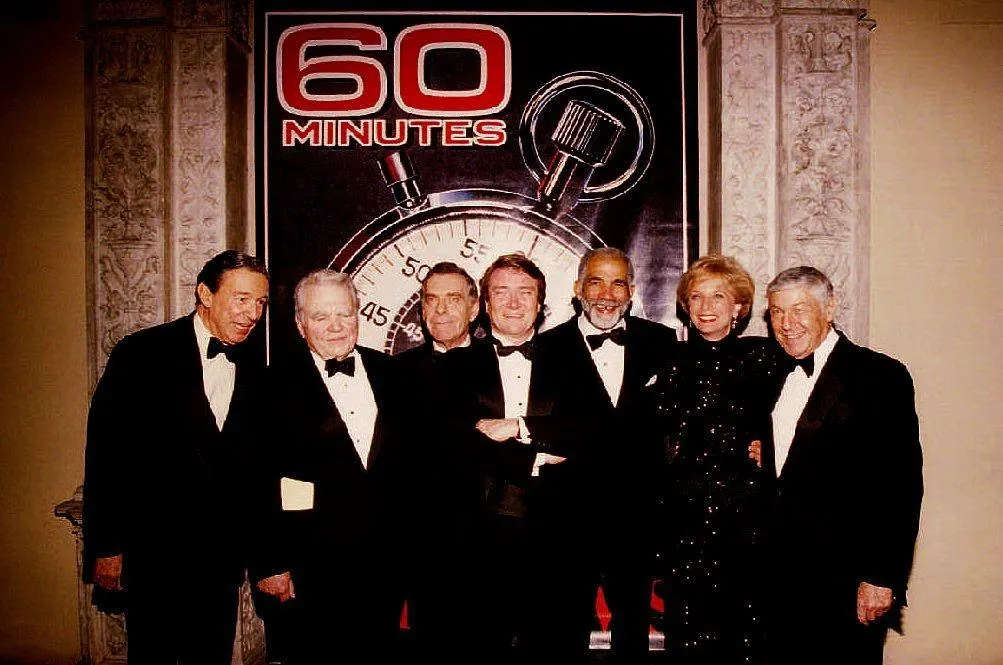

NEW YORK, NY – NOVEMBER 10: Members of television’s “60 Minutes” news program gather at the Metropolitan Museum of Art in New York, NY, 10 November 1993 to celebrate the 25th anniversary of the popular show. From left are: Mike Wallace, Andy Rooney, Morley Safer, Steve Kroft, Ed Bradley, Leslie Stahl, and Executive Producer Don Hewitt. (Photo credit should read BOB STRONG/AFP via Getty Images)
AFP via Getty Images
The word “trust” has been prominently featured in recent CBS News advertising and promotional campaigns and continues as the network moves forward under the leadership of Editor-in-Chief Bari Weiss.
According to Nielsen data, CBS Evening News averages about 4 million viewers nightly, while 60 Minutes reaches an average audience of 9.1 million viewers per episode. Across digital channels, the reach is far greater. In May 2026, Paramount Press Express reported that “60 Minutes reached more than one in three Americans at least once this season” and “nearly 20 billion minutes of 60 Minutes have been consumed this season across linear and streaming.”
In the current environment for news and information, the larger question for the leadership of CBS News is: How do you maintain both your colleagues’ trust and credibility inside the organization as well as a large, unique, global audience across all these developing platforms?
When Weiss came to lead a television news organization of approximately 1,000 employees, she’d never worked in one before, having led The Free Press. I would hope, if you’re in Weiss’ position, you’ve done as much homework as you possibly can–you’ve watched all the programming you need to see, broken it down, and maybe even spent some time at the Paley Center (William Paley, founder of CBS) in New York where the Museum of Broadcasting is located. None of this, of course, is why you were hired or even would want the job.
Many inside and outside the organization who also follow the news business had concerns. That said, Weiss came to make big changes and set up the newsroom for generational change. There were budget cuts, no doubt. Those cuts were hard and necessary, but rational and transparent while being deeply disruptive.
Nevertheless, CBS News is now struggling and uncompetitive, hurting an organization that has built its respect over the last 75 years. There is an enormous opportunity for innovation, however, and new ideas for creative programming that will create a culture for game-changing efforts across the company.
Internally, as has been widely reported, Bari Weiss is seen by many as not the right person for the job. She has destabilized 60 Minutes, the most popular, most honored, financially successful single weekly news hour in the history of television. It is believed internally that the organization’s independence has been dramatically compromised because she is also perceived as an opinion journalist with political ties to the current administration, which further undermines her credibility.
Looking back for a moment, it’s useful for one to understand how deeply the CBS News culture values its credibility. In 1971, Life Magazine did a cover story on Walter Cronkite, the legendary CBS News managing editor and anchorman. The reporter, Paul O’Neil, wrote, “In a period of deception and social insecurity, many Americans no longer read newspapers. Cronkite’s professional reputation was based on his rigorous objectivity and a refusal to inflict his own opinions on the viewing public. This was a time when President Nixon’s justice department tried to force reporters in 1970 to reveal their sources. Cronkite resolved to go to prison if subpoenaed rather than comply.”
Cronkite was the most trusted man in America with 27-to-29 million viewers nightly—number one for 14 years in a row. The CBS evening news today has about 4 million viewers and is in third place behind ABC News and NBC News. While we’re in a much different media ecosystem in the 21st century, this past year has been rough to say the least for CBS News. It need to have the audience’s trust, but with leadership in journalism, management must also build trust within the organization, which is crucial to success.
My advice: focus on what’s not working. Don’t mess with success anymore. Take a breath. Spend more time talking and listening–mostly listening–to people. Allow them to share with you their new and old ideas that may not have worked. Institutional memory is valuable.
And then you see where the game-changer ideas come from: inside, not outside.
Just listening to people–having that conversation with your colleagues, especially in areas you know so well, you’ll find you’re not the smartest person in the room anymore. And you only need one or two good ideas to bring credibility back to the work you are doing with your colleagues.
Lastly, keep in mind the ingenious words of Thomas Edison that vision without execution is hallucination.
Trust takes time. In the case of CBS News, with leadership today, it may be that an opinion journalist is not the right person to be the Editor-in-Chief.















Leave a comment