


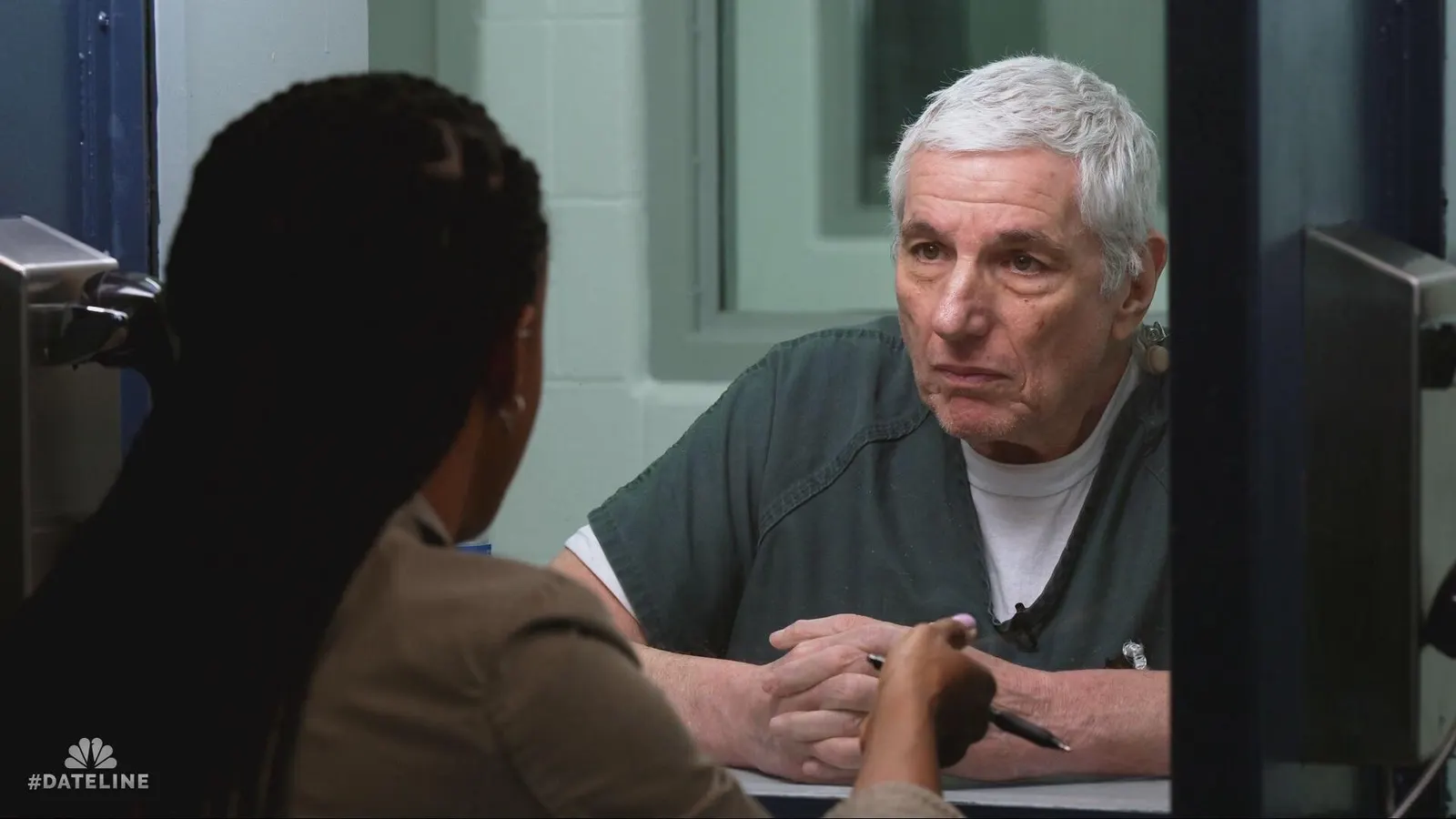

‘Dateline’ correspondent Blayne Alexander during a jailhouse interview with Fred Tanzer
Liam Dahlborn (NBCUniversal)
Dateline correspondent Blayne Alexander doesn’t usually get to know the crime victims in the stories she reports for NBC’s iconic news magazine–usually, as murder victims, they’re dead.
“This is my first time since joining Dateline that I have been able to sit down face to face with a direct victim, and it was a it was an experience that I will never forget,” Alexander told me. “I think that’s the best way to say it because Dana Beatty is an incredible person.”
Sexual assault survivor Dana Beatty told her story to ‘Dateline’ correspondent Blayne Alexander
Liam Dahlborn (NBCUniversal)
Beatty was the victim of a brutal sexual assault more than 30 years ago, a cold case that was re-opened after Beatty’s daughter–a fan of true crime podcasts–made a connection between her mother’s case and an attack on another woman.
“Dana sat for hours on end and walked me through–in excruciating detail–every step of what happened to her. She remembers it. She remembers every second. She remembers what happened. She remembers how she was feeling from moment to moment,” Alexander said, describing the emotional interview set to air on NBC Friday night, in a Dateline investigation dubbed ‘Unmasking the Monster.’ “She remembers all of these details, and she laid them all out to me over the course of hours during our interview.”
Retired Cincinnati Police Detective Charlie Beaver told ‘Dateline’ about the frustrations and dead ends he ran into trying to identify a suspect in the case.
Liam Dahlborn (NBCUniversal)
While DNA had been collected during the original police investigation in the 1990’s, the technology was in its early days, and it didn’t lead to an arrest–at least, not then. Detectives–including now retired Cincinnati Police detective Charlie Beaver–told Alexander about the repeated dead ends they followed trying to identify a suspect in Beatty’s assault.
It wasn’t until decades later that new detectives were able to use modern investigative techniques, taking the original DNA sample and linking it to a suspect.
“The investigator I spoke with said the things that they’re able to do now with DNA evidence would have been complete science fiction to the detectives who were working back in 1989, 1990,” Alexander told me. “So, to their credit, they were doing the best they could with what they have. But now, 30 plus years on, there are many more ways to solve these crimes.”
“As we do these stories in Dateline, we see all the time where forensic genetic genealogy is able to solve cold case murders,” she added. “Murderers are brought to justice decades later. That same technology can be applied to these violent sexual assaults. And so, kind of the question that kept coming up in this reporting is why have the laws not kept up with the fact that these cases are now able to be solved?”
It was a desire to bring about change that convinced Beatty to talk to Dateline. Not just about using DNA on cold cases like hers, but also to address another issue: statute of limitation laws in many states that limit the time prosecutors have to bring suspects in rape cases to justice. For Beatty, even though a suspect, Fred Tanzer, was connected to her assault, time ran out and he couldn’t be charged with the rape.
“That was Dana’s reason for doing this. It obviously wasn’t an easy interview to do. This wasn’t an easy process for her to sit down, recount all of it, and give us access to this entire period in her life. But she did it for two reasons. One, because she really wants to talk about these statute limitations laws,” Alexander said. “She wants them to go away across the country. That’s her, you know, her focus. And two, because she is hoping that if there are any other victims of Fred Tanzer out there, that they will be inspired to come forward after hearing her tell her story.”
‘I learned to be unafraid in asking questions’: Blayne Alexander talks about her first job in TV news–watch the full interview with Mark Joyella
The production team worked to convey the assault’s horror without making the account unnecessarily graphic. Alexander said they tried different versions of the narration, leaving some details to viewers’ imagination while keeping the focus on Beatty’s experience.
“We’d heard Dana tell the full story, so we knew everything,” Alexander said, describing the meetings she and the Dateline team had with Beatty before sitting down for the televised interview. “A large percentage of what she told us, we could not put on TV because it was very graphic and very detailed. No way we could put it on TV.”
For Alexander, the challenge was giving viewers enough information to understand the true nature of the horrific attack, without going too far. “I will say we tried it several different times in terms of writing that. I tracked it several different ways to kind of see what felt right and what sounded right.”
Alexander’s Dateline report “Unmasking a Monster” airs Friday night on NBC.












Leave a comment