



Dave Clark cofounder of Promise. Photo Credit: Jeff Lorch
Courtesy of Promise
Dave Clark was four, maybe five, when his father came home to Rhein-Main Air Base in Frankfurt carrying Predator. They watched it on a small tube television atop a huge wooden trunk, beside crystals his mother had collected across Europe.
What transfixed Clark was a creature that could cloak itself and vanish. He did not understand special effects; it was magic, proof that someone had the job of building worlds that did not exist.
Decades later, the film business had slowed during Covid-19 and Clark was in California doing the arithmetic.
“At this point, I have three children, a wife, a mortgage and a dog,” Clark says.
Then a friend told him to look at the image tools.
AI gave Clark a way to show people the films in his head before somebody financed them. Promise, where he is cofounder and chief creative officer, is attempting something harder: turning those images into entertainment studios can own, insure, edit and release.
Whether any AI company can do that repeatedly, and account for where each frame came from, remains unproven.
The Making Of A Director
Clark was born in 1984 in Charleston, South Carolina, spent his infancy at Osan Air Base in South Korea and grew up at Rhein-Main, where his father served as a master sergeant. The family later settled in Newport News, Virginia.
Clark is Black, Korean and Native American. That inheritance shaped his relationship to stories Hollywood tended not to tell; Southern history became a recurring subject, less period setting than unfinished business.
A year after 9/11, while considering enlistment, Clark was steered toward art school by a teacher, Brian Kershasky. A grant took him to Pratt Institute. After graduating in 2006, he entered advertising to pay down student debt and rose from art director to commercial director, working on campaigns for Pepsi, Intel and Coca-Cola.
“You have great ideas in your head,” Clark says, “but how do you communicate that to a team of 100 people?”
Clark moved west in 2013, signed with UTA and developed projects, including with Brad Fuller at Platinum Dunes. What he still lacked was a way to show the movie in his head before someone else gave him permission to make it.
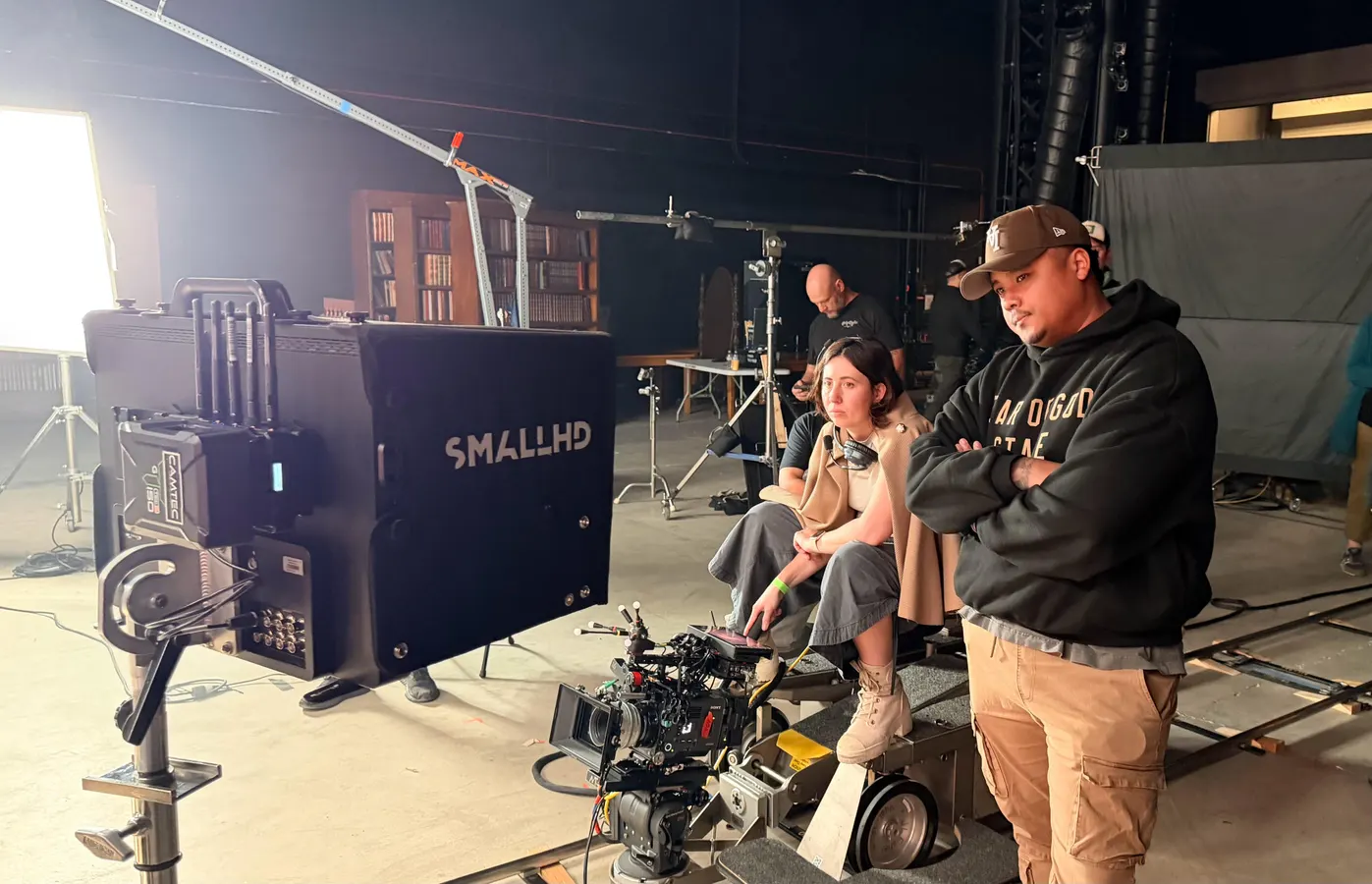
Dave Clark directing on set at Promise’s studio
Courtesy of Promise
The Catalyst
The friend was Chris White, an executive producer of A24’s Backrooms, who suggested image-generation tools for pitch materials. A speculative Adidas commercial Clark posted to Reddit in late 2023 caught the attention of Fullscreen founder George Strompolos.
“For me, it was the first time you could really see the potential of this technology as a viable production tool,” Strompolos said in a statement. “I slid into Dave’s DMs and we clicked immediately.”
Clark’s films kept escalating. Another, a hybrid of live action and generative AI, premiered during his Cannes Next keynote in May 2024. That September came Battalion, a World War II short about the 320th Barrage Balloon Battalion, the Black unit at Normandy he first heard about from his father.
The angriest responses, Clark says, came from commenters insisting Black soldiers had not been at Normandy.
Hollywood noticed. Ridley Scott’s son Luke contacted Clark and showed his father the work. Clark later met Scott twice, once with his Promise cofounders.
Clark had learned to make images. Promise would try to make them admissible.
The Production Test
Promise’s argument is not simply that generative AI can produce shots faster or cheaper. It is that studios need a clear route between generated material and finished entertainment.
In an industry built on ownership, guild rules and chain of title, a convincing image is not enough. The frame must be explainable.
The clearest test is Hardcore 94, a four-part adult animated series whose pilot is in production. Based on Clark’s original idea, written by Ivan Rome and co-directed by Clark and AI artist MetaPuppet, it follows an alien invasion over Compton in 1994.
The difficulty is visible in its look: animated characters moving through photoreal environments. Off-the-shelf models struggle to preserve that combination.
Clark says a Promise artist trained a character-specific model on original hand-drawn artwork, then separated the characters and backgrounds into layers. For some shots, the team positions a camera and characters inside a 3D environment in Unreal Engine before feeding those positions back into the image tool.
“That’s something you just can’t do with off-the-shelf models,” Clark says.
Muse, Promise’s filmmaking software, records each version of prompts, settings and approvals. Its Copyright Guardian tool checks generated material for potential intellectual-property conflicts and marks what is cleared for use. At wrap, the company says it can produce a chain-of-title record documenting how the material was made.
Promise applied the process to Harlan Coben’s Final Twist, a true crime series airing on CBS and Paramount+. Using old crime-scene photographs, the company says it created 3D environments in about a day, then filmed Coben on a Los Angeles volume stage.
Its own slate includes Tuning In, a four-quadrant animated feature written by Robert Rugan and directed by Clark, now in pre-production. Promise says 17 projects include animation and hybrid live action, six of them in production.
Clark says filmmakers have traditionally ruled out high-quality animation because they “know how much Pixar films cost.” Generative production, he argues, shortens the distance between an idea and the point at which a director can judge it.
Promise employs 35 people and is backed by Andreessen Horowitz, Peter Chernin’s North Road and Google’s AI Futures Fund. It also runs Curious Refuge, an AI film school acquired in 2025 that says it has trained 12,000 students in 170 countries.
That is progress. It is not yet proof of a repeatable studio model.
From left: Jamie Byrne, George Strompolos and Dave Clark, cofounders of Promise. Photo Credit: Jeff Lorch
Courtesy of Promise
What Was Actually Hard
Clark spent close to 20 years learning how images are proposed, supervised, revised and approved. AI did not give him taste or production experience. It gave him a faster way to make his ideas visible.
What will people misunderstand about this first wave? Not prompts, Clark says. Almost anyone can generate an impressive 15-second test. The hard part is holding the same look across 20 minutes without the model drifting, then finishing at streaming quality.
“You can’t prompt your way to the ends,” Clark says.
Dave Clark with Joel Hynek (visual effects supervisor on the original 1988 film “Predator”) now VFX Supervisor at Promise
Courtesy of Promise
That is why Promise pairs AI-native artists with veterans including visual effects supervisor Joel Hynek, whose work helped create the cloaking effect in Predator.
The person who helped make the magic Clark watched in Frankfurt now works beside him on new visual-effects work.
“I’m not your typical American,” Clark says.
When almost anyone can generate an image, what counts is which images a filmmaker chooses, and whether a company can carry them through production intact.
The audience watching Hardcore 94 may never ask where each frame came from. The company financing, insuring and distributing it will.
Clark’s first problem was making the movie in his head visible. Promise will be judged on whether it can make those images accountable.










Leave a comment