


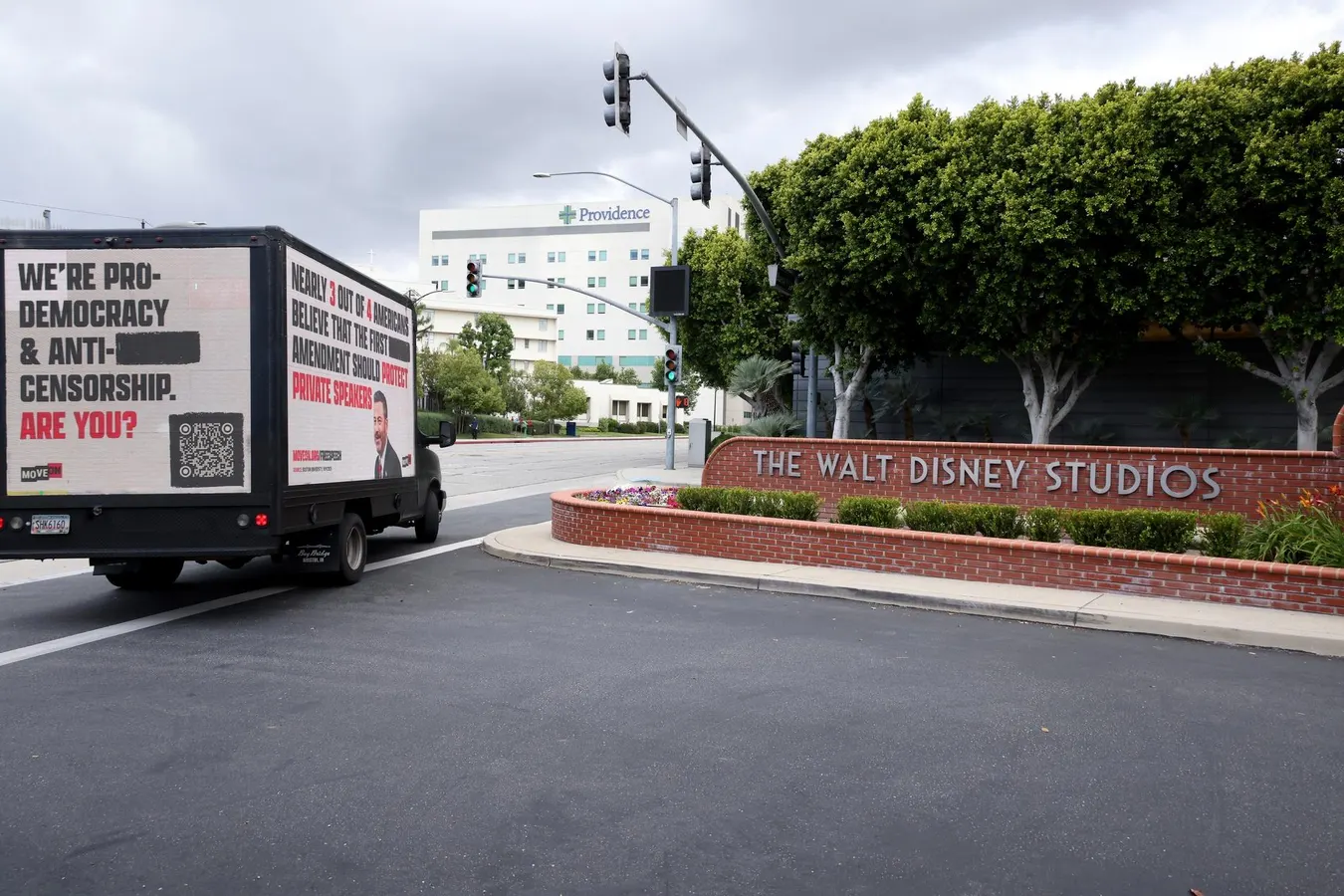

BURBANK, CALIFORNIA – MAY 04: A mobile billboard sponsored by MoveOn circles Disney headquarters with a message urging new Disney CEO Josh D’Amaro to protect free speech and stand firm against FCC censorship on May 04, 2026 in Burbank, California. (Photo by Anna Webber/Getty Images for MoveOn.org Civic Action )
Getty Images for MoveOn.org Civic Action
Disney’s ABC TV stations sued the Federal Communications Commission last week, pre-emptively looking to halt the Commission’s attack on ABC’s licenses to broadcast TV. Ironically for the Trump Administration – if there is any sense of irony left in Washington, DC – the present threats to revoke ABC’s licenses follow decades of mostly Republican-led efforts to diminish the federal government’s ability to do exactly what the FCC now seems to want.
The Disney/ABC action seems like an inevitable next step in a fraught regulatory environment for major media companies and especially their broadcast operations since the outset of the second Trump Administration. In its complaint, Disney claims that “the Administration has waged a retaliatory campaign against ABC for a single reason: it disapproves of what ABC broadcasts.” The specific FCC actions involve an accelerated timetable for reviewing ABC’s broadcast licenses, without which a broadcaster literally cannot broadcast.
Disney argues that the FCC’s decision to start these administrative proceedings is aimed at what is calls “the Commission’s true purpose: coercing and retaliating against a network that refuses to bow to the Administration’s demands.” No matter how one views the specific legal merits of this lawsuit and the extent or limitations of the FCC’s authority, it should go without saying that is no greater “nuclear” option in the government’s regulatory arsenal than to halting a broadcaster’s ability to broadcast.
Disney has staked its claim on the first amendment, and sees all of this as an effort to inhibit its ability to make editorial content decisions. Disney lays out in great detail a series of intimidation tactics from the Administration and the FCC, all related to the content of the news and entertainment programming finding disfavor with the Administration. This includes the notorious suspension of late-night host Jimmy Kimmel by Disney itself, seemingly in response to pressures exerted by the Administration.
Most pointedly, as the complaint lays out, President Trump, in direct response to ABC’s recent decision not to broadcast a Trump prime time address, stated: “NBC and ABC fake news have both said that they would not cover this speech . . . . [T]his should mean a revocation of their licenses.” It’s pretty hard to argue that anything other than the content of ABC’s speech is the focal point for the Administration.
The rare history of license revocations
The revocation of a broadcaster’s license is an extraordinary remedy, and the FCC has exercised it in extraordinarily rare circumstances. Among the handful of situations in which such revocation ever occurred were three cases that date back to the 1960s. An Alabama station WLBT-TV lost its broadcast license in the 1960s based on an extensive track record of racial discrimination. But the FCC actually sought to extend the broadcaster’s license in this case. It took an activist Supreme Court and a new process that permitted community involvement to overturn that decision and pave the way for the station’s license revocation.
The FCC spent over 20 years fighting RKO General over the revocation of that company’s 14 broadcast TV licenses. This began in 1965 and didn’t end until 1987. The record of the company’s corporate misconduct, inaccurate financial reports and, and lack of candor in dealing with FCC all contributed to this unusual result and it still took decades to get these licenses denied.
The FCC revoked the license of WHDH-TV in Boston in 1969 in a comparative renewal proceeding, turning its license over to a group of local business and community leaders. To underscore the true historical oddity here, the new owners reinvested in the station’s original content production creating such landmark programming as Good Morning in 1973 (the ABC network later usurped this title for its own morning show), Chronicle magazine (a local type of 60 Minutes), and Pop Goes the Fourth (coverage of the Boston Pops July 4th concerts). This was the first and last of such examples in broadcast licensing history.
The legal changes ending these types of proceedings
As rare as these proceedings were, the 1969 WHDH case likely helped fuel a series of regulatory decisions at the FCC to diminish the likelihood of broadcast license decisions even further. In 1970s the FCC attempted to create a “renewal expectancy” for broadcast license holders, which eventually became the law by 1982.
In 1981 as the Reagan era got underway the FCC extended the renewal term for broadcast TV licenses from three to five years. In 1987, the Reagan FCC abolished the Fairness Doctrine, a longstanding doctrine that required broadcasters to cover important and controversial public policy issues and to ensure that opposing views had the opportunity to be heard. That permitted the flood of highly partisan talk radio to flourish led by Rush Limbaugh among others.
The bipartisan Telecommunications Act of 1996 brought a host of deregulatory communications law into effect. The Act extended the renewal of broadcast TV licenses to eight years (the present term) and ended entirely the practice of “comparative renewal” proceedings, which was the lever in the WHDH case. Without such hearings that standard became whether the license holder performed well enough to deserve to keep their license at the same time that the expectations for what was “well enough” were systematically reduced.
Fair or not, these regulatory changes did bring an enhanced level of business stability to broadcast TV licensees and likely made the investment in long-term technologies such as the switch to HDTV a bit easier to absorb knowing the threat to your license was diminished. It’s a pretty traditional approach of conservative regulators, and one almost completely at odds with the behavior alleged by ABC in its lawsuit.
Where do we go from here?
Spoiler alert: ABC isn’t going to lose their broadcast TV licenses. But they did lose the first procedural dispute in this fight as they sought an expedited hearing schedule that the federal district court denied. There will be no quick resolution here. The quagmire that awaits in the courts and inside of the FCC, is, I suspect the very message meant to be sent. Win or lose on this one, the FCC is making it clear to those that it sees as ideological opponents that life isn’t going to get any easier.















Leave a comment