


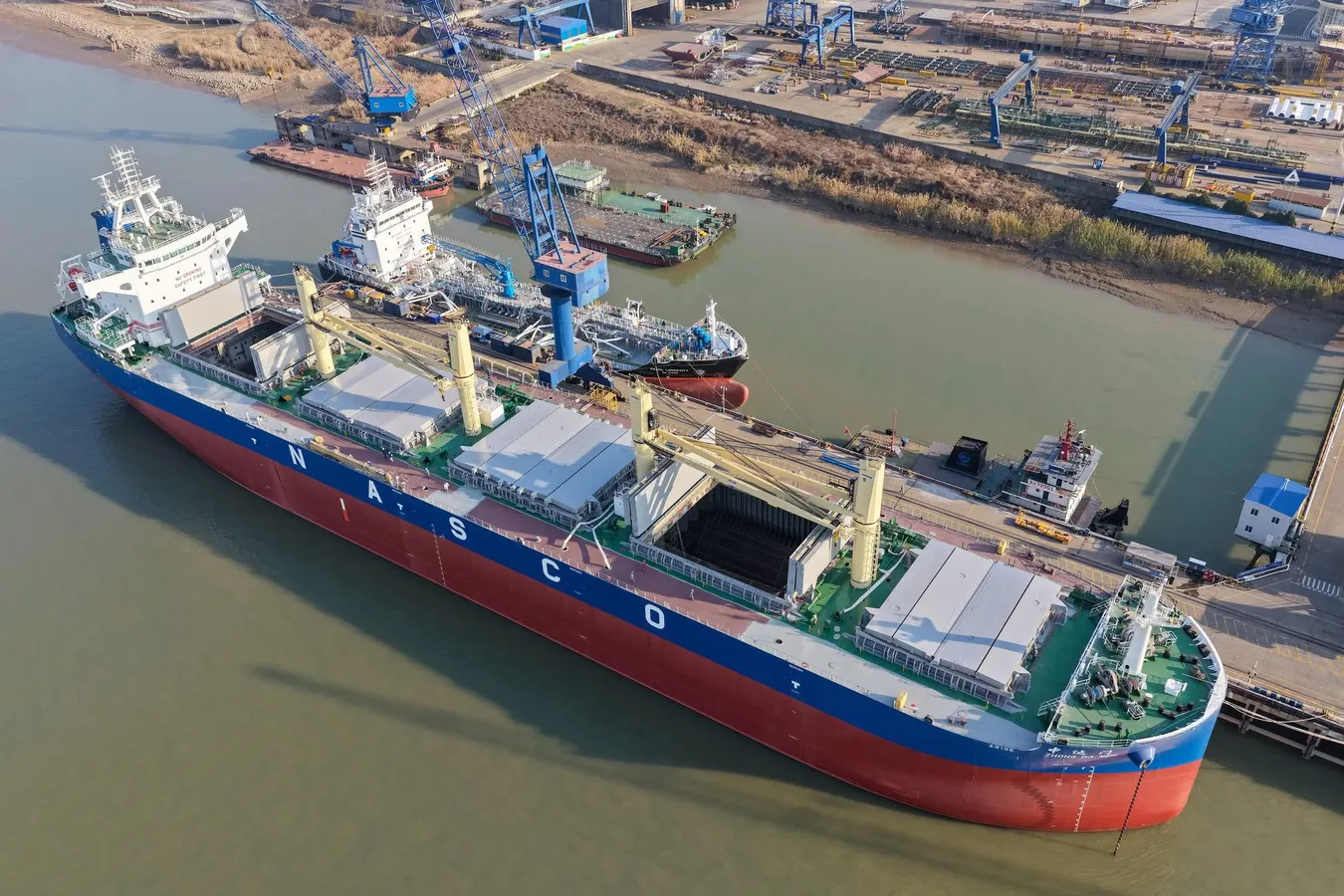

Workers build ships at the Jinling Shipyard of China Merchants Industrial in Nanjing, Jiangsu Province, China, on December 27, 2025. (Photo by Costfoto/NurPhoto via Getty Images)
NurPhoto via Getty Images
President Trump’s new National Security Presidential Memorandum recognizes a reality that has become impossible to ignore. The United States needs more ships, but its maritime industrial base cannot build and repair them at the required rate. Solving that problem requires more than additional orders. It requires new capacity, stronger competition, disciplined designs, and greater cooperation with allied shipbuilders.
The memorandum directs the Department of War to develop new acquisition approaches for surface combatants, replenishment tankers, and roll on, roll off vessels using what it calls the Finland Model. It also calls for a fifth public Navy shipyard, a centralized component repair center for the submarine fleet, and a review of Naval Sea Systems Command intended to reduce bureaucracy and establish greater accountability for vessel delivery. Together, these actions address the interconnected problems behind the shipbuilding crisis, including insufficient capacity, limited competition, unstable designs, constrained repair infrastructure, and a weakened supplier base.
The Cost Of Limited Shipbuilding Capacity
The Ford class aircraft carrier program demonstrates how long the United States now takes to produce its most important naval assets. Gerald R. Ford was procured in fiscal year 2008, commissioned in 2017 and did not reach initial operational capability until December 2021. John F. Kennedy was procured in 2013 and is not expected to be delivered until 2027. Enterprise was procured in 2018 and is scheduled for delivery in 2030. Each ship requires approximately 12 to 15 years to move from procurement to scheduled delivery.
The United States cannot rapidly expand or consistently sustain its carrier force when every new Ford class vessel takes more than a decade to deliver. As older Nimitz class carriers retire, delays in the Ford class program can create temporary fleet shortfalls, reduce deployment flexibility, and place additional pressure on the carriers that remain available.
The constraint extends beyond carriers. Private shipbuilders face major construction backlogs, while the Navy’s four public shipyards carry demanding maintenance workloads for nuclear powered submarines and carriers. The memorandum requires a plan that incorporates private sector capabilities and establishes a fifth public Navy yard. That facility should be located where it can expand national capacity without adding pressure to regions already managing much of the Navy’s workload.
The Gulf of America deserves serious consideration, particularly Alabama and Florida. Mobile, Alabama, has an established shipbuilding workforce, deepwater access, and a network of supporting manufacturers. Florida brings extensive naval infrastructure, commercial ports, ship repair operations, and access to both the Gulf and Atlantic. Locating additional capacity in this region could strengthen construction and maintenance, attract allied investment, expand the supporting supply chain, and create a more geographically distributed maritime industrial base.
Why The Finland Model Can Work
Building a new public yard will require years of planning, construction, and workforce development, while the Navy’s need for additional vessels is immediate. The memorandum addresses both timelines by adapting the Finland Model.
Under the naval version, a qualified foreign shipbuilder may construct the first two vessels of an approved class overseas, but only if it simultaneously builds a new American yard, assumes ownership of an existing yard, or takes a majority equity position in one. The company must also train American citizens, license applicable production methods, establish a domestic supply chain, and build all subsequent vessels in the United States.
The model is based on the United States and Finland’s agreement to acquire 11 Arctic Security Cutters. Four are being built in Finland, which has specialized icebreaker design and construction experience, while seven are planned for American yards using Finnish expertise. Building the first vessels at mature Finnish yards allows the Coast Guard to receive ships sooner. Transferring the production knowledge to American facilities then creates the capacity to build the remaining vessels domestically. The Navy’s version applies the same principle to as many as three ship classes, potentially including surface combatants, replenishment tankers, and roll on, roll off vessels.
This is the right kind of foreign direct investment. Producing the first ships at an established allied yard could reduce startup risk and deliver initial capacity sooner, while requiring the builder to invest in American yards, workers, and suppliers. This is not traditional outsourcing. It is a structured way to transfer proven capability into the United States while creating permanent American capacity.
Section 3(c) of the presidential memorandum is critical to making the approach work. It prohibits the Navy from imposing iterative changes on the mature parent designs used in Finland Model programs without senior approval. Foreign builders can transfer proven designs, production methods, and technical knowledge, but the speed and cost advantages will disappear if the Navy repeatedly alters those designs after construction planning begins. The model can improve naval shipbuilding only if the United States accepts mature designs, controls requirements, and allows yards to build vessels in repeatable production runs.
Turning Allied Investment Into American Production
South Korea should be a leading partner in this effort. Korean companies operate some of the world’s most productive shipyards and bring extensive experience in serial production, complex vessels, and advanced manufacturing. Korean companies are already building relationships in the United States, with HD Hyundai working with Huntington Ingalls Industries on naval and commercial ship construction and partnering with Edison Chouest Offshore and Tampa Ship on American production of LNG dual fuel containerships. Hanwha has also announced plans for billions of dollars in American shipyard infrastructure and production capacity.
The $150 billion Make American Shipbuilding Great Again initiative, known as MASGA, is the maritime component of a broader $350 billion investment agreement between South Korea and the United States. The remaining $200 billion is intended for other strategic American industries, including energy, semiconductors, pharmaceuticals, critical minerals and, artificial intelligence. MASGA provides a framework for directing Korean capital, financing and industrial expertise into American shipyards, equipment, workforce development, and suppliers. If paired with predictable American ship orders and clear domestic investment requirements, it could modernize American facilities, strengthen suppliers, train workers, and expand production capacity.
Funding alone will not increase output. Shipbuilding depends on mature engineering, available materials, skilled labor, functioning equipment, and reliable suppliers. Late designs, missing components, and quality problems disrupt production and create rework, which means foreign investment must strengthen Tier 2 and Tier 3 suppliers as well as the major shipyards. Block purchases and standardized designs can support that investment by providing predictable demand, improving workforce performance, and spreading infrastructure costs across more vessels.
Congress must complete the fiscal year 2027 defense appropriations process and provide the predictable funding needed to turn these plans into production. Success will not be measured by money committed or ships placed under contract. It will be measured by mission ready vessels delivered at the required speed, cost, and quality. Allied coproduction can deliver initial ships sooner while building the American yards, suppliers, and workforce needed to produce the rest here, giving the United States an opportunity to move beyond documenting the shipbuilding crisis and begin expanding the industrial capacity required to solve it.
















Leave a comment